Monasterio de Santa María de la Rábida: A Franciscan Monastery in Spain


Site at a Glance
- Rating
- 4.5
- Popularity
- Medium
- Country
- Spain
- Primary era
- Medieval
- External website
- Open
- Eras represented
- Medieval, Early Modern, Modern
- Civilizations
- Crown of Castile, Spanish
- Site type
- Religious
- Remains
- Fortified Monastery
On this page18 sections
History
Monasterio de Santa María de la Rábida is a Franciscan monastery in Palos de la Frontera, Spain, built in stages during the fourteenth and fifteenth centuries in a combination of Gothic and Mudéjar forms. It belongs to the Order of Friars Minor and remains a Catholic convent and parish. The monastery forms part of the Columbian Places, historically connected sites around Huelva associated with Christopher Columbus and the communities that supported his first voyage.
Earlier traditions and Franciscan foundation
The monastery occupies a coastal elevation overlooking the meeting of the Tinto and Odiel rivers and the Huelva estuary. The place was traditionally called Saturn’s Rock. An old codex associates the hill successively with a Phoenician altar to Baal or Melqart, a Roman cult of Proserpina, an Islamic ribat, the Knights Templar, and an early Franciscan foundation. A ribat was a religious and military establishment, often placed on a frontier or coast. These associations belong to local tradition rather than securely established history.
The Islamic ribat is traditionally regarded as the source of the name La Rábida, also rendered Rápita. Another tradition says that Saint Francis of Assisi visited the site with twelve disciples and founded a small Franciscan community. Francisco de Gonzaga placed the foundation in 1261, while the formal documentary foundation is a papal bull issued by Benedict XIII on 7 December 1412. The bull authorized Friar Juan Rodríguez and his companions to establish a religious community after they had occupied the Hermitage of Santa María de La Rábida since 1403.
Its position near the coast gave the community a defensive and refuge function against pirate attacks. Pope Eugene IV granted indulgences to people who helped needy travelers there, while nobles and local inhabitants contributed to the conventual buildings. Much of the construction took place in the early fifteenth century, and the principal buildings were completed in successive phases across the fourteenth and fifteenth centuries.
Columbus and the first voyage
Christopher Columbus first arrived at La Rábida in 1485 while seeking support for his proposed voyage. The Franciscans Juan Pérez and Antonio de Marchena offered spiritual and intellectual assistance and helped connect him with the Crown, local mariners, and Martín Alonso Pinzón. Pinzón, a wealthy shipowner and leading figure in Palos, provided financial support and helped recruit the expedition’s crew.
Before the first voyage to the Americas, Columbus and some of his crew prayed before the image of Santa María de La Rábida, known as the Virgin of the Miracles. The monastery later became associated with the evangelization of the Americas. Its religious life also influenced Franciscan and other figures from Palos and neighboring towns, including Juan de Palos and Juan Izquierdo.
Martín Alonso Pinzón returned gravely ill after the voyage and died about fifteen to twenty days later. In accordance with his wishes, he was buried in the monastery church at the feet of the Virgin of the Miracles, wearing a Franciscan habit as a shroud.
Visitors connected with the conquest of the Americas
Hernán Cortés stayed at the monastery in May 1528 after conquering New Spain for Spain. His companion Gonzalo de Sandoval arrived seriously ill, died shortly afterward in Palos, and was buried near the altar of the Virgin of the Miracles. Francisco Pizarro also came to the convent soon afterward, receiving spiritual assistance and meeting Cortés, his relative. Pizarro later became associated with the Spanish conquest of the Inca Empire.
Damage, abandonment, and restoration
During the Spanish War of Independence in the early nineteenth century, Napoleonic troops expelled the friars and devastated the monastery. The community later returned, was expelled again during the Liberal Triennium in 1820, and returned in 1823. The confiscation of church property in 1835 then led to abandonment and deterioration.
In 1851, Governor José María Escudero consulted the Ministry of Commerce, Instruction and Public Works about selling the remains and using the proceeds to build a monument to Columbus. Governor Mariano Alonso y Castillo opposed demolition, preventing the proposal from taking effect. Restoration followed in 1855 with support from the Duke and Duchess of Montpensier and the provincial authorities. Later works directed by the architect Ricardo Velázquez Bosco aimed to preserve the building’s original atmosphere and character. The monastery was declared a Spanish National Monument by royal order on 23 February 1856.
Modern religious and Columbian associations
The Franciscan order formally regained possession in 1920 after the monastery had been ceded to it in 1919. La Rábida retained strong institutional and cultural links with Ibero-American communities and was recognized at the 1999 Ibero-American Summit as a meeting place of the Ibero-American Community of Nations. The Royal Columbian Society of Huelva, founded in 1880, regards the monastery as its spiritual headquarters and has held commemorative ceremonies there connected with Columbus’s departure and annual Hispanic Day observances.
The monastery hosted the crew of the Plus Ultra before their 1926 flight from Palos de la Frontera to Buenos Aires. Their aircraft took off from the Muelle de la Calzadilla on 22 January 1926, rising in front of the convent, and commemorative events followed their return. A meeting of the Spanish Council of Ministers, presided over by King Juan Carlos I, took place inside the monastery on 3 August 1992. Pope John Paul II visited on 14 June 1993 for the pontifical coronation of the Virgin of the Miracles.
The Virgin of the Miracles has long been regarded as patron of the monastery and Palos de la Frontera. Her patronage of the town was confirmed canonically in 1967, and John Paul II crowned the image in 1993. She also received the title of perpetual mayoress. Each year the image is transferred to the parish church of San Jorge in Palos on 4 August, carried in procession on 15 August for the Feast of the Assumption, and returned to La Rábida at the end of August during a traditional Andalusian pilgrimage.
The monastery was recognized as the First Historic Monument of the Hispanic Peoples in 1949 and incorporated into the Columbian historical-artistic sector in 1967. It received the Gold Medal of Andalusia in 1992 and was added to UNESCO’s Tentative List in 2016 as part of the proposed Monastery of Santa María de La Rábida and the Columbian Places of Huelva.
Remains
The monastery stands on a small hill southwest of Palos de la Frontera, near the Atlantic coast and close to the confluence of the Tinto and Odiel rivers. Its irregular plan covers approximately 2,000 square metres. The complex is arranged around the church and two patios or cloisters. Whitewashed walls contrast with brick door and window surrounds, while the exterior preserves a predominantly medieval character despite later additions and alterations.
Church and cloisters
Church
The church has a single nave, a presbytery, or main chapel, and a chapel dedicated to Santa María de La Rábida, the Virgin of the Miracles. Its exact construction date is uncertain, although it belongs to the monastery’s fourteenth- and fifteenth-century building history. An early arch leads into a small chapel, and other preserved elements are connected with the earlier Islamic monument. Arches link the church with the entrance cloister and show clear Almohad influence.
The church ceiling is a polychrome wooden artesonado, a decorated timber ceiling arranged in a geometric pattern, made by Ricardo Velázquez Bosco in the nineteenth century after he removed an eighteenth-century barrel vault. Portions of the walls retain frescoes, and ten eighteenth-century paintings by Juan de Dios Fernández depict episodes from the life of Saint Francis.
A fifteenth-century sculpture of the crucified Christ presides over the main altar and replaced an earlier image destroyed during the Spanish Civil War. A door on the north side of the presbytery leads to the rectangular sacristy, which contains Christ of the Greatest Sorrow, a 1962 crucifix by León Ortega.
Chapel of the Virgin of the Miracles
A small chapel on the south wall is dedicated to the monastery’s patroness. It contains a small alabaster image whose date is variously placed in approximately the thirteenth or fourteenth century. The Gothic sculpture reflects an elegant Norman mannerist style and has a curved form whose appearance changes according to the viewer’s perspective.
A traditional story says that a sailor from Palos brought the image from one of his voyages and that it was hidden beneath the waters of the Huelva estuary during the arrival of the Muslims before fishermen recovered it in their nets. The story has no historical foundation, although an eighteenth-century restoration record mentions salt and marine silt on the sculpture.
Mudéjar cloister
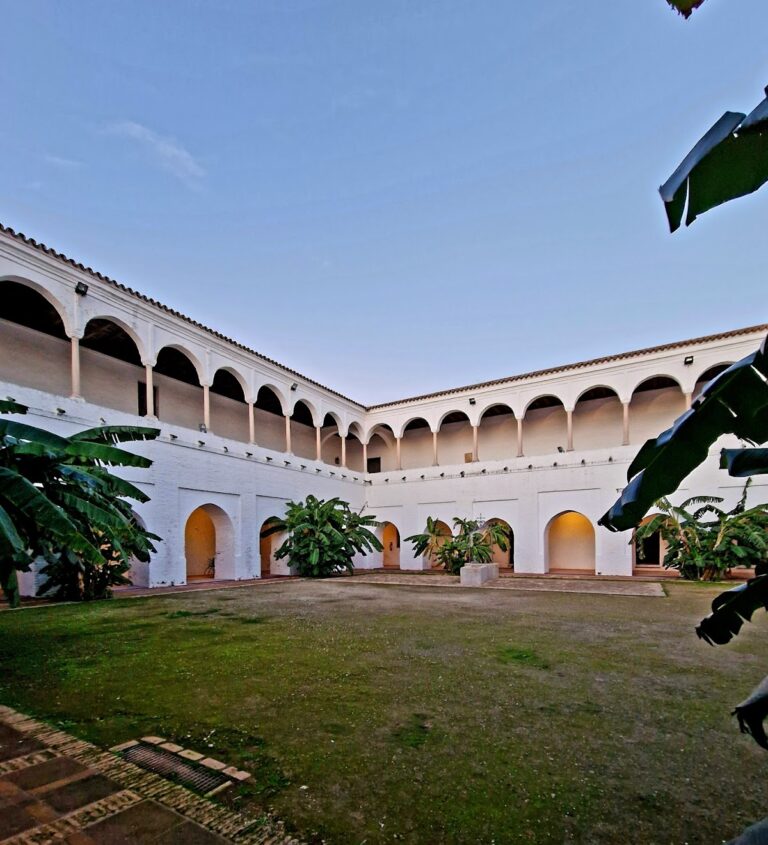
The fifteenth-century Mudéjar cloister is organized around a rectangular courtyard and has four lower galleries. Its arcades use round arches supported by hexagonal columns with bases and capitals, set on a low blind parapet. The structure is chiefly built of brick, and fragments of fifteenth-century fresco decoration survive in the galleries, supplemented during later restoration.
The cloister was the part of the monastery best preserved by the Lisbon earthquake of 1755. A second storey with battlements was added in the seventeenth century, partly to strengthen the complex against pirate incursions. The upper floor now contains a permanent display of scale models of the caravels Niña, Pinta, and Santa María.
Entrance cloister
The entrance cloister, also called the Cloister of Flowers or the Hospedería, provided accommodation and refuge for distressed sailors and local inhabitants during pirate or North African incursions. It connects the library, church, sacristy, and Mudéjar community cloister. Its entrance vestibule contains twentieth-century frescoes by Daniel Vázquez Díaz depicting episodes from Columbus’s life.
Rooms and interior collections
Sala de las Conferencias
The Sala de las Conferencias stands beside the Mudéjar cloister and is traditionally identified as the place where Columbus met Juan Pérez to discuss his proposed voyage. The rectangular historical refectory contains a whitewashed pulpit for reading, a Romanesque crucifix dated to the beginning of the fourteenth century, and paintings from different periods.
Chapter house
The rectangular chapter house, traditionally called Father Marchena’s Cell, is the monastery’s largest cell. Some Columbian scholars associate it with conversations involving Antonio de Marchena, Martín Alonso Pinzón, and García Fernández, the physician of Palos. Reconstructed in the seventeenth century, it has an eighteenth-century artesonado and artworks representing Columbus, Marchena, Martín Alonso Pinzón, Vicente Yáñez Pinzón, and other figures connected with the discovery of America.
Library and museum rooms
The library contains historically valuable documents and objects, including a copy of Juan de la Cosa’s world map showing the coast of the Americas. Another room displays the flags of the American countries and a small container holding soil from those countries. The monastery museum also preserves commemorative objects associated with the discovery of America.
Paintings, gardens, and commemorative works
Rooms around a small planted patio contain Poem of the Discovery, a fresco cycle painted in 1930 by Daniel Vázquez Díaz in pastel colors. Its scenes concern Columbus’s arrival at La Rábida, his voyage, and the departure from Palos. The style reflects the artist’s early Cubism, developed after his time in Paris.
The exterior grounds contain an iron cross and busts of the Franciscans Juan Pérez and Antonio de Marchena by León Ortega. They also include a monument to Columbus and the Monument to the Discoverers, a white-stone commemorative work covered with figures and scenes concerning the discovery, evangelization, and colonization of the Americas.
Wider La Rábida complex
The wider complex includes the Ibero-American Forum, an open-air theatre designed by Álvarez Checa and Corbelo with classical Greco-Roman visual references and seating for approximately 4,000 people. It also contains the José Celestino Mutis Botanical Garden, which presents flora characteristic of Ibero-America.
In front of the Ibero-American Forum, the Muelle de las Carabelas museum contains reproductions of the Niña, Pinta, and Santa María. Constructed in 1992 for the fifth centenary of the discovery of America, the vessels took part in the Universal Exhibition of Seville and later exhibitions in Europe and the Americas.
Nearby sites