Castillo de San Pedro: Medieval Fortress of Huelva

Site at a Glance
- Rating
- 3.3
- Popularity
- Very Low
- Country
- Spain
- Primary era
- Medieval
- Eras represented
- Medieval
- Civilizations
- Unclassified
- Site type
- Military
- Remains
- Castle
On this page8 sections
History
Castillo de San Pedro was a medieval castle of Arab origin in Huelva, Spain, occupying San Pedro Hill beside the parish church of Saint Peter the Apostle. Its defensive system helped protect western Andalusia from entry by sea, giving the fortress an important role in the history of the city and its surrounding region.
Medieval lordship and defence
In 1293, Sancho IV of Castile, the medieval king and son of Alfonso X, granted the lifelong lordship of Huelva to Juan Mathé de Luna, Admiral Major of Castile. Shortly after Mathé de Luna’s death, on 9 August 1299, his successor Fernando IV granted Huelva, including its alcázar, a fortified royal or aristocratic residence, to Diego de Haro. Diego de Haro was Lord of Biscay and Major Standard-Bearer of Castile.
The castle’s position and military purpose were reflected in Huelva’s former coat of arms and its motto, “Portus Maris et Terrae Custodia,” meaning “Guardian of the Sea and the Land.” Together with the adjacent parish church and square, the fortress stood in an area that served for centuries as the city’s civic, cultural, and religious centre.
The Medina Sidonia connection
The castle later belonged to the Dukes of Medina Sidonia, members of one of Andalusia’s most powerful noble houses. During the first decades of the seventeenth century, it was the residence of Manuel Pérez de Guzmán y Gómez de Silva, 11th Count of Niebla, a title associated with the house.
His daughter, Luisa Francisca de Guzmán y Sandoval, was born in the castle on 24 October 1613 and baptized in the parish of San Pedro. She later married John IV, the first Portuguese king of the House of Braganza, and became Queen of Portugal. The House of Medina Sidonia subsequently built a palace on the flat part of the expanding city. The surviving palace on Calle Palacio bears a stone coat of arms belonging to the House of Niebla.
Earthquake, bombardment, and protection
The Lisbon earthquake of 1 November 1755, a major earthquake whose effects extended across the Iberian Peninsula, seriously damaged the castle. Juan Agustín de Mora’s description of 1762 portrayed it as a magnificent structure with four finely built corner towers and the fortifications customary in earlier periods. He also noted that its size and height made it vulnerable to artillery. The remaining fabric later disappeared, and the site was shelled by the French army in 1808.
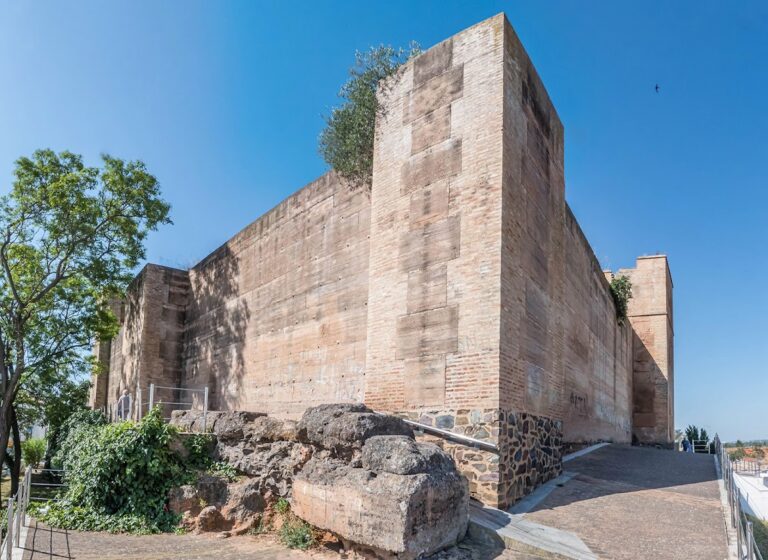
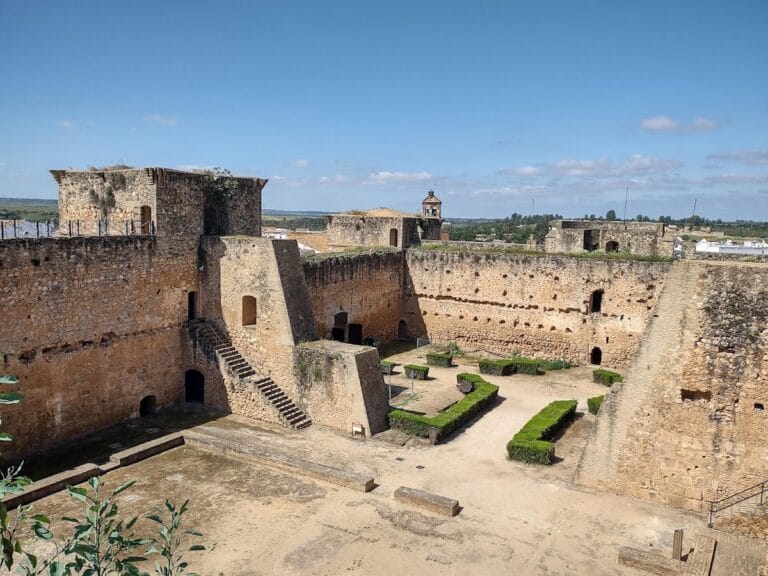
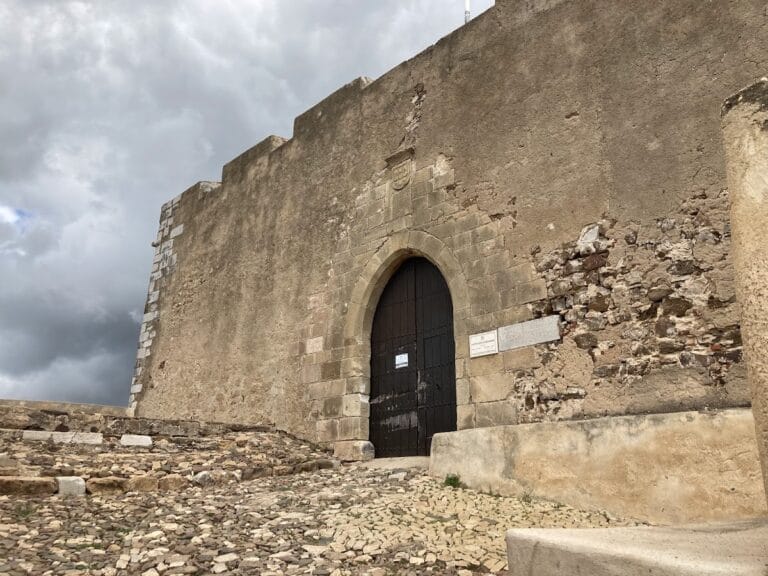
Castillo de San Pedro is now understood through its archaeological remains, including two defensive structures associated with the castle and a reconstructed tower above surviving remains. The site lies within the Cabezo de San Pedro Archaeological Site, a prominent hill or raised mound entered in the General Catalogue of Andalusian Historical Heritage in 2001. The castle also has protected-monument status under the 1949 decree on Spanish castles and Spain’s 1985 Historical Heritage Law, and is recorded as an Asset of Cultural Interest in the monument category. Students of Systems Technical Computer Engineering at the University of Huelva have undertaken a virtual study and reconstruction of the fortress.
Remains
Hilltop layout and defensive structures
The castle occupied the summit of San Pedro Hill in Huelva’s historic centre, beside the Church of Saint Peter the Apostle and the Plaza de San Pedro. Its recorded plan included four corner towers connected with defensive fortifications. Juan Agustín de Mora described the towers as finely built, while the available evidence does not establish their materials or dimensions. The fortress is represented today by archaeological remains within the wider archaeological site of the hill.
Reconstructed tower
One tower has been reconstructed above its surviving remains. It forms the clearest visible element of the castle’s former defensive arrangement, while the wider fortress is known through the archaeological evidence preserved across the site.
Associated defensive structures
Recent archaeological work identified two defensive structures regarded as related to Castillo de San Pedro. Their association extends the surviving physical evidence for the castle’s defensive system beyond the reconstructed tower and the recorded four-corner layout.