San Domenico, Palermo: A Dominican Church and Pantheon of Sicilian Figures


Site at a Glance
- Rating
- 4.6
- Popularity
- Low
- Country
- Italy
- Primary era
- Early Modern
- External website
- Open
- Eras represented
- Medieval, Early Modern, Modern
- Civilizations
- Crown of Aragon, Italian, Kingdom of Sicily, Spanish
- Site type
- Religious
- Remains
- Church
On this page34 sections
History
San Domenico is a Roman Catholic church in Palermo, Italy, built and developed by the Dominican Order and chiefly shaped by a Baroque reconstruction begun in the seventeenth century. Located in Piazza San Domenico in the La Loggia quarter, it is one of Palermo’s major religious buildings and has served since the nineteenth century as the Pantheon of illustrious Sicilians.
The Dominican foundation
The Dominican presence in Sicily followed the Fourth Lateran Council of 1215, a major church council that promoted religious reform and preaching. Palermo’s bishop, Berardo di Castagna, asked Dominic of Guzman, the Castilian founder of the Dominican Order, to send friars to Sicily. Pope Honorius III confirmed the arrangement in a papal brief, and the first Dominicans arrived in 1217.
The friars were initially hosted by the Teutonic Order at the Magione. They then temporarily occupied a former Basilian monastery near the early church of San Matteo al Cassaro. In 1270, the Santa Flora and Mastrangelo families donated land that included the primitive church of Sant’Orsola. A Dominican church, convent, and cloister were built there between 1280 and 1285 in a Norman-Gothic style.
The medieval church was oriented in the reverse direction from the present building. Construction was slowed by the Sicilian Vespers, the 1282 uprising against Angevin rule that disrupted political and building activity in Sicily. The medieval church remained in use until 1457.
Expansion and the Renaissance church
The Dominican community also directed the foundation of a women’s monastery dedicated to Santa Caterina at the Cassero. It was established through the bequests of Benvenuta Mastrangelo, her mother Palma Mastrangelo, and Benvenuta’s husband, Guglielmo di Santa Flora. Benvenuta’s will, drawn up between 1310 and 1312, required her funerary monument to be placed in the primitive Chapel of Sant’Orsola before it was later transferred to the church of Santa Caterina.
The convent of San Domenico, founded in 1300 as the fourth Dominican institution in Sicily, expanded during major renovations that began in the sixteenth century. Cloisters, dormitories, refectories, an infirmary, storerooms, sacristies, chapels, libraries, and study rooms were added. The convent became a center of philosophy and theology, and its priors included Tommaso Fazello, a historian and theologian.
As the Dominican community and congregation of worshippers increased, the medieval church was judged too small. In 1414, Pietro Ranzano and Bartolomeo Carbone began an enlargement financed by prominent Palermitan families and Pope Martin V. Only the principal nave was completed before the project stopped.
Around 1420, Archbishop Simone Beccadelli of Bologna entrusted the renewal and enlargement to the Dominican architect Salvo Cassetta Doza. Special indulgences, granted in exchange for offerings, helped finance the work, together with the patronage of the Sabia family and other noble households. The Renaissance church was built between 1458 and 1480.
Several Renaissance works were destroyed during later rebuilding campaigns. One recorded example was the funerary monument of Guglielmo Ajutamicristo, made by Antonino Berrettaro in 1524.
The Baroque rebuilding
The Renaissance church eventually became inadequate for the liturgical needs of the Dominicans. In 1630, the Palermitan community commissioned Andrea Cirrincione to build a new church. Archbishop Giannettino Doria promoted the rebuilding, and the ceremony marking the beginning of the works took place on 2 February 1640. The present church is principally the result of this reconstruction.
The complex combines medieval, Renaissance, and Baroque phases. The cloister and several adjoining rooms retain Gothic elements, while the church was largely rebuilt in the Baroque period. Its facade was completed in 1726 on Piazza San Domenico, formerly known as Piazza Imperiale or Largo Imperiale. Later columnar elements were superimposed on the earlier structure, producing a more unified and dynamic composition.
A civic pantheon
San Domenico acquired a new public role during the Sicilian Revolution of 1848, a movement that challenged the existing political order in Sicily. The Sicilian Parliament was inaugurated in the church on 25 March. Vincenzo Fardella di Torrearsa presided over the assembly, and Ruggero Settimo was elected its first president. The first revolutionary government, presented on 27 March, included Mariano Stabile, Pietro Riso, Michele Amari, Pietro Lanza, and Francesco Crispi.
In 1853, San Domenico became the Pantheon of illustrious Sicilians. The initiative had been promoted in 1840 by Agostino Gallo. The church’s civic importance also increased after the opening of Via Roma, which incorporated Piazza San Domenico into the city’s changing urban framework.
The church has continued to host major funerary ceremonies and preserve the memory of public figures. General Carlo Alberto dalla Chiesa was buried after his funeral there on 4 September 1982. On 25 May 1992, Cardinal Salvatore Pappalardo celebrated the funerals of magistrate Giovanni Falcone, his wife Francesca Morvillo, and the three police officers killed with them. Falcone’s remains were transferred from the cemetery of Sant’Orsola to San Domenico in June 2015. Sebastiano Tusa was buried in the church in October 2019, and the remains of Giuseppe Tomasi di Lampedusa were transferred from Palermo’s Capuchin cemetery in March 2024.
Among the religious figures, scholars, artists, patriots, politicians, and cultural figures buried or commemorated at San Domenico are Guglielmo Ajutamicristo, Emerico Amari, Michele Amari, Stanislao Cannizzaro, Francesco Crispi, Agostino Gallo, Giovanni Meli, Pietro Novelli, Giuseppe Piazzi, Rosolino Pilo, Ruggero Settimo, Giuseppe Pitrè, Gioacchino Ventura, and Valerio Villareale. The cloister additionally contains burials or memorials associated with Harriet Withers Cannizzaro, Giacomo Serpotta, Gian Filippo Ingrassia, Vincenzo Florio, and members of the Chiaramonte, Mastrangelo, and Santofiore families. The convent contains burials associated with Alberto Crusio, Domenico del Castrone, Mariano Valguarnera, and Pietro Novelli.
Specific burials include Ottone of Lusignan, son of James I of Cyprus, in 1420 or 1421; Giovanni Meli in 1853; Ruggero Settimo in 1865; Francesco Crispi in 1905; Giovanni Falcone in 2015; and Giuseppe Tomasi di Lampedusa in 2024. Eleonora Alagona’s funerary monument of 1536 is an early documented burial memorial. The church has also been associated with the tomb of Francesco Crispi, the monument to Emerico Amari, the tomb of Giovanni Meli, the monument to Rosolino Pilo, and memorials to the Turrisi Colonna family. Relatives declined a proposal to transfer the remains of Paolo Borsellino to San Domenico.
Religious use and conservation
San Domenico remains connected with the liturgical life of the Archdiocese of Palermo through the Corpus Christi celebration, the city festival of Our Lady of the Rosary, and the Feast of the Immaculate Conception. These processions connect the church with Palermo Cathedral and, for the Immaculate Conception, with the nearby monument and the Basilica of San Francesco d’Assisi.
During Lent, the church displays a large painted cloth known as a tila. It is about 30 meters high and as wide as the apse arch. At the Easter Vigil, the cloth falls at the Gloria to reveal the high altar, symbolizing the Resurrection of Christ. The rite belongs to the wider Sicilian tradition of the Lenten veil, whose introduction to Sicily is associated with Teutonic missionaries who arrived after the Norman reconquest.
Major restoration campaigns have brought the church’s original colors back to light. San Domenico is recognized as an Italian cultural property, while its continuing religious use preserves the connection between the building, Palermo’s civic memory, and Dominican worship.
Remains
San Domenico is a large classical-plan church with three naves divided by eight Tuscan columns on each side. The interior is broad and austere, faced principally in gray Billiemi stone, a building material quarried near Palermo. Baroque works occupy numerous niches, while the adjoining cloister and convent retain Gothic features and reused elements from thirteenth-century structures.
Facade and entrance
The Baroque facade
The facade on Piazza San Domenico has three principal orders and was completed in 1726. The first order is arranged with paired pilasters, two molded cornices, entrances, and rectangular windows. The second has corresponding niches and a central arched window. The third contains two symmetrical bell towers, balustrades, and a raised arched pediment with an elaborate outer cornice. Its Doric-Roman interpretation of the Baroque has a strongly dynamic Sicilian Baroque character.
Four pairs of paired Doric columns frame the entrances of the first order. Two additional pairs, with Corinthian capitals, frame the central window niche above. The monolithic columns were quarried at Monte Billiemi. The inner columns project slightly farther forward than the outer ones, particularly the four central columns, strengthening the perspective of the composition.
The main architrave bears the Dominican emblem of a dog carrying a torch in its mouth while seated on the book of the Constitutions. Papal symbols appear on the statue bases and in the friezes behind the statues, giving parts of the facade a Rococo character. Stucco statues of the Dominican popes Innocent V, Pius V, Benedict XI, and Benedict XIII occupy the four outer buttresses. Giovanni Maria Serpotta made them under the direction of the architect Consalvo. Giacomo Serpotta made the side-niche statues of Thomas Aquinas and Peter Martyr.
A frieze above the central arched window carries the inscription “LEX VERITATIS FUIT IN ORE EJUS.” The arched pediment contains a shell symbolizing pilgrimage and a statue of Saint Dominic.
The bell towers
The two bell towers are symmetrical and Baroque in form. One bears the date 1723, while the clock on the other was completed in 1770. Their upper stages have square-based, faceted bulbous domes, single openings on each side, volute decoration, pinnacles, spheres topped by crosses, and weather vanes. Tommaso Maria Napoli designed the right-hand tower. The other was later built as a copy and financed by Bishop Vincenzo Maria de Francisco y Galletti.
The counterfacade reliefs
Above the right-hand holy-water font is a thirteenth-century marble relief showing the arrival of the first Dominicans in Palermo. It is surmounted by an eighteenth-century painting of the Guardian Angel attributed to Vito D’Anna. Above the left-hand font is another thirteenth-century marble relief showing Dominican friars at prayer, also surmounted by a painting attributed to D’Anna. The latter image was traditionally identified as Blessed Giacomo Salomoni, although its iconographic features have also been recognized as those of Blessed Pietro Geremia.
South aisle
Saint Louis Bertrand and Our Lady of Lourdes
The south aisle has seven bays. The Chapel of Saint Louis Bertrand contains a wooden group of the Madonna, the Christ Child, and Saint Dominic receiving the Rosary. Attributed to Girolamo Bagnasco and dated to the early nineteenth century, the group is accompanied by a painting traditionally attributed to Giuseppe Velasco.
The second bay was originally the Chapel of Saint Rosalia and is now dedicated to Our Lady of Lourdes. Giuseppe Di Giovanni decorated it in 1880. The bay also contains the marble funerary monument of Francesco Maria Emanuele Gaetani, Marquis of Villabianca, made by Leonardo Pennino in 1802.
Saint Thomas Aquinas
The Chapel of Saint Thomas Aquinas contains Giovanni Paolo Fondulli’s 1573 painting of the Crucified Christ with Mary Magdalene and Saint Thomas Aquinas. It also preserves the funerary monument of Lauretta Li Greci by Rosario Anastasi and the cenotaph of Giuseppina Turrisi Colonna by Valerio Villareale. A cenotaph is a commemorative monument for someone whose remains are elsewhere or are not contained within it.
Saint Joseph
Giovanni Stefano Oneto, Duke of Sperlinga, commissioned the Chapel of Saint Joseph in the second half of the seventeenth century. Gaspare Guercio’s design is dated 1665. The chapel is faced with polychrome marble, inlays, friezes, putti, and twisted columns. Its sixteenth-century statue of Saint Joseph is by Antonello Gagini, while other sculptures are by Guercio and Gaspare Serpotta.
Gagini’s statue came from a cloister oratory first patronized by the Marini family and later by the Dukes of Terranova. Ernesto Basile executed the vault in 1898. The chapel also contains an inlaid balustrade, an elaborate grille, a central niche framed by twisted columns and a broken pediment, marble and stucco putti, medallions, busts, festoons, garlands, and a circular marble paliotto, the decorated front panel of an altar.
Funerary monuments and extensive Baroque stucco, marble inlay, and sculptural decoration occupy the side walls. The chapel was used for burials of the Sperlinga, Maiorca, Francavilla, and Mortillaro families. It was formerly dedicated to an image of Saint Dominic traditionally believed to have been made without human hands and venerated at Soriano Calabro.
Saint Anne and Emerico Amari
The fifth bay was originally the Chapel of Saint Agnes of Montepulciano and is now the Chapel of Saint Anne. Its altar has mixed marble decoration and painted sarcophagi. The altarpiece shows the Virgin as a child with Saints Anne, Joachim, and Agnes of Montepulciano, and is attributed to Rosalia Novelli, daughter of Pietro Novelli.
The sixth bay was formerly an entrance from Via Meli and is now occupied by the commemorative monument to the jurist Emerico Amari. He is represented seated at his chair of criminal law. Falcone’s coffin was placed opposite the monument in 2015.
Saint Vincent Ferrer
The Chapel of Saint Vincent Ferrer contains Giuseppe Velasco’s 1787 painting of the saint. A commemorative relief of Blessed Giuliano Majali is attached to the pilasters. Majali was a Benedictine who died in 1470 and founded the Ospedale Civico, also known as the Ospedale Grande e Nuovo. The bay was originally under the patronage of Troiano Parisi.
North aisle
Saint Joseph, Saint Rosalia, and Saint Catherine of Siena
The north aisle also has seven bays. Its first bay, another Chapel of Saint Joseph, contains a funerary monument. The Chapel of Saint Rosalia contains Andrea Carrera’s painting of the saint, made after 1670, together with Giovanni Meli’s 1828 sarcophagus and its finely carved relief by Valerio Villareale. The 1813 monument to Gabriele Lancellotti, made by the neoclassical sculptor Leonardo Pennino, is also located there.
The Chapel of Saint Catherine of Siena contains an unidentified Sicilian-school terracotta statue from the mid-sixteenth century. The chapel is dedicated to Catherine as patron saint of Italy and Europe.
The cloister entrance
The former Chapel of Blessed Giacomo Salomoni provides access to the cloister. Its right-hand niche contains Antonello Gagini’s 1527 statue of Saint Catherine of Alexandria, whose pedestal shows scenes from her martyrdom. The statue came from the Chapel of the Magdalene, where the royal secretary Giacomo Maddalena had commissioned a funerary monument.
The left-hand niche contains a Gagini-style statue of Saint Barbara. It formerly stood in the chapel entered from the cloister and has been associated with the church precinct since 1730. The work has been compared with a statue commissioned from Antonello Gagini in 1533 for the Chapel of Saint Barbara, later called the Chapel of Cangialosi, and transferred from the church of San Francesco d’Assisi.
Saint Raymond of Penyafort and Saint Rose of Lima
The Chapel of Saint Raymond of Penyafort contains Gaspare Bazzano’s 1601 altarpiece of the saint crossing the sea on his cloak. The funerary monument of Rosolino Pilo stands to the right.
The north-aisle vestibule has an artistic wrought-iron grille. The Chapel of Saint Rose of Lima contains a seventeenth-century painting by Girolamo di Fiandra and the burials of the Palermitan Risorgimento patriots Salvatore, Pasquale, and Raffaele De Benedetto.
Transepts and apsidal chapels
Chapel of Saint Dominic
The right transept contains the Chapel of Saint Dominic of Guzman. Its altarpiece, commissioned in 1603, depicts the Ecstasy of Saint Dominic and is surrounded by eighteen small panels showing miracles from his life. The painting was formerly attributed to Filippo Paladini or Giuseppe Salerno and has also been attributed to Gaspare Vazzano, or Bazzano.
The altar rises through two superimposed orders of broken and curved pediments, groups of Corinthian columns, angels, putti, volutes, marble, stucco, friezes, and inlay. Its structural arrangement is comparable to that of the altar of Our Lady of the Rosary opposite it, although the heraldry, figures, and tabernacle differ. The chapel also contains Guglielmo Ramondetta’s 1691 funerary monument, designed by Paolo Amato with figures conceived by Giacomo Serpotta and executed by members of the Francesco Scuto family. Giovanni Nicolini’s 1904 monument to Francesco Crispi and a fifteenth-century work known as the Madonna of Monserrato are also preserved there.
The right transept additionally contains a sixteenth-century painting of Our Lady of Monserrato with Saint Blaise and Saint Antoninus Pierozzi, Archbishop of Florence.
Chapel of Our Lady of the Rosary
The left transept contains the Chapel of Our Lady of the Rosary. Its painted-panel altarpiece of 1540, by Vincenzo degli Azani, known as Vincenzo da Pavia, represents the Mystery of the Rosary. The Virgin gives the Rosary to Saint Dominic, while Saints Christina, Vincent Ferrer, Thomas Aquinas, and Ninfa kneel nearby with the commissioning couple, members of the Plaia family.
The chapel contains the monuments of Michele Schiavo, Bishop of Mazara, and Domenico Schiavo, a cathedral canon and jurist who died in 1771 and 1773. Ignazio Marabitti made the monuments, which came from the demolished church of San Giuliano, built on the site of the Teatro Massimo Vittorio Emanuele. A sixteenth-century holy-water font stands nearby.
The raised Baroque altar repeats the structural arrangement of the Saint Dominic chapel but has different heraldry, figures, and a tabernacle representing a Roman temple. Its lunette and panels depict scenes from the life of the Virgin.
Saint Hyacinth and the ante-sacristy
The entrance to the ante-sacristy and the Chapel of Saint Hyacinth of Poland has an altar framed by two twisted stucco columns. Its painting of Saint Hyacinth, made on slate and dated 1598, has recently been attributed to Gaspare Bazzano. The date may correspond to the saint’s canonization. The room also contains a Gagini-school relief and the monumental sarcophagus of Ruggero Settimo.
The apsidal chapels
The right apsidal chapel is dedicated to the Holy Crucifix. It contains Giovanni Matinati’s 1509 Crucifix, an expressive sixteenth-century relief of the Pieta, a Gagini-school holy-water font, and a relief of Saint Catherine of Siena attributed to Antonello Gagini. A 1477 relief of the Trinity and Valerio Villareale’s cenotaph to Annetta Turrisi Colonna are also preserved there. An opening in the floor leads to a large, gridded crypt dedicated to Francesco Crispi, who was buried there in January 1905.
The left apsidal chapel, dedicated to the Sacred Heart of Jesus, contains reliefs of Saint Jerome and the Annunciation attributed to Antonello Gagini. It also contains the sarcophagus of Michele Amari, a monument to the Dominican Luigi Di Maggio, who established the presence of the Sicilian Society for Homeland History at San Domenico, and the burial of Giuseppe Pitrè.
High altar, choir, and sacristy
The high altar and organs
The high altar is made of mixed marble with copper moldings. Beneath its altar slab is the urn of Blessed Pietro Geremia, a Dominican writer born in Palermo. A people-facing bronze altar was installed in the transept in 1987. Sebastiano Milluzzo made it, and the Dominican friar Leonardo Gristina decorated it with colored enamels on silver depicting Gospel scenes and Dominican saints.
Two organs stand on matching galleries beside the apse. Their wooden cases have three-bay fronts, sculpture, and gold-leaf decoration. Domenico Del Piano built the Gospel-side organ between 1768 and 1774. The organ on the Epistle side was built by the Palermitan Giacomo Andronico in 1781 and completely rebuilt by Pacifico Inzoli in 1898.
Choir and pulpit
Behind the altar is a large walnut choir made in 1700 to a design by the Dominican Giovanni Battista Ondars. He also designed the walnut pulpit, carved by unidentified craftsmen in 1732. The pulpit depicts five Dominican saints and blesseds: Blessed Giovanni Liccio, Saint Vincent Ferrer, Saint Thomas Aquinas, Saint Antoninus Pierozzi, and Blessed Giacomo Salomoni.
Sacristy
The sacristy contains wooden furnishings commissioned by Bishop Vincenzo Maria de Francisco y Galletti and designed by Lorenzo Olivier. They represent the Dominican popes Innocent V, Benedict XI, Pius V, and Benedict XIII. The room also preserves a fifteenth-century wooden Crucifix from the Pisan school and the Chapel of the Ecce Homo with a marble lavabo.
Convent and cloister
The Gothic cloister
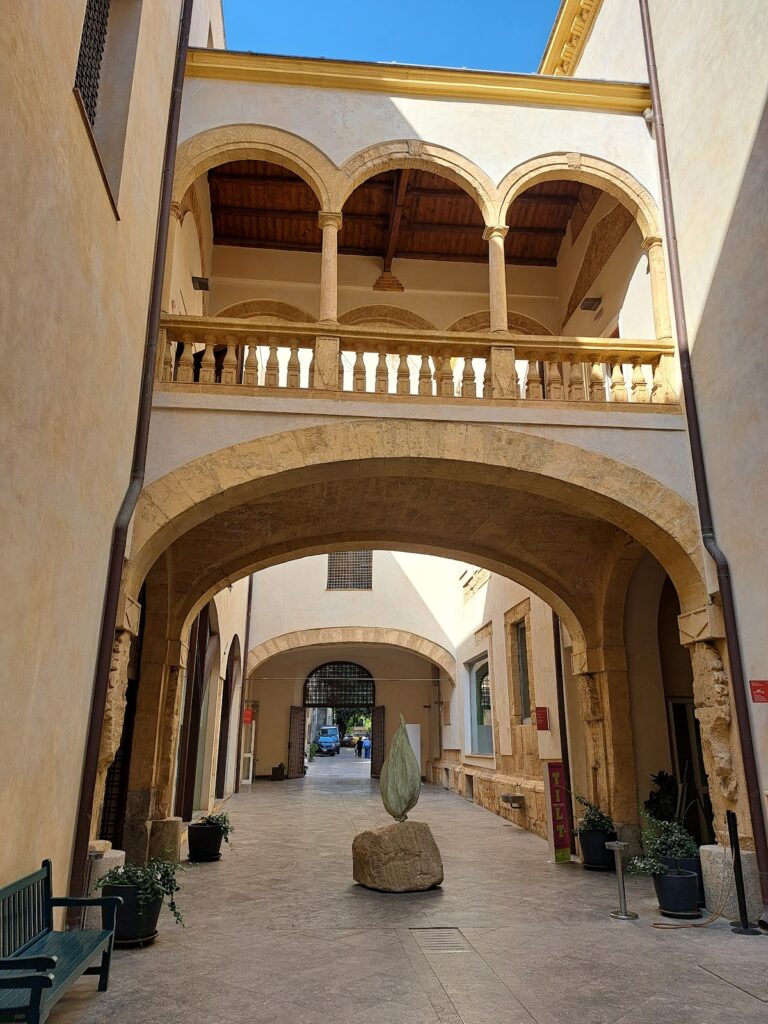
The convent lies north of the church and is reached from the north aisle. Its cloister, associated with the Chiaramonte family and Manfredi I Chiaramonte, retains columns, arches, capitals, and reused architectural elements from thirteenth-century structures. These spolia form part of the later cloister fabric.
The cloister walls are painted with Dominican saints and scenes of the Apocalypse and Last Judgment, including works by Nicola Spalletta of Caccamo. Giovanni Biagio Amico designed the exterior during the first half of the eighteenth century.
Rooms of the convent
The convent includes a refectory, a large library, a small religious library, the Hall of the Sixteenth Century, the Hall of Saint Barbara, the Chapel of the Ecce Homo, the sacristy, the Confraternity of the Rosary of San Domenico, and the Congregation of the Name of Jesus. A plaque in the Hall of Saint Barbara recalls that the room housed the Accesi Academy in the sixteenth century.
The Hall of the Calendar
The Hall of the Calendar contains a 1723 fresco by the Dominican Benedetto Maria Castrone. Its perpetual liturgical calendar covers the years 1700 to 2192 and uses mathematical and astronomical calculations to determine movable feasts such as Easter. The painted frame bears the motto “IANUA TEMPORU PERPETUA,” meaning “Perpetual Gate of Time,” and surrounds the entrance to a room formerly used as the Dominican community’s private library.
A documented work formerly associated with the convent is Pietro D’Asaro’s 1612 painting of Saint Charles Borromeo adoring the Crucifix. A fifteenth-century glazed terracotta Madonna and Child, attributed to Luca della Robbia or Andrea della Robbia, is now held at the Regional Gallery of Sicily in Palazzo Abatellis.
Nearby sites