Grafschaft Abbey: A Benedictine Monastery in Germany


Site at a Glance
- Rating
- 4.8
- Popularity
- Very Low
- Country
- Germany
- Primary era
- Early Modern
- Eras represented
- Medieval, Early Modern, Modern
- Civilizations
- Holy Roman Empire
- Site type
- Religious
- Remains
- Monastery
On this page16 sections
History
Grafschaft Abbey is a former Benedictine monastery in Germany, in the Grafschaft district of Schmallenberg, founded in 1072 by Archbishop Anno II of Cologne. Established as the Benedictine Abbey of Saint Alexander, it followed the Siegburg form of the Cluniac reform, a movement that promoted stricter monastic observance and more disciplined worship. The abbey strengthened Cologne’s political and ecclesiastical influence in the Sauerland and remained connected to the archbishops of Cologne until its dissolution during secularization in 1803–1804.
Foundation and Episcopal Rule
Anno acquired the site from a widow named Chuniza and her son, Tiemo. The first monks came from Siegburg Abbey, another foundation of Anno, and Luitfried probably became the first abbot through appointment by the archbishop rather than through an election. Although the community followed the reform customs of Siegburg, it remained within the diocesan organization of Cologne and was not directly subject to the pope or to Siegburg.
Anno’s grant of the libertas coloniensis allowed the monks to elect their abbot and advocate, the lay official who exercised secular protection over the monastery and its possessions. The archbishop still had to confirm the abbot, and the community remained obliged to attend diocesan synods and accept episcopal authority. Grafschaft was therefore an episcopal proprietary monastery, meaning that its ecclesiastical lord retained legal rights over its property and governance while the community possessed defined internal privileges.
The foundation created a narrow secular territory between the lands of the noble lords of Bilstein and the counts of Arnsberg. Grafschaft supervised twelve churches and chapels and controlled farms, villages, church rights, and extensive estates extending between Hemer, Lüdenscheid, and Schmerlecke. Its foundation records contain some of the earliest written references to numerous settlements in the Sauerland. The abbey also possessed two vineyards near Bacharach and Linz in the Rhineland from its beginning. After secularization, these vineyards passed to the von Fürstenberg family and became part of the Schloss Fürstenberg wine estate.
The surviving foundation charter is considered reliable in its date and general contents, although the document is probably not Anno’s original charter. Its final line, including the thirteenth-century form of the place-name Belecke, was identified as a later addition probably made after 1200, perhaps during disputes over tithe rights. The abbey’s secular advocacy passed from the counts of Dassel, who held it from 1166, to the counts of Arnsberg in 1232. After Cologne acquired the County of Arnsberg in 1368, the archbishops held the office. A hereditary subordinate advocacy was first held by Gerhard of Hachen, then by the lords of Grafschaft, and from 1573 by successive members of the von Fürstenberg family.
Conflict, Destruction, and Medieval Recovery
Grafschaft initially maintained close institutional and spiritual connections with monasteries including Gladbach, Deutz, and possibly Nonnenwerth. Its monastic life was regarded as unusually strict in the German-speaking lands. In 1101 Archbishop Friedrich settled a dispute with Meschede Abbey over the Engeren land deanery, a territorial subdivision used to supervise parishes, ruling against Grafschaft. The abbey’s loyalty to the archbishops also drew it into the political opposition of Friedrich of Schwarzenburg and Lothar of Supplinburg to Emperor Henry V.
In 1114 troops loyal to the emperor, commanded by Giso IV, attacked and heavily damaged the abbey. The complex was rebuilt, and the community entered a period of prosperity during which it sometimes numbered as many as eighty monks. Under Abbot Widukind of Wittgenstein, who served from 1258 to 1272, the abbey divided its revenues so that one-third went to the abbot and two-thirds to the convent. The transfer of major property, including Berleburg in hereditary lease, to the Wittgenstein family weakened the monastery’s finances.
A major fire destroyed almost the entire complex in 1272. Contemporaries interpreted the disaster as divine punishment. Abbot Gottfried of Bilstein directed the rebuilding and partly restored the abbey’s financial position. In 1294 Grafschaft transferred its principal estate at Glindfeld to the Augustinian convent of Küstelberg in exchange for the convent’s promise to choose its provost from Grafschaft. Three years later Archbishop Wigbold of Holte commissioned the abbot to move the Augustinian nuns from Küstelberg to Glindfeld.
During the later Middle Ages, both the economic and spiritual condition of Grafschaft deteriorated. A more worldly way of life increasingly replaced the earlier discipline, some monks held personal property, and monastic farms were leased instead of being worked by lay brothers. Archbishop Wigbold restricted the community to twenty-four monks in 1304. Grafschaft received an arm relic of Saint Anno from Siegburg Abbey in 1391. In 1444 Archbishop Dietrich II of Moers consecrated a chapel and altar in the church entrance hall to the Archangel Michael and the Holy Angels. The chapel, later demolished, became the burial place of the lords of Grafschaft.
Grafschaft and the Development of Schmallenberg
The abbey expanded its religious influence across the Upper Sauerland, while its economic and ecclesiastical rights affected the development of Schmallenberg. Schmallenberg Castle was built near the end of the twelfth century chiefly to protect Grafschaft, and the settlement below the castle developed into the later town. The abbey maintained administrative establishments in Schmallenberg and Warstein, including a feudal office and a tithe barn.
Grafschaft helped finance Schmallenberg’s town wall in 1243, but it did not exercise lordship over the town. That jurisdiction had been leased to the lords of Bilstein. Disputes involved the appointment of the town priest, forests, grazing, fishing, and related rights. In 1683 the Werl Officialate Court definitively confirmed the abbey’s unrestricted right of patronage over the Schmallenberg parish.
Reform and Economic Change
During the fifteenth century Grafschaft increasingly served as a provision for sons of the regional nobility. The community had fallen to seven monks by 1507, when Archbishop Hermann IV of Cologne began a comprehensive reform. He cited private property and declining discipline, although the abbey’s financial troubles were also connected with the archbishop’s heavy financial demands. The remaining monks were required to leave, receiving pensions or parish appointments, and Abbot Albert of Cologne introduced a new community from Brauweiler Abbey.
On 30 October 1508, the former abbot Peter of Dörenbach, supported by nobles and former monks, seized the abbey and expelled the new community. Troops of the archbishop drove him out, allowing the reformers to return. Grafschaft joined the Bursfeld Congregation in the same year. This federation of reformed Benedictine monasteries promoted common standards, visitations, mutual supervision, stricter discipline, and more careful observance of worship. The abbots of Abdinghof and Boke were assigned to visit Grafschaft, while the abbey assumed responsibility for the Benedictine nunnery of Odacker in 1513. Visitations continued to criticize discipline, and Abbot Albert was threatened with suspension in 1520 and 1522.
The Reformation affected some communities under Grafschaft’s authority, and Abbot Heinrich Steinhoff of Würdinghausen eventually resigned without a pension. Earlier debts and the long-term effects of the agrarian crises of the fourteenth and fifteenth centuries continued to burden the abbey. During the sixteenth century the monks responded by expanding into iron production. In 1590 the archbishop exempted the abbey’s ironworks from all dues, and this industrial income contributed to mining and ironworking in the Sauerland. Around Silbach, Grafschaft operated six lead and iron mines in the eighteenth century.
Renewed Prosperity and Dissolution
In 1612 the abbey elected its only external abbot, Gabel Gobelinus Schaffen of Abdinghof, because of his administrative reputation. He refinanced the institution, redeemed mortgaged farms, entered its income rights in urbarial records, and imposed a stricter daily routine based on the Rule of Saint Benedict. His reforms provoked resistance, including a planned poisoning attempt. Three monks who took part were sentenced to life imprisonment in other monasteries.
Under Schaffen and his successor Johannes Worth, Grafschaft’s finances improved, and the abbey escaped most of the worst devastation of the Thirty Years’ War, the prolonged European conflict of 1618–1648. Its library also expanded. An acquisition catalogue lists 271 new books between 1580 and 1631, including theological writings, classical authors, and works on geography and economics. The abbey’s industrial installations included water-powered iron hammers on the Lenne and Sorpe rivers, a smelting works near Obersorpe, and another ironworks near Latrop. It also held mining rights at Siedlinghausen, Bigge, Niedersfeld, Medebach, Dreislar, Altenbüren, and Schmallenberg.
From the seventeenth century Grafschaft entered a new period of prosperity. The Roman Congregation of Rites granted its abbots the right to wear a mitre in 1632. From the late seventeenth century until the early nineteenth century, the community generally contained at least thirty monks and reached fifty in 1746. Thirty monks remained at dissolution, while four new brothers had entered in 1801.
The transfer of the Duchy of Westphalia to Hesse-Darmstadt in 1802 accelerated the abbey’s suppression. Grafschaft passed into civil ownership on 26 October 1803. The last thirty-two monks were allowed to celebrate the feast of Saint Benedict on 21 March 1804 before leaving on state pensions. The abbey then owned approximately 1,000 Morgen of land. Its buildings and possessions passed first to the Hessian state, later became a Prussian state domain, and were acquired by the von Fürstenberg family in 1827, which still owns the complex.
Secular Uses and the Borromean Sisters
The abbey church was offered to the parish of Grafschaft, but the community could not meet its maintenance costs. It was demolished in 1832, apart from the medieval tower, and some of its material was reused in the Catholic parish church of Saint Burchard in Oedingen. The former church site became the north wing of the present complex in 1962. The archive moved first to Arnsberg and later, in the mid-nineteenth century, to the State Archive in Münster. Important manuscripts went to Darmstadt, while parts of the library passed through Belecke, Paderborn, and Arnsberg before entering other collections.
During the nineteenth and early twentieth centuries, the former monastery served agricultural, residential, educational, and other secular purposes. It housed rooms for the village school and teachers’ accommodation, and during the National Socialist period it was used as a school countryside hostel. Plans for a teacher-training institute began but were abandoned because of the Second World War. During that war, about forty families made homeless by bombing lived in the complex. Museums in Düsseldorf, Dortmund, and Essen stored endangered cultural property there, along with parts of the Dortmund city archive and industrial reserve goods including 43,000 bottles of cognac. Military action damaged the buildings near the end of the war.
A new monastic phase began in 1948, when Sisters of Mercy of Saint Charles Borromeo from the former Trebnitz Abbey in Silesia settled at Grafschaft after German-speaking members of the congregation were expelled from Poland. The sisters initially faced difficult conditions, leased the complex from the von Fürstenberg family, and later obtained a favorable hereditary lease. Their first restoration phase ended in 1950, when Archbishop Lorenz Jaeger consecrated the renewed monastery. Grafschaft became the mother house of the formerly Silesian congregation, and from 1951 to 1983 Elisabeth Schache directed it as the congregation’s general procurator.
The Borromean sisters established the specialist hospital Kloster Grafschaft, a pulmonary hospital, and later a home for elderly sisters. The complex continues to serve as the congregation’s mother house and also contains a museum. Later alterations and new buildings were undertaken with regard for monument protection. The Benedictine Abbey of Königsmünster in Meschede, founded in 1956, consciously adopted Grafschaft’s tradition, including the stag antlers from its coat of arms, and compiled a necrology of Grafschaft’s monks for commemorative prayer.
Remains
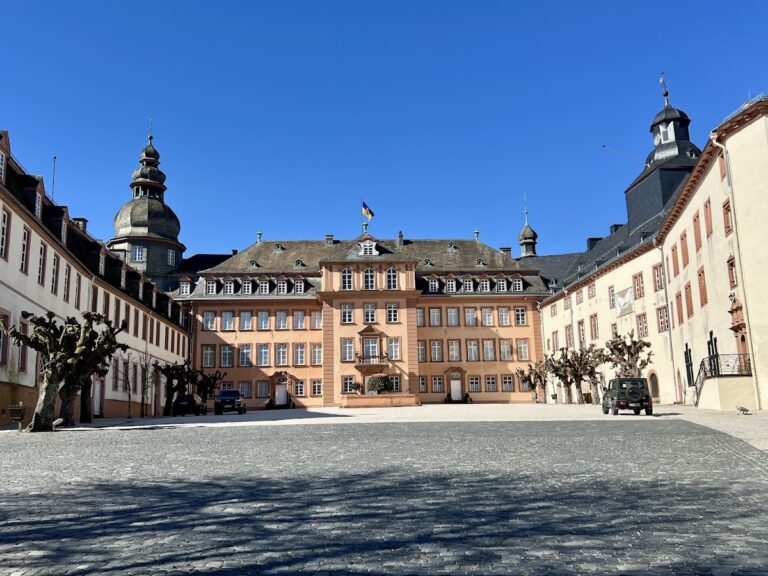
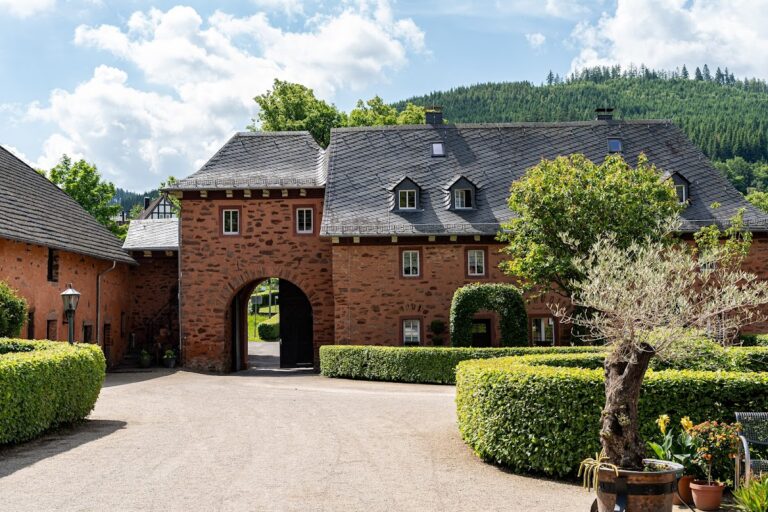
Grafschaft’s surviving complex is predominantly baroque and reflects the rebuilding carried out between 1729 and 1742. The economic buildings were renewed from 1765 to 1787, and a new gatehouse was added in 1770. Rüthen green sandstone was used for the exterior portals, window niches, and much of the sculptural decoration. The modern complex also preserves the medieval tower, parts of the earlier monastery, later chapels, a museum collection, and evidence of the abbey’s manuscript and industrial activity.
Baroque Monastery and Church Site
Monastery Buildings
Abbot Ambrosius Bruns laid the foundation stone of the rebuilt monastery and the cornerstone of the steward’s office on 19 May 1729. Master builder Michael Spanner completed the principal rebuilding by 1742. A three-winged cloister stood along the south side of the church. West of the church were the abbot’s residence and an attached archive building, with the brewery and distillery beneath the residence and the guesthouse in the west wing.
The main entrance lay among the economic buildings and displayed the abbey’s coat of arms together with a statue of Saint Anno. The south wing contained the cellarer’s office and refectory, with a large assembly hall above. The ground floor also held the infirmary and monastic school, as well as the prior’s residence and the monks’ entrance, above which stood a figure of Saint Benedict. The east wing contained the sacristy, chapter house, and library, while the monks’ dormitory occupied the first floor.
Abbey Church
The first church, built after the foundation in 1072, was a three-aisled basilica with a western tower and a three-aisled eastern crypt. It suffered heavy damage in 1114 and was nearly destroyed by the fire of 1272. The medieval church had a prominent memorial program devoted to Saint Anno, including a statue on the high altar and a side altar dedicated jointly to Saint Benedict and Anno.
Spanner built the replacement church between 1738 and 1743. It was a three-aisled hall church, and the medieval tower, including the abbot’s chapel, was incorporated into the new structure. A crypt containing an altar and burial vaults lay beneath the choir. Abbot Ludwig Grona consecrated the church in 1747, while its furnishings were installed between 1744 and 1757. The interior combined baroque and Rococo work and was considered among the finest church interiors in the Electoral Cologne Sauerland.
Church Furnishings
A master named Peter of Warstein made the baroque choir stall with sixty seats, the pulpit, and the confessionals. Kaspar Störmann of Schmallenberg produced the elaborate grille separating the monks’ choir from the nave. Johann Heinrich König carved the pulpit sculpture and the decoration of the cross altar. Johann Philipp Seuffert of Würzburg built the principal organ, which was accompanied by two additional organs. Christoph Volmar of Geseke constructed the main altar and five side altars; Johann Theodor Axer of Paderborn completed the main altar, while the painter Honck supplied its painted work.
Paintings by Dehne of Dillenburg decorated the church and monastery. Their subjects included biblical scenes, the Feast of Herod, the rich glutton, Saul and David, the Benedictine order, the abbey and its possessions, and portraits of abbots, popes, apostles, and martyrs connected with the order. A chapel dedicated to Saint Roch had been established in the infirmary in 1626, and the medieval tower received a Baroque roof in 1629.
The baroque church was demolished in 1832, leaving the medieval tower. Its movable artistic inventory was dispersed among churches and collections. The high altar, donated by Ferdinand von Fürstenberg in 1665, went first to Attendorn and later to Fröndenberg. The pulpit and confessionals were transferred to the provost church in Arnsberg, another pulpit went to Geseke, and Seuffert’s 1747 organ went to Frankenberg before its remaining registers were transferred to Banz Abbey. Apostle statues went to Saint James’s Church in Winterberg, the cross altar to the Church of the Exaltation of the Holy Cross in Wissen, and parts of the high altar to Saint Barbara’s Church in Büddenstedt. Other works went to Belecke and nearby churches, while the Borromean sisters later reacquired some pieces.
Surviving Tower and Modern Chapels
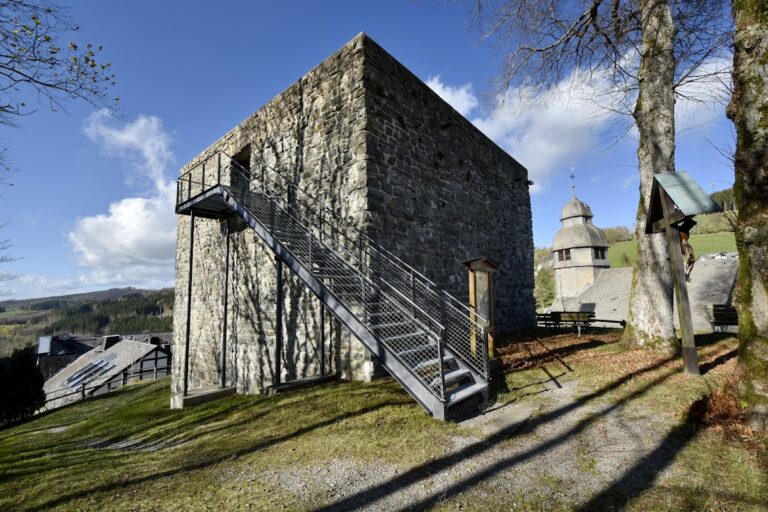
The medieval tower is the oldest surviving part of the complex. Its Anno Chapel contains relics of the founder and is used for private contemplation. The modern mother house also has a larger chapel for worship and the Liturgy of the Hours. The museum contains liturgical vessels, vestments, relics, and religious artworks from the former abbey that returned through purchase or donation, together with objects associated with the history of the Borromean sisters.
Manuscripts and Industrial Remains
Manuscript Heritage
Grafschaft produced manuscripts with elaborate decorated initials. Manuscripts created or preserved in connection with the abbey include saints’ lives from the late eleventh or early twelfth century, a twelfth-century miscellany containing a commentary by Hrabanus Maurus and a letter by Archbishop Adalgot of Magdeburg, and an approximately 1150 collection of sayings of the Desert Fathers. Twenty-two Grafschaft manuscripts from the High and Late Middle Ages, the sixteenth century, and the early seventeenth century are preserved in Darmstadt, including six palimpsests, manuscripts whose earlier writing was scraped away for a later text. The manuscript later known as the Vita Annonis Minor was associated with Grafschaft by one tradition in 1186, while another interpretation places its arrival at the abbey in the fourteenth century.
Ironworking and Mining
The abbey’s industrial holdings included water-powered iron hammers on the Lenne and Sorpe rivers, a smelting works near Obersorpe, and another ironworks near Latrop. In the eighteenth century, six lead and iron mines operated around Silbach under Grafschaft’s ownership. Additional mining rights lay at Siedlinghausen, Bigge, Niedersfeld, Medebach, Dreislar, Altenbüren, and Schmallenberg. These installations and rights form part of the physical and economic remains of the abbey’s long involvement in Sauerland mining and iron production.
Nearby sites