Kyiv Pechersk Lavra: An Eastern Orthodox Monastic Complex in Ukraine


Site at a Glance
- Rating
- 4.7
- Popularity
- Very High
- Country
- Ukraine
- Primary era
- Early Modern
- External website
- Open
- Eras represented
- Medieval, Early Modern, Modern
- Civilizations
- Cossack Hetmanate, Kievan Rus, Russian
- Site type
- Religious
- Remains
- Fortified Monastery
On this page23 sections
History
Kyiv Pechersk Lavra is an Eastern Orthodox monastic complex in Ukraine, founded as a cave monastery in 1051. Its architectural ensemble developed over almost nine centuries, with much of its surviving above-ground character shaped by Ukrainian Baroque, the regional Baroque tradition used especially in Ukrainian religious and civic buildings during the seventeenth and eighteenth centuries. The monastery became a major center of Christianity, learning, literary culture, and political and religious life in Kyivan Rus and later Ukraine.
Foundation and Kyivan Rus
The monastery’s origins are traditionally linked with Anthony of the Caves, a monk from Liubech who returned from Mount Athos, and his disciple Theodosius of Kyiv. The early community formed around caves used for prayer and ascetic practice. The Primary Chronicle gives two apparently conflicting foundation dates, 1051 and 1074, while 1051 remains the traditional date associated with the establishment of the monastery under Prince Yaroslav the Wise.
As the community expanded, Anthony appointed Varlaam as abbot before withdrawing to another cave. Theodosius later became abbot and introduced the Studite rule, a communal monastic system emphasizing shared worship, common property, and collective discipline. Other monasteries in Rus subsequently adopted this rule.
During the eleventh century, the monastery helped spread and consolidate Christianity in Kyivan Rus. It also became a center of religious culture, manuscript copying, translation, literary production, and chronicle writing. Figures associated with its intellectual and artistic life included Hilarion the Rusyn, Nikon the Great, Nestor the Chronicler, and the artist Alipius. The community’s ascetic reputation and substantial donations also made the monastery one of the largest landowners in pre-Mongol Rus. Its estates eventually included towns, villages, fisheries, ferries, mills, beekeeping revenues, distilleries, inns, workshops, and other agricultural and commercial assets.
Destruction, Recovery, and Orthodox Resistance
The monastery suffered attacks and destruction in 1096, 1151, 1169, 1203, and 1240. The Mongol invasion of 1240 brought especially severe devastation. Monks were killed or dispersed, and the community entered a period of decline before being re-established by the fourteenth century.
Edigey’s attack on Kyiv in 1416 caused another fire. Prince Simeon Olelkovich rebuilt and embellished the monastery in 1470, but the Crimean Tatar ruler Mengli I Giray burned and plundered it again in 1482. Renewed donations supported its recovery. In the sixteenth century, the monastery became an important stronghold of Eastern Orthodoxy during opposition to the Union of Brest, the 1596 agreement through which part of the Orthodox hierarchy in the Polish-Lithuanian Commonwealth entered communion with Rome while retaining Eastern rites. Its implementation intensified conflict between Orthodox and Uniate communities.
The monastery was described in 1592 as a stauropegion of the Ecumenical Patriarchate of Constantinople. A stauropegion is an ecclesiastical institution placed directly under a patriarch rather than under a local bishop. The chronology of its titles, including lavra, archimandry, and stauropegion, remains disputed. Proposed dates for the stauropegial status range from the late twelfth century to 1481, 1592, and 1688. The monastery was associated with the Patriarchate of Constantinople from 1592 until 1688, when it became directly subordinate to the Moscow Patriarch.
Education, Printing, and Fortification
During the seventeenth century, the Lavra developed into a major center of Ukrainian religious, literary, educational, and cultural activity. Its printing house was established under Eliseus Pletenetsky and produced liturgical and polemical works, including publications connected with resistance to Uniatism. The Kyiv Caves Patericon, a collection of narratives about the monastery’s monks and saints, was compiled in the thirteenth century by monks associated with the community and became an important source for the religious memory and medieval history of the Lavra.
Peter Mohyla established a school in 1631. It later united with the Brotherhood School to form the Kyiv Mohyla Collegium, an early-modern institution that combined Orthodox theological education with elements of contemporary European schooling. The Lavra subsequently maintained the Kyiv Theological Academy and Seminary, as well as a library, archive, museum collections, and a church-archaeological collection.
Lithuanian forces under Hetman Janusz Radziwill plundered the monastery in 1651. Hetman Ivan Samoylovych surrounded it with an earthwork, and Ivan Mazepa later constructed stone fortifications. Further bastion-type defenses built during the reign of Peter I made the Pechersk fortress Kyiv’s principal fortification. These works contributed to the development of the Lavra as a fortified monastic complex.
Imperial Administration and Fire
In 1688, the monastery became directly subordinate to the Moscow Patriarch. From 1786 it was administered by the Metropolitan of Kyiv, who held the office of its ecclesiastical archimandrite. That year, Catherine II’s secularization measures stripped the monastery of most of its lands and ended its stauropegial status. Its elected leadership was replaced by metropolitan-appointed administration, while a deputy superior managed daily affairs.
Despite the loss of its estates, the Lavra became a major pilgrimage center and remained an extensive ecclesiastical landlord during the eighteenth century. In the nineteenth and early twentieth centuries, it continued as a residence of the Metropolitans of Kyiv and as a center of pilgrimage, religious publishing, and church activity. Construction, repair, and restoration continued, including the building of a stone defensive wall around the Lower Lavra during the mid-nineteenth-century reconstruction of the Pechersk fortress. A hospital at the St. Nicholas Monastery was built in 1849, and a separate hospital for pilgrims and travelers treated more than 500 patients annually.
A major fire in 1718 destroyed the principal cathedral, archive, library, printing house, and many other buildings. The cathedral was rebuilt by 1729. The printing house and other institutional functions were restored or reorganized afterward, while later construction gave much of the complex its Ukrainian Baroque appearance.
War, Soviet Suppression, and Museum Preservation
On 25 January 1918, during the first Bolshevik capture of Kyiv, Metropolitan Vladimir of Kyiv and Galicia was killed in the Lavra. Fighting in 1918–1920 caused further damage. Soviet authorities confiscated the monastery’s property in 1919 and transferred its movable and immovable property to state administration in 1920. A state Invalids’ Town was organized on the territory, although the monastic community continued temporarily as a legally recognized cooperative until 1929.
In 1921, the Lavra’s Spiritual Council transferred its libraries and archive to the National Library of Ukraine for protection. Soviet authorities dissolved the council in 1922, arrested monks and novices, and eventually suppressed the monastery. On 29 September 1926, the complex became the All-Ukrainian Museum Town, a state historical and cultural preserve. The monastery was finally dissolved on 18 November 1929, and its monks faced repression during the 1930s.
The preserve and its museums suffered severe losses during the Second World War. More than 30 architectural monuments were destroyed, and museum collections were looted. On 3 November 1941, the Dormition Cathedral was blown up during the German occupation. Responsibility has been attributed variously to retreating Soviet forces, Soviet partisans, or German forces that detonated explosives discovered beneath the cathedral. The unresolved responsibility remains an important part of the cathedral’s modern history.
During the occupation, a police station operated in the Lavra, where approximately 500 civilians were killed. Monastic activity resumed in the Near Caves on 27 September 1941 with permission from the occupation authorities. The preserve resumed operations in May 1944. Most destroyed monuments were rebuilt during the following decade, but the Dormition Cathedral remained in ruins until its remains were conserved in 1962–1963.
Revival, World Heritage, and Contemporary Administration
Monastic activity resumed in 1988 in connection with the millennium of the Christianization of Rus. The monastic community first received the Far Caves complex in June 1988 and the Near Caves complex in April 1990, followed later by the Gostinny Dvor and other buildings. From 1988 until 2023, substantial parts of the Lower Lavra were used by the Ukrainian Orthodox Church associated with the Moscow Patriarchate, including its monastery, theological academy and seminary, metropolitanate, governing offices, and chief cathedral. The restored monastery initially had more than 100 monks.
The Dormition Cathedral was reconstructed with state funding between 1998 and 2000 using modern materials and was consecrated on 24 August 2000. Large-scale restoration of other buildings was also undertaken by the beginning of the twenty-first century. The Kyiv Pechersk Preserve, created as a museum institution during the Soviet period, received national status in 1996. The complex is state-owned, with the state preserve administering the Upper Lavra while religious institutions have used parts of the site under lease or free-use agreements.
Kyiv Pechersk Lavra, together with Saint Sophia Cathedral and related monastic buildings in Kyiv, was inscribed on the UNESCO World Heritage List in 1990 under criteria I, II, III, and IV. The listed property has a 24-hectare central zone and a 108-hectare buffer zone. In 2023, the Lavra was placed on the World Heritage List in Danger because of risks arising from Russia’s war against Ukraine.
A 2013 agreement transferred 79 buildings and structures for free use by the Ukrainian Orthodox Church associated with the Moscow Patriarchate, including the Near and Far Caves and the Dormition and Refectory churches. In late 2022 and 2023, the Ukrainian government ended or declined to renew the agreements, citing violations and alterations to the historic property. The religious organization was ordered to leave the Lower Lavra, and state authorities resumed control of 79 objects and two additional buildings formerly used by the Kyiv Theological Academy and Seminary.
The Orthodox Church of Ukraine registered its own Holy Dormition Kyiv Pechersk Lavra monastery on 1 December 2022. From January 2023, its clergy conducted services in parts of the complex. It held a Christmas service in the Dormition Cathedral on 7 January 2023, and an Easter service in Ukrainian took place there on 16 April 2023 for the first time in many years. Metropolitan Epiphanius became the monastery’s ecclesiastical archimandrite, while Archimandrite Avraamiy Lotysh became acting deputy superior on 29 March 2023 and formal deputy superior in February 2024. The monastery adopted the New Julian calendar on 15 November 2023. In August 2024, the Church of the Life-Giving Spring in the Lower Lavra opened as a military church for joint service by monks and military chaplains.
Russian attacks in January and June 2026 damaged the complex. The January attack damaged the entrance to the Far Caves and the Church of the Conception of Saint Anne. The June attack caused a major fire and severe damage to the Dormition Cathedral’s roof, domes, walls, and other parts of the building, and also damaged the Tower of Saint John Kushnyk. Beginning in 2026, the preserve undertook measures to create a Ukrainian national pantheon on its territory and began planning three-dimensional digitization of relics, early printed books, icons, and other artifacts to preserve digital models in case of damage or loss.
Remains
The Lavra occupies two high hills on the right bank of the Dnipro, divided by a deep ravine that descends toward the river. The modern ensemble covers approximately 22 hectares and is organized into the Upper Lavra, the Near Caves, the Far Caves, and the Gostinny Dvor. Its surviving buildings, underground systems, burial areas, defensive works, museums, libraries, and service structures form a complex associated with the Dnipro landscape and Kyiv’s river-facing silhouette.
Cave Complexes
Near and Far Caves
The Near and Far Caves are underground monastic complexes used for prayer, residence, burial, and the preservation of relics. They are separated by a ravine and a mountain ridge. Their narrow corridors, generally about 1 to 1.5 meters wide and 2 to 2.5 meters high, were excavated in loess, a fine wind-deposited sediment that can be cut into chambers and passageways but requires continuing attention to stability and conservation. The cave systems contain living quarters, burial niches, and underground chapels.
The Near Caves contain the relics of approximately 80 saints, while the Far Caves contain those of approximately 45 saints. Laypeople and members of princely and state families were also buried in the caves. Relics associated with Anthony and Theodosius, Nestor the Chronicler, Alipius of the Caves, Agapitus of Pechersk, and Saint Kuksha are among those connected with the underground complexes. The Far Caves traditionally preserve the head of Pope Clement I, while his other relics were taken to San Clemente in Rome. The Near Caves Belltower, Far Caves Belltower, Church of the Exaltation of the Cross, Church of the Near-Caves Saints, and Church of the Conception of Saint Anne form part of the wider cave precincts.
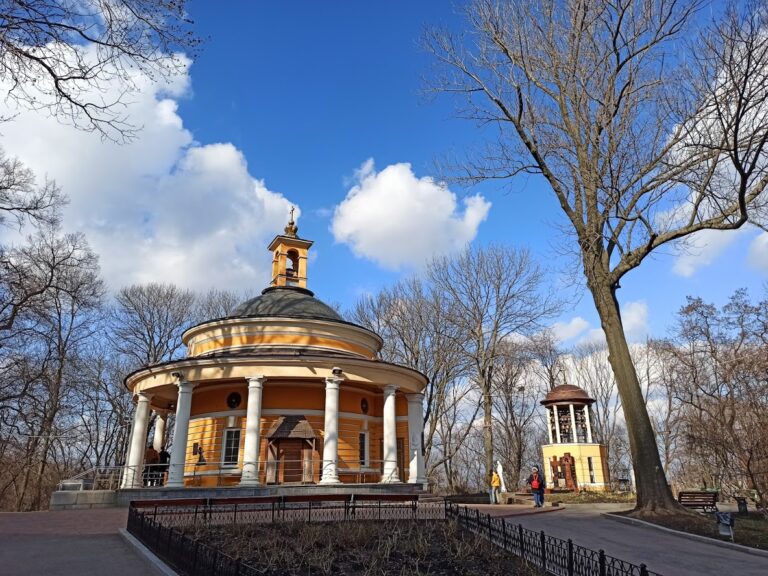
Church of the Conception of Saint Anne
The Church of the Conception of Saint Anne belongs to the Far Caves complex. A Russian attack in January 2026 damaged its entrance portion and facade elements.
Principal Churches and Monastic Buildings
Dormition Cathedral
The Dormition Cathedral, the monastery’s principal church, was founded in the eleventh century. It was rebuilt after earlier destruction and after the 1718 fire, then destroyed by the explosion of 3 November 1941. The surviving ruins were conserved in 1962 and 1963. Reconstruction took place between 1998 and 2000, and the cathedral was consecrated on 24 August 2000.
The former Great Church contained the wonder-working Dormition icon, relics of Saint Theodosius and Metropolitan Michael of Kyiv, and the head of Prince Vladimir. It also held the tomb of Prince Konstanty Ostrogski, a crypt beneath the Saint Stephen Chapel, an icon associated with Igor Olgovich, and burials of Peter Mohyla, Varlaam Yasinsky, and Field Marshal Peter Rumyantsev. The tomb monument of Konstanty Ostrogski, destroyed in the 1941 explosion, was reconstructed in 2021 through cooperation between Lithuania and Ukraine.
The reconstructed cathedral was directly damaged during the June 2026 Russian attack. The impact struck the area of the Saint Stephen Chapel and the roof, causing a fire of approximately 800 square meters and damaging the roofing structure, domes, walls, and the Tower of Saint John Kushnyk.
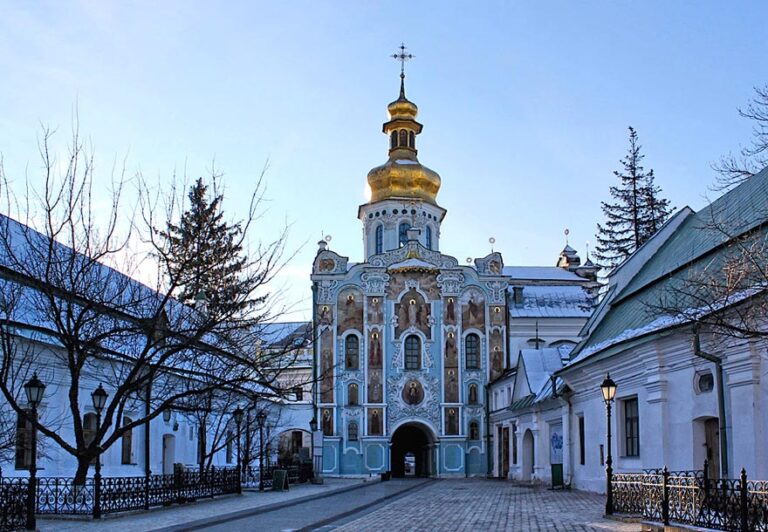
Trinity Gate Church
The Trinity Gate Church stands above the Holy Gates, the principal entrance to the monastery. Its foundation is traditionally attributed to Chernihiv Prince Sviatoslav II, and the present church was built over an earlier stone church. After the 1718 fire, its facades and interior walls received enriched stucco decoration. An eighteenth-century reconstruction added a gilded pear-shaped dome, plant-patterned exterior stucco, and a stone vestibule on the north side.
Early twentieth-century paintings on the fronts and entrance walls were executed by icon painters working under V. Sonin. The interior contains murals attributed to Alimpy Galik.
Refectory Chambers and Church of Saints Anthony and Theodosius
The Refectory Chambers and Church of Saints Anthony and Theodosius are the third known refectory complex at the Lavra. The first refectory and church, built in the twelfth century, has not survived. A second church dedicated to Saints Peter and Paul was built during the Cossack Hetmanate and demolished in the nineteenth century. The present refectory church was built in 1895, and regular services resumed there in 1990.
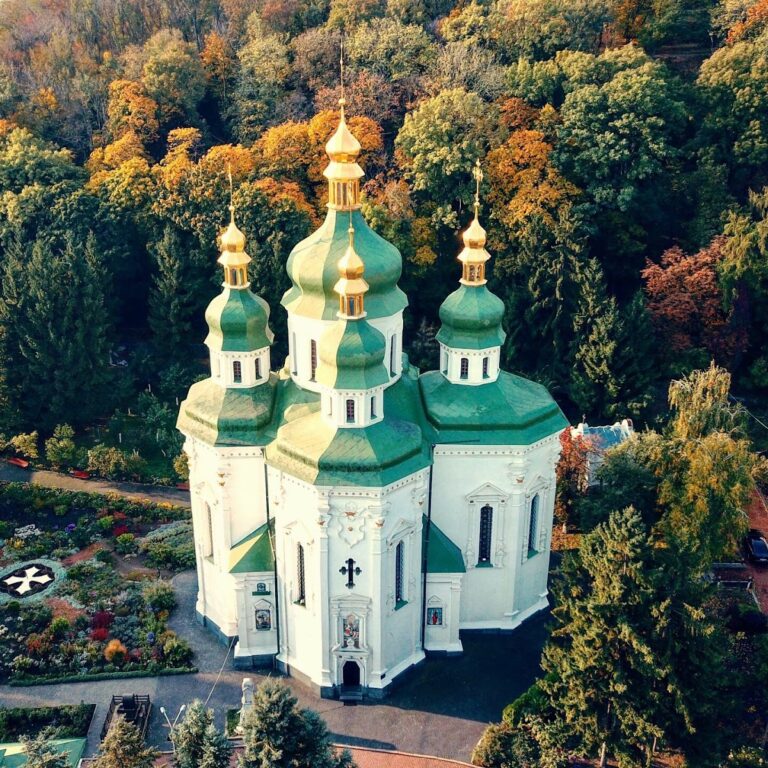
Church of All Saints
The Church of All Saints was erected between 1696 and 1698 and is an example of Ukrainian Baroque architecture. Its facades have rich architectural embellishment, while students of the Lavra art school painted its interior walls in 1905. The church retains an early eighteenth-century carved wooden iconostasis arranged in several tiers.
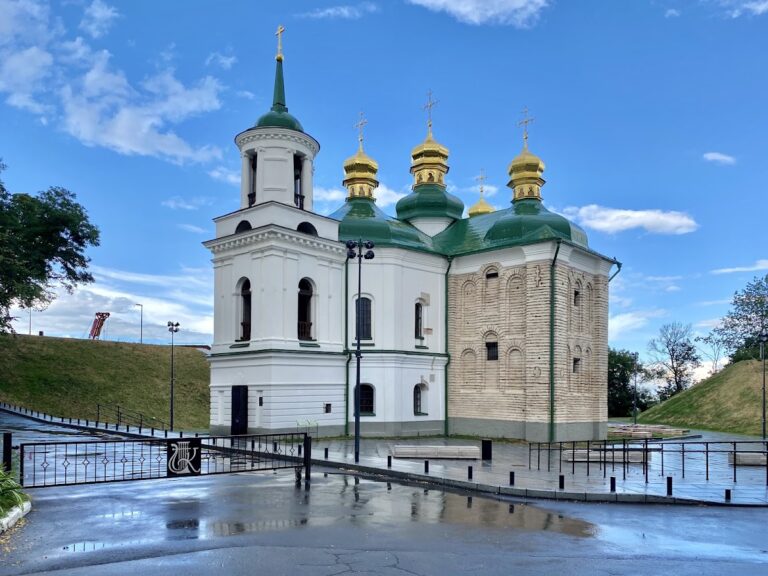
Church of the Saviour at Berestove
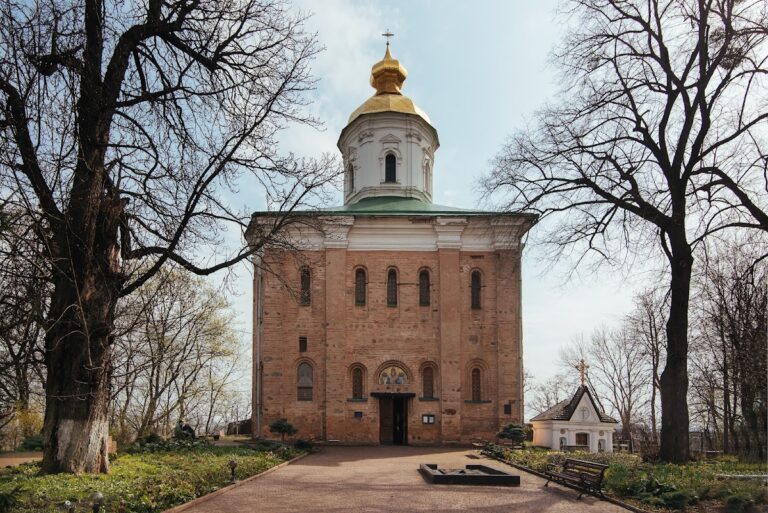
The Church of the Saviour at Berestove stands north of the main Lavra fortifications but forms part of the complex. It was built in the village of Berestove around the beginning of the eleventh century during the reign of Prince Vladimir Monomakh and later served as a mausoleum for members of the Monomakh dynasty. Burials associated with the dynasty include Yuri Dolgoruki, Oleg, son of Vladimir Monomakh, and Eufemia of Kyiv.
Other Churches and Institutional Buildings
Other buildings include the Church of the Life-Giving Spring, the Church of the Nativity of the Virgin, the Church of Christ’s Resurrection, the Annunciation Church, and the Church and former hospital chambers of the St. Nicholas Monastery. The complex also contains the St. Nicholas Monastery itself, the former hospital monastery near the main gates, and the theological academy and seminary buildings in the Lower Lavra.
Belltowers and Fortifications
Great Lavra Belltower
The Great Lavra Belltower was built between 1731 and 1745, after preliminary work began in 1707 with funds provided by Ivan Mazepa. Its completion was directed by the German architect Johann Gottfried Schädel. The structure rises approximately 96.5 meters, including its cross, and consists of several tiers topped by a gilded dome. It has 374 steps to its upper level and was visible from approximately 25 to 30 kilometers away.
Defensive Works
The Lavra’s defensive remains include a stone defensive wall, earthworks, bastion-type fortifications, courtyards, residences, and service buildings. The earthwork associated with Ivan Samoylovych, the later stone fortifications of Ivan Mazepa, and the bastion defenses constructed during the reign of Peter I reflect the monastery’s development as a fortified complex. A stone wall was built around the Lower Lavra during the mid-nineteenth-century reconstruction of the Pechersk fortress.
Burials, Collections, and Libraries
The Lavra’s historic necropolis contains more than a hundred burials. Alongside the Monomakh dynasty burials at the Church of the Saviour at Berestove and the saints buried in the caves, notable interments include Konstanty Ostrogski near the Dormition Cathedral, and Vasily Kochubey, Ivan Iskra, and Pyotr Stolypin near the Refectory Church.
The complex historically included a sacristy containing ancient Gospels, liturgical vessels, vestments, portraits, and documents, as well as a library on the choir lofts. Museum collections associated with the Lavra include precious-metal religious objects, prints, textiles, chalices, crucifixes, portraits of senior clergy, photographs, icons, and works from the printing house and icon-painting workshop.
The historical library and archive were destroyed or severely damaged in the 1718 fire. After the revival of monastic activity in 1988, library holdings were rebuilt from surviving books, new acquisitions, and publications from the restored Lavra printing house. More than 10,000 volumes had been collected within two decades. The library moved to more suitable premises in 2008, after which cataloguing and records were digitized.
Museums and Present Layout
The Upper Lavra contains museum and exhibition institutions, including the Museum of Books and Printing, the National Museum of Ukrainian Folk Decorative Art, the Museum of Theatre, Music and Cinema Arts, the Treasury of the National Museum of the History of Ukraine, and the National Historical Library of Ukraine. The Lower Lavra includes the theological academy and seminary buildings, the caves, churches, monastic structures, and other buildings associated with renewed religious use.
The physical ensemble therefore combines underground corridors and burial places with churches, belltowers, defensive works, institutional buildings, museum spaces, and service structures. More than 20,000 square meters of new construction may have been added to the preserve during the period of Ukrainian Orthodox Church use, while unauthorized construction and alterations to historic monuments were also documented.
Nearby sites