Basilica of Saint Anthony of Padua: A Franciscan Pilgrimage Shrine in Italy
Site at a Glance
- Rating
- 4.8
- Popularity
- Very High
- Country
- Italy
- Primary era
- Medieval
- External website
- Open
- Eras represented
- Medieval, Early Modern, Modern
- Civilizations
- Holy Roman Empire, Venetian
- Site type
- Religious
- Remains
- Basilica
On this page17 sections
History
The Basilica of Saint Anthony of Padua is a Catholic pontifical minor basilica and international shrine in Padua, Italy, built around the tomb of the Portuguese-born Franciscan preacher Anthony of Padua. Construction began in the 1230s and continued until 1310, producing a church that combines Romanesque, Gothic, Byzantine-Venetian, Renaissance, and Baroque elements. Locally called Il Santo, it is one of Padua’s principal Catholic sanctuaries and is administered by the Order of Friars Minor Conventual under a Pontifical Delegation.
The basilica is distinct from Padua’s cathedral, whose title belongs to the Cathedral-Basilica of Saint Mary. Its importance comes from the rapid development of Anthony’s tomb as a pilgrimage centre. More than 6.5 million pilgrims are received annually, while the basilica and associated buildings also form part of the UNESCO World Heritage property “Padua’s fourteenth-century fresco cycles,” inscribed in 2021.
Santa Maria Mater Domini and the cult of Anthony
During the medieval period, the site stood on the outskirts of Padua beside the small church of Santa Maria Mater Domini, which had been entrusted to the Friars Minor. Anthony stayed there from 1229 until May 1231, and a Franciscan convent was established beside the church, possibly through his own initiative in 1229. Anthony, who lived from 1195 to 1231, was a Portuguese-born Franciscan preacher who became especially associated with preaching, miracles, and the recovery of lost things.
Anthony died at Arcella, north of Padua, on 13 June 1231. In accordance with his wishes, his body was embalmed and buried at Santa Maria Mater Domini. Miracles attributed to the tomb soon drew pilgrims from Padua and from across the Alps. The commune, the bishop, university professors, religious orders, and the people of Padua jointly supported his canonization. Pope Gregory IX, who was pope from 1227 to 1241, canonized Anthony in Spoleto Cathedral on 30 May 1232, less than a year after his death.
A late-medieval tradition claimed that a temple of Juno had once occupied the site and that the people of Padua had dedicated and displayed war trophies there. This story has no historical or archaeological foundation. The securely known history of the shrine begins with Santa Maria Mater Domini and the Franciscan community associated with Anthony.
Building the basilica
After Anthony’s canonization, Santa Maria Mater Domini was considered too small for the growing pilgrimage. A larger church was therefore begun beside it, with the earlier building incorporated as the nucleus of the new basilica. Its surviving portion is now the Chapel of the Madonna Mora. The first church had a single nave, an apsidal presbytery, broad transepts, and two square bays covered by hemispherical domes. Later in the thirteenth century, aisles were added, and the building developed into a cross-shaped, domed church.
The eastern end was subsequently enlarged with an ambulatory, a passage around the choir or apse, and nine radial chapels arranged around it. The central radial chapel began on 28 September 1267, while the other eight were completed in 1296 and 1297. During the transfer of Anthony’s body on 8 April 1263, his tongue was found to be preserved. This discovery increased the shrine’s importance, and in 1265 the commune of Padua approved annual assistance of 4,000 lire to help complete the church. Anthony’s body was transferred to its transept chapel on 14 June 1310.
Later medieval transformations
Work continued after the main construction period. An incendio and the collapse of a campanile, or bell tower, in 1394 led to substantial rebuilding. The ambulatory was raised, the choir was reorganized, and a new choir screen was constructed. Pietro Lombardo worked in the basilica between 1464 and 1467, during a period when the church was receiving important Renaissance commissions.
The basilica was drawn into the military crisis of the War of the League of Cambrai in 1509. This conflict brought several European powers into opposition to Venice, whose troops held Padua. Because the church stood close to the city’s fortifications, it was affected by the actions of both the besieged Venetian forces and the imperial army. Each side occupied the basilica at different stages.
The shrine’s treasures suffered major losses when Padua was conquered by Venice in 1405 and again after the French revolutionary army arrived in 1797. The convent, rebuilt farther south when work on the basilica began, was described as a “noble monastery” in 1240. It underwent many alterations and extensions during the fourteenth century and acquired much of its present appearance in the fifteenth century.
Chapels, devotion, and artistic change
The Chapel of Saint Anthony, also called the Chapel of the Ark, was redecorated after its earlier frescoes deteriorated through damp. Its principal sculptural campaign was planned by Andrea Briosco and carried out by Giovanni and Antonio Minello and other artists, with later work by Giovanni Maria Falconetto. The campaign extended from the early sixteenth century to 1533, and the chapel was consecrated in 1532. Its later reliefs recount miracles attributed to Anthony.
The Chapel of the Blessed Sacrament was begun in 1457 for the tombs of the condottiero Erasmo Gattamelata, a professional military commander in medieval and Renaissance Italy, and his son Giannantonio. Originally dedicated to Saints Francis and Bernardino, it was rededicated to the Blessed Sacrament in 1651. A major decorative programme directed by Lodovico Pogliaghi was completed between 1927 and 1936. The Chapel of Saint James, later also called the Chapel of Saint Felix, was commissioned in the 1370s by Bonifacio Lupi, marquis of Soragna and an office-holder under Padua’s Carrara rulers. It became associated with the cult of Saint Felix in 1504.
The Chapel of the Blessed Luca Belludi was erected in 1382 for the Paduan patricians Naimerio and Manfredino Conti. Formally dedicated to the apostles Philip and James the Less, it became known by Luca Belludi’s name because his remains are preserved there. The chapel’s frescoes, completed around 1382, include a depiction of Padua near the end of the fourteenth century. The Chapel of the Sacred Heart began in 1624 as the Santuliana family burial chapel. It was later enlarged, and its decoration includes a 1958 gilded relief of Marcantonio Santuliana at the Battle of Lepanto.
The radial chapels acquired new dedications and decoration over time. The Chapel of Saint Joseph was formerly dedicated to Saint John the Evangelist, the Chapel of Saint Francis to Saint Clare, and the Chapel of Saint Stanislaus to Saint Bartholomew. Other chapels were likewise renamed, including the Chapel of Saint Leopold, formerly dedicated to Saint John the Baptist, the Chapel of the Blessings, formerly dedicated to Saint Catherine of Alexandria, and the Chapel of Saint Stephen, formerly dedicated to Saint Louis of Toulouse. The Chapel of Saint Boniface had formerly been dedicated to Saints Prosdocimus and Justina, while the Chapel of Saint Rose of Lima had formerly been dedicated to Saint Agatha.
The lateral chapels were extensively repainted in fresco during the twentieth century because earlier paintings had deteriorated through age and neglect. The basilica was damaged by the earthquake of 29 May 2012, when more than three square metres of decorated plaster by Casanova detached. Heritage authorities secured the fragments and protected the ambulatory around the presbytery against further falling material.
Administration and continuing religious life
Under the Lateran Pacts, ownership and administration of the basilica passed to the Holy See, although the complex remains within Italian territory. The 1993 apostolic constitution Memorias Sanctorum defines the relationships among the Pontifical Delegation, the Franciscan friars, and the Veneranda Arca di Sant’Antonio. This lay body has been responsible for conservation and maintenance of the complex since 1396. Archbishop Diego Giovanni Ravelli became pontifical delegate on 27 June 2023.
The basilica’s musical tradition includes Francesco Antonio Calegari as maestro di cappella in the 1720s, Giuseppe Tartini as maestro di cappella in the eighteenth century, and Luigi Bottazzo as organist from 1872. Its frescoed chapels, including those of Saint James and the Blessed Luca Belludi, contributed to the property “Padua’s fourteenth-century fresco cycles,” recognized by UNESCO in 2021.
Remains
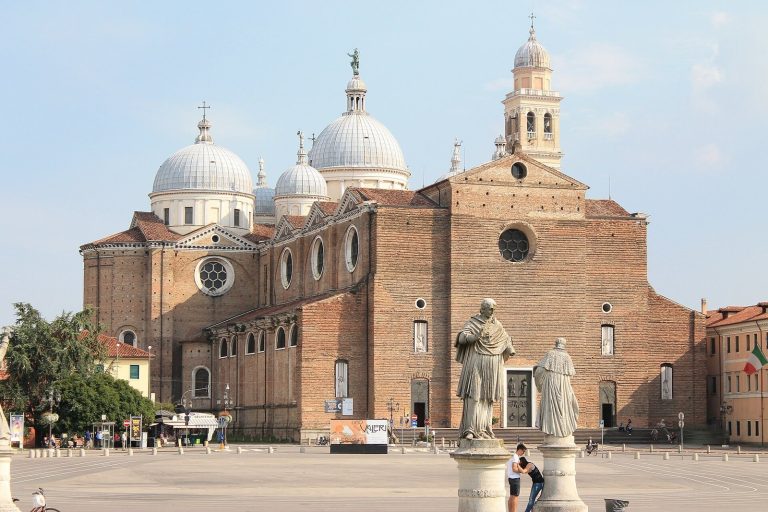
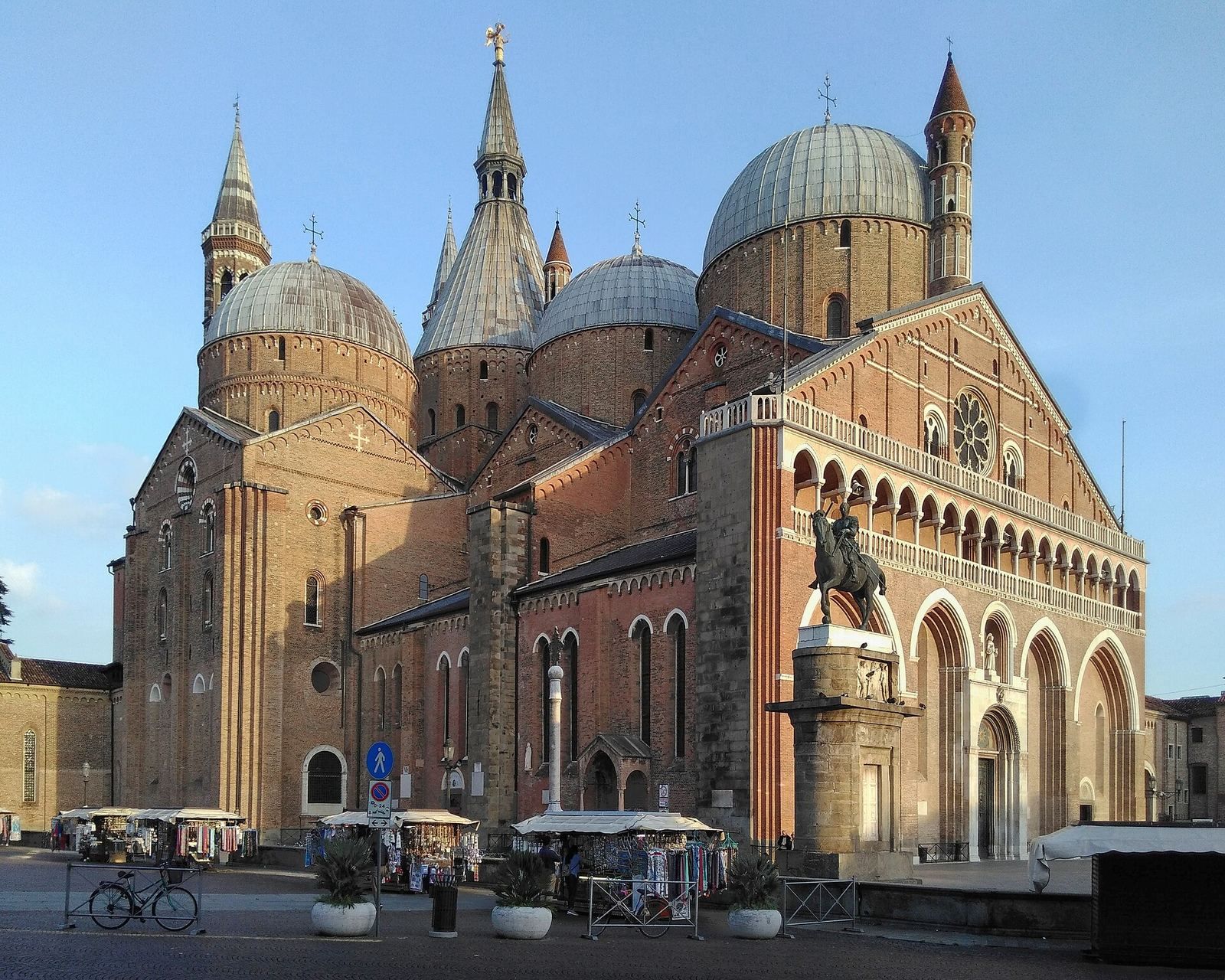
The basilica is a large Latin-cross building approximately 115 metres long and 55 metres across the transept. It has three aisles, a short transept, an eastern ambulatory, six principal chapels, and several cloisters. Its architecture brings together Romanesque, Gothic, Byzantine-Venetian, Renaissance, and Baroque forms. The exterior is particularly influenced by Saint Mark’s Basilica in Venice and by Byzantine traditions transmitted through Venice, while the eastern apse and ambulatory reflect French Gothic models.
Exterior and structural form
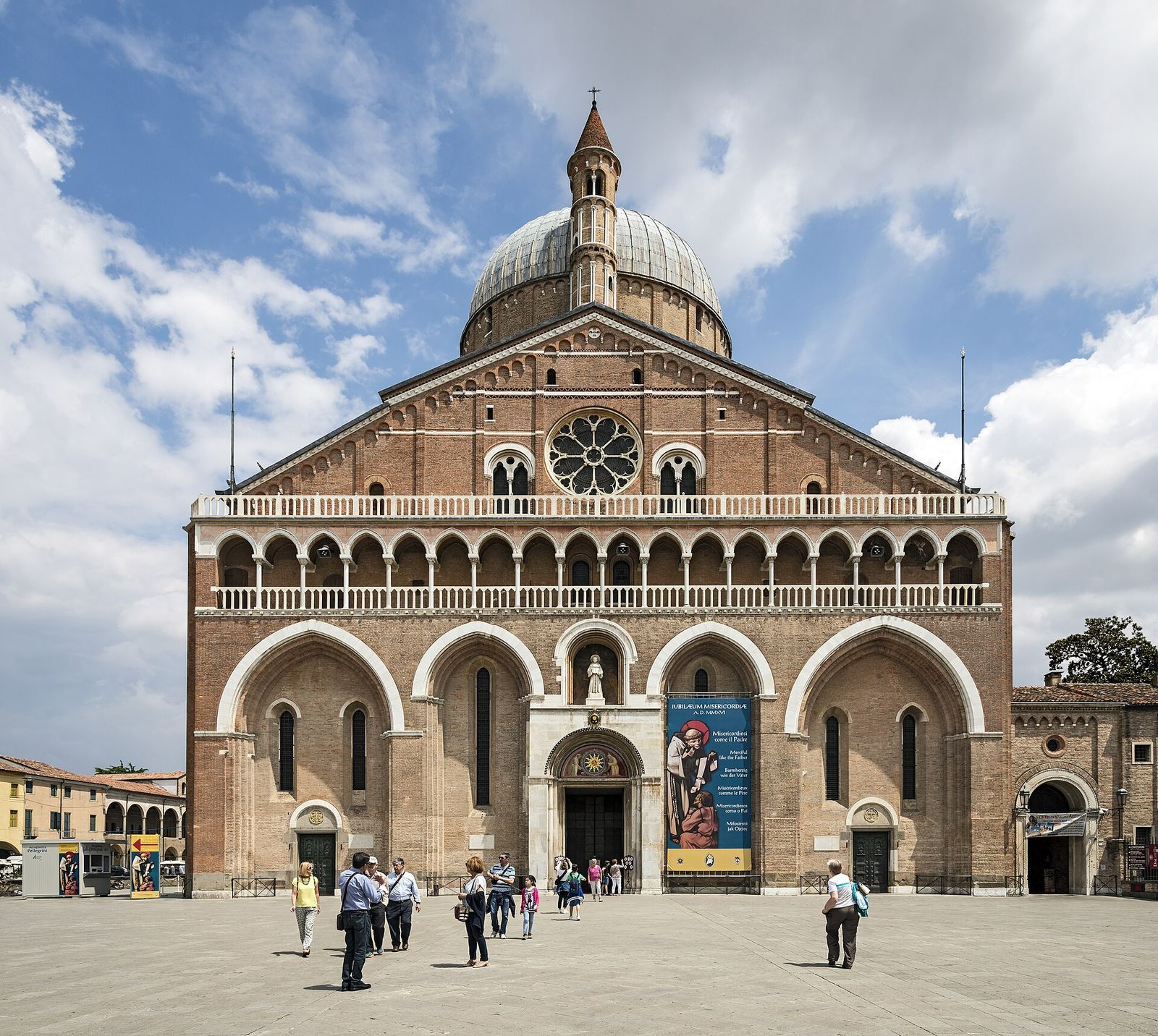
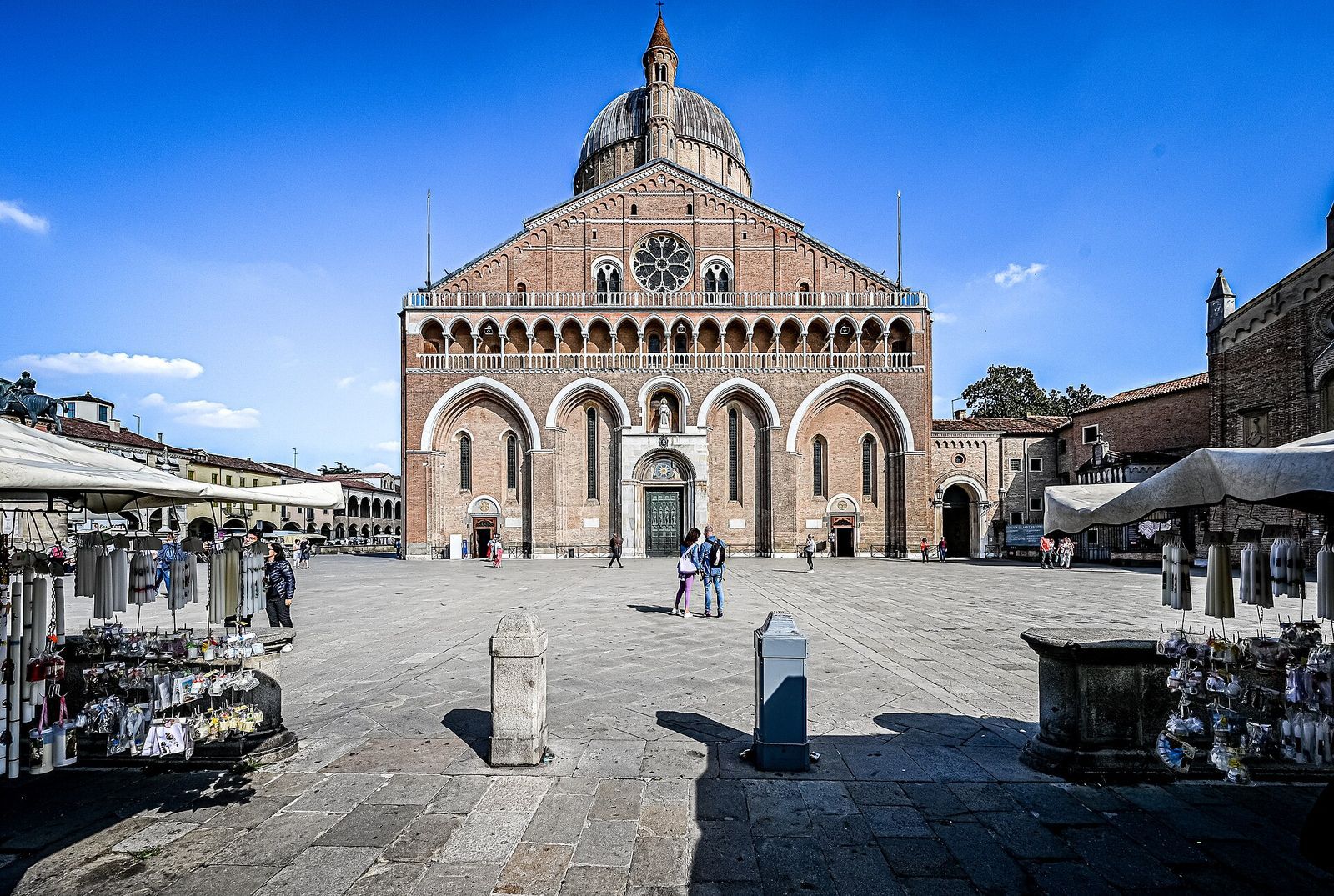
The brick facade is gabled, about 37 metres wide and 28 metres high. Its Romanesque central section was extended when the aisles were added, producing four deep Gothic recesses and a long arcaded loggia with a white stone balustrade. Broad buttresses, low gables with blind brick arcading, and several small towers give the front a massive sculptural profile. Three rose windows, circular windows with radiating tracery, illuminate the church, one in the facade and two at the transept ends.
Eight domes mark the roofline, together with two campaniles approximately 68 metres high and two smaller belfry-like towers often compared with minarets. The three bronze doors were designed by Camillo Boito and made in 1895. The central door includes figures of Saints Louis of Toulouse, Francis, Anthony, and Bonaventure by Giuseppe Michieli. Above the main portal stands a 1940 copy by Napoleone Martinuzzi of Rinaldino di Francia’s fourteenth-century statue of Saint Anthony. A copy by Nicola Lochoff of Andrea Mantegna’s image of Saint Anthony and Saint Bernardino adoring the monogram of Christ occupies the portal lunette. The originals are preserved in the Antonian Museum.
The former forecourt served as a cemetery for centuries. A surviving funerary monument on the basilica’s left exterior wall is the tomb of the jurist Antonio Orsato, who died in 1497. It consists of an elegant aedicule and a funerary urn. The two campaniles contain eight diatonically tuned bells cast in 1962 by Daciano Colbachini of Padua. They replaced a seven-bell set cast in 1799 and hang from wooden frames with falling clappers.
Interior, presbytery, and central nave
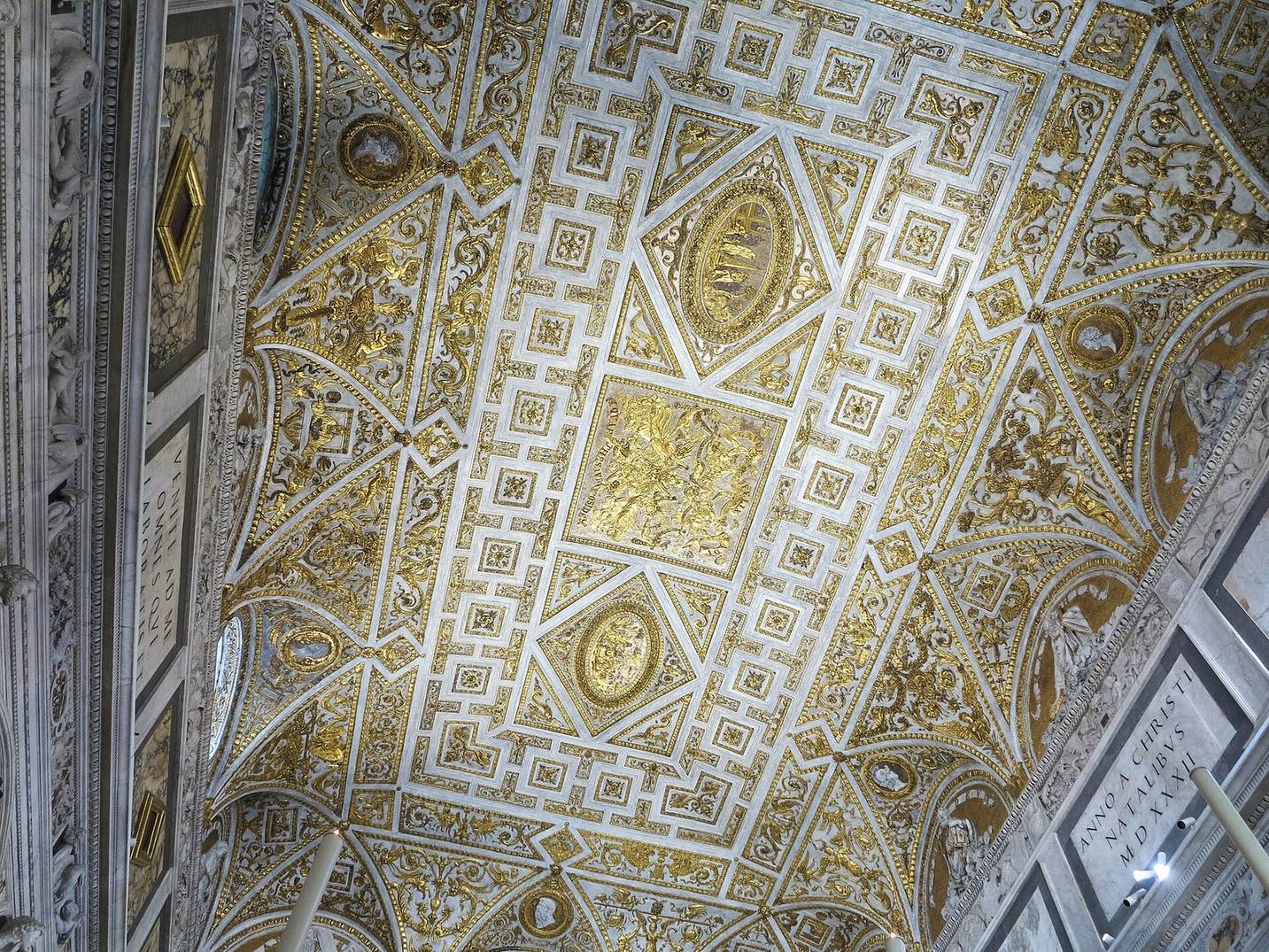
Massive piers divide the interior into three aisles, while galleries run along the upper walls. The principal supports are approximately 4.8 metres thick. Pointed arches, ribbed vaults, small circular windows, and Gothic rose windows organize the interior. The maximum height inside reaches 38.5 metres.
The presbytery contains Camillo Boito’s present high altar, which incorporates Donatello’s bronze sculpture, although the arrangement differs from the original fifteenth-century composition. The works include the Madonna and Child, Saints Francis, Anthony, Justina, Daniel, Louis, and Prosdocimus, as well as bronze reliefs and a Crucifix. The first Gothic high altar was demolished in 1448 to make way for Donatello’s altar. A later Mannerist altar by Giacomo Campagna and Cesare Franco was dismantled around 1668. Its ciborium was moved to the Chapel of the Blessed Sacrament and its triumphal arch to the rear of the apse. In 1895, Giovanni Lomazzi made bronze furnishings for the lectern and the cartagloria designed by Boito.
The central nave contains numerous funerary monuments, chiefly from the fifteenth to the seventeenth centuries. They commemorate figures connected with the civic and cultural life of Padua and the Venetian Republic, including Antonio Trombetta, the Caimo family, Simone Ardeo, Caterino Corner, Antonio Roselli, Alessandro Contarini, Costantino Dottori, and Pietro Bembo.
Pietro Lombardo’s Roselli mausoleum, made between 1464 and 1467, includes a jurist’s effigy, an urn beneath a triumphal arch, putti seated on tortoises, and a lunette showing the Madonna and Child with Saints Catherine of Alexandria and Mary Magdalene. The Contarini mausoleum combines works by Michele Sanmicheli, Alessandro Vittoria, Pietro Grazioli da Salò, Pietro Zoppo, and Danese Cattaneo. Its decoration includes a fleet relief, military trophies, telamons, Nereids, and a figure of Fame.
The right aisle contains the transferred altar of Saints Charles Borromeo and Joseph of Copertino, made in 1673 and moved from the destroyed church of Sant’Agostino in 1833. It also includes the Altar of the Souls, made in 1648 with statues added in 1663 and 1664, and monuments to Polish figures including Stanislaus Antonio Fryznekier and Cristoforo Sapieha.
Chapel of the Ark of Saint Anthony
The Chapel of the Ark occupies the left side of the church at the end of the left transept. Its facade has a double attic, four small columns, two pilasters, busts of the four Evangelists, and five statues. These represent Saint Justina by Giovanni Minello, Saint John the Baptist by Severo Calzetta, Saint Anthony by Giacomo Fantoni, Saint Prosdocimus by Sebastiano da Lugano, and Saint Daniel the Martyr by Giacomo Fantoni. Fantoni’s figures are stucco, while the others are marble.
The altar by Tiziano Aspetti, dated 1607, stands on a platform reached by seven steps and is crowned by statues of Saints Anthony, Bonaventure, and Louis of Toulouse made in 1593 and 1594. Its 1742 tabernacle and silver relief cartaglorie depict miracles and episodes associated with Anthony. Girolamo Paliari made the bronze altar grille in 1603, while Giovanni Balbi made the two silver candlesticks dated 1673 and 1686. Their marble supports are by Filippo Parodi and Orazio Marinali.
Nine marble high-reliefs line the chapel. They show Anthony receiving the Franciscan habit, the jealous husband, the resurrected young man, a resurrected young woman and child, the usurer’s heart, the healed foot, the intact glass, and the speaking child. The works were produced by Antonio Minello, Giovanni Rubino, Silvio Cosini, Danese Cattaneo, Jacopo Sansovino, Tullio Lombardo or his son Sante, Giovanni Maria Mosca, Pietro Paolo Stella, and Antonio Lombardo.
Madonna Mora and the medieval foundation
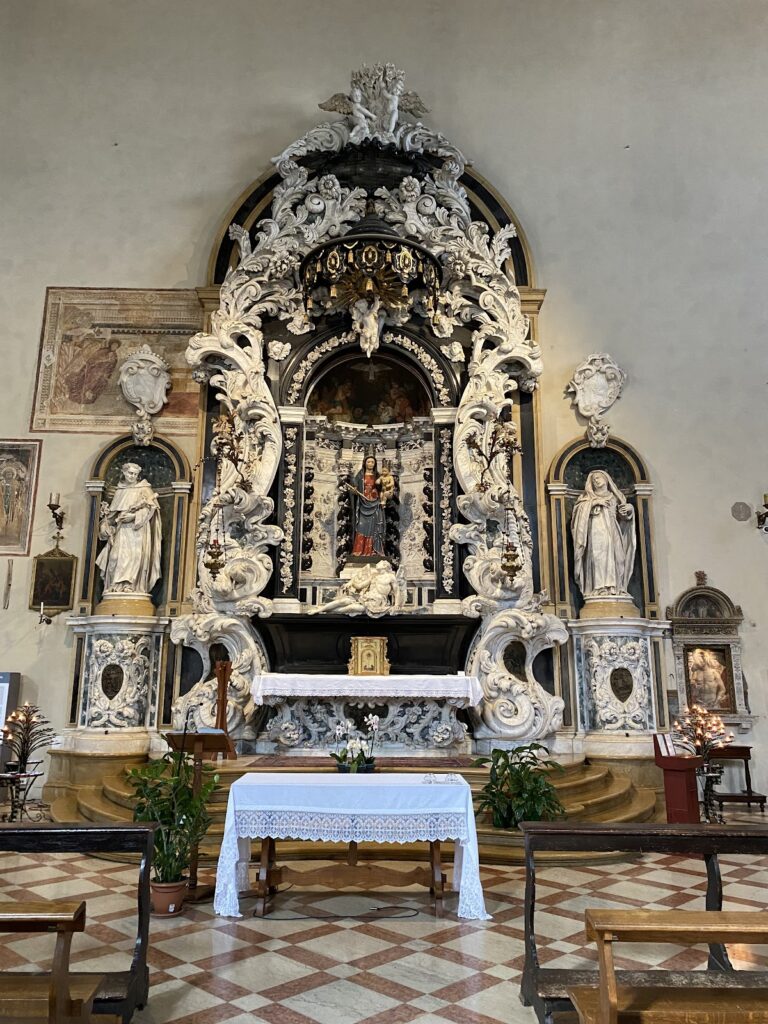
The Chapel of the Madonna Mora preserves the surviving part of Santa Maria Mater Domini, the late twelfth- or early thirteenth-century church associated with Anthony’s burial. Its Gothic baldachin altar carries sculptures of the Announcing Angel and Madonna, the Eternal Father, the Dead Christ, angels bearing the instruments of the Passion, Saint John the Baptist, and Mary Magdalene. The sculptures and the polychrome stone Madonna and Child are attributed to Rinaldino di Puydarrieux and his workshop. The Madonna and Child was made in 1396 for the Confraternity of Saint Anthony.
The chapel contains a background fresco traditionally attributed to a follower of Altichiero and, in another interpretation, recognized as a work by Giotto from the early fourteenth century. Other paintings include a fourteenth-century saint bishop, a Madonna and Child with four saints, a votive image of Saints Prosdocimus, Anthony, Michael, and Louis of Anjou, a fourteenth-century Saint Louis of Anjou, a Bologna-school Saint Francis with Saint Catherine and a donor, and the damaged Christ Taking Leave of His Mother, restored in 2017.
The arch bears reliefs of the Rogati-Negri family’s eagle emblem and a late-thirteenth-century Saint Anthony. A late-thirteenth-century red-marble Rogati-Negri sarcophagus shows Christ enthroned, heraldic eagles, and reliefs of Saints Prosdocimus, Matthew, Mark, John, and Justina. The chapel’s frescoes are badly worn through age, historical damage, and human neglect.
Chapel of the Blessed Luca Belludi
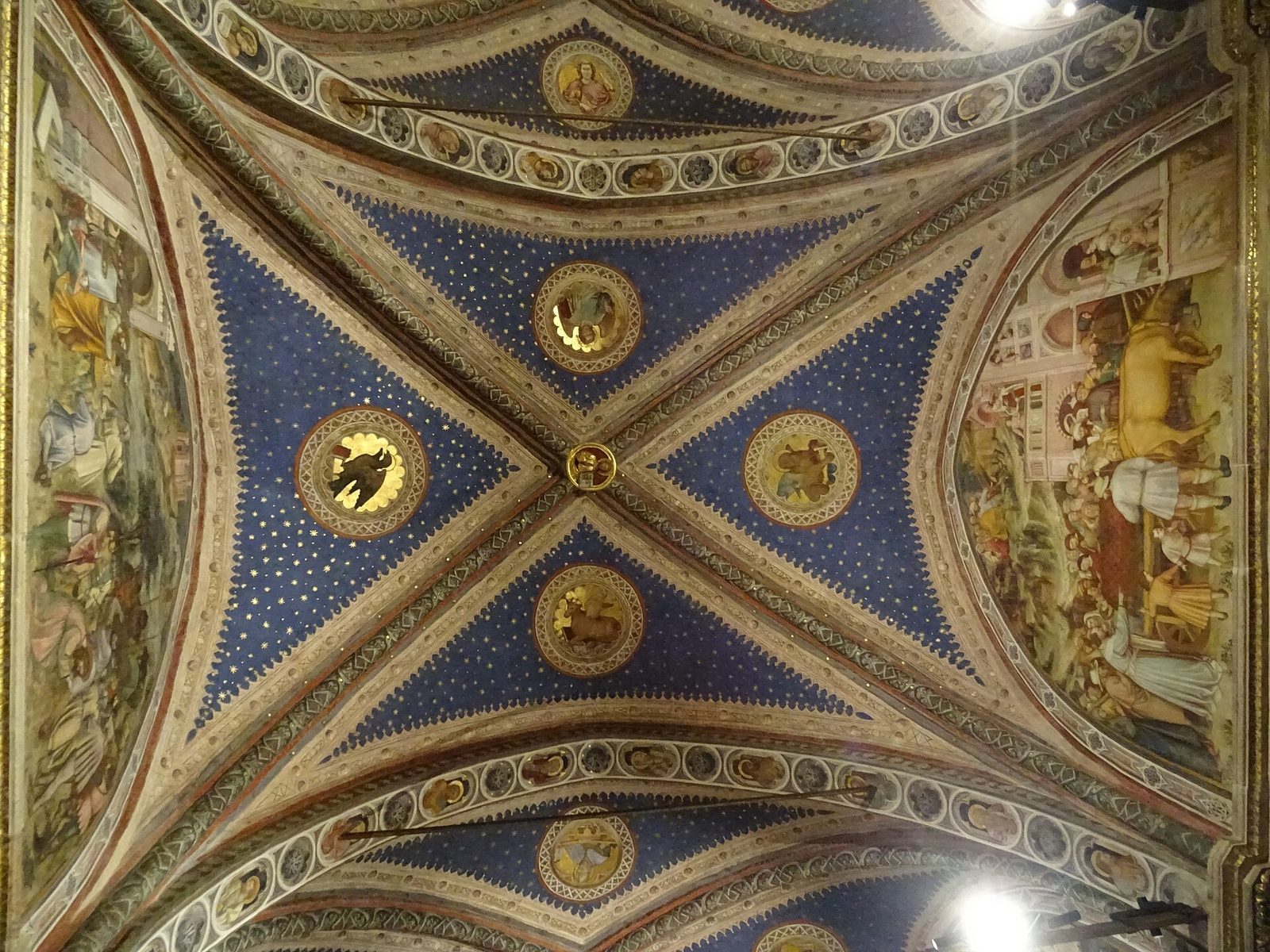
The Chapel of the Blessed Luca Belludi has a single nave, a ribbed vault, and a small semi-octagonal apse with a pavilion vault. Luca Belludi’s remains lie in a thirteenth-century ark reached by a five-step balustraded stair. A tradition says that Anthony’s remains were kept in this same ark between 1231 and 1263, but contemporary documents do not confirm the claim.
Giusto de’ Menabuoi and his collaborators painted 68 frescoes around 1382. Their subjects include the Virgin and Child with Francis, Louis of Anjou, Anthony, and Luca Belludi; donor portraits; the Annunciation; the Evangelists; episodes from the lives of Saints Philip and James; and scenes connected with Luca Belludi. These include Anthony’s prophecy of Padua’s liberation and the faithful gathered around Luca’s tomb. One painting shows Padua as it appeared near the end of the fourteenth century.
Chapel of Saint James and Chapel of the Blessed Sacrament
The Chapel of Saint James, also known as the Chapel of Saint Felix, is a Gothic room with five trefoil arches, marble-covered walls, and extensive fresco decoration. Altichiero da Zevio’s Crucifixion dominates the southern wall. Altichiero and Jacopo Avanzi painted scenes from the life of Saint James using episodes from the Golden Legend. A three-keyboard Mascioni organ, built in 1929, stands in the gallery above the chapel.
The square Chapel of the Blessed Sacrament is Gothic and supported by four corner columns with a ribbed vault. It contains the sarcophagi of Erasmo Gattamelata and his son Giannantonio, with sculptures by Gregorio d’Allegretto dated 1458. Original frescoes by Pietro Calzetta, Matteo del Pozzo, and Jacopo Parisati da Montagnana were completed in 1473, while the altarpiece by Jacopo Bellini and his sons Giovanni and Gentile also belonged to the earlier decoration. The present programme includes fourteen bronze figures by Lodovico Pogliaghi, representing figures regarded as precursors of the Eucharist.
Radial and family chapels
The Chapel of the Sacred Heart has a small apse, marble wall coverings, and a gilded relief of Marcantonio Santuliana at the Battle of Lepanto dated 1958. Its present altarpiece is a panel by Pino Casarini showing Christ displaying his wounded side. The Chapel of Saint Joseph contains a 1895 statue by Leonardo Liso and frescoes by Antonio Ermolao Paoletti. The Chapel of Saint Francis has twentieth-century frescoes by Adolfo De Carolis and Ubaldo Oppi and a 1928 bronze statue by Aurelio Mistruzzi.
The Chapel of Saint Stanislaus was repainted in fresco by Taddeo Popiel from 1899. Its decoration includes scenes from the saint’s life, images of the Virgin of Ostrabrama and the Virgin of Czestochowa, Polish saints, a 1905 bronze bust of King John III Sobieski by Antonio Madeyski, a bust of Erasmo Kretkowski by Francesco Segala, and a memorial to Princess Carolina Jablonowska with a Neoclassical relief by Luigi Ferrari.
The Chapel of Saint Leopold contains a wooden altar by Ferdinand Stuflesser and frescoes from 1905 by Gherardo Fugel. Its fourteenth-century sarcophagus of the jurists Aicardino and Alvarotto degli Alvarotti has twisted columns, arches, the Mystic Lamb, lambs, and crosses, and may reuse an eleventh-century tomb. Opposite it stands the late-fourteenth-century tomb of Biancofiore da Casale.
The Chapel of the Blessings contains twentieth-century paintings by Giuseppe Cherubini, a fourteenth-century funerary ark of the Zabarella family, and Pietro Annigoni’s frescoes Saint Anthony Preaching to the Fish from 1981 and Saint Anthony Meets Ezzelino from 1982. Annigoni also painted the Crucifixion altarpiece in 1983. Earlier frescoes in the entrance arch have been attributed to Giotto or his collaborators and have also been associated with the Scrovegni family.
The Chapel of Saint Stephen contains frescoes begun by Ludovico Seitz and completed by Biagio Biagetti in 1907 and 1908, a Biagetti altar, and a 1915 bronze statue by Lodovico Pogliaghi. The entrance-arch frescoes date from the second half of the fourteenth century. The Chapel of Saint Boniface has stained glass bearing the arms of Catholic German regions. The Chapel of Saint Rose of Lima contains Biagio Biagetti’s frescoes from 1913 and 1914 and a signed 1924 bronze statue by Aurelio Mistruzzi. Tiepolo’s Martyrdom of Saint Agatha, formerly associated with the chapel, is now in the Antonian Museum.
Treasury Chapel and relics
The present Treasury Chapel replaced an earlier apsidal chapel dedicated to Saint Francis, begun in 1267. The round Baroque chapel was built in 1691 under Filippo Parodi and completed within three years. Its lantern dome was demolished in 1739 because it threatened to collapse and was replaced by the present hemispherical masonry dome with an external lead covering. Relics were transferred there from the sacristy in 1745. The chapel measures 13.29 metres across internally and reaches 20 metres in height.
Filippo Parodi created the marble group of Saint Anthony in Glory, while Pietro Roncaioli made the stucco angels and dome decoration. Augusto and Ferruccio Sanavio and Carlo Bianchi produced the Neo-Baroque Glory of Purity between 1910 and 1913. The chapel contains an 81-centimetre gilded-silver reliquary for Anthony’s tongue by Giuliano da Firenze, a pupil of Ghiberti, and a book-shaped reliquary for the saint’s vocal apparatus made by Carlo Balljana in 1981.
Anthony’s chin is held in a bust-shaped reliquary made in 1349 for Cardinal Guy de Boulogne. Its fifteenth-century base has four small lions. The relic was stolen on 10 October 1991 and recovered intact near Rome. Other principal objects include a 1440 gilded-silver thurible by Marco Baldi, a sixteenth-century incense boat, a Turkish-style gilded-silver mace donated by King John III Sobieski, and a 1672 reliquary containing Anthony’s radius. The latter was offered in thanks for the recovery of Victor Amadeus II of Savoy.
The treasury also preserves a French Renaissance ciborium with 23 cameos acquired in 1586, a gold chalice with enamel and emeralds donated in 1733 by Maria Amalia of Habsburg, a fifteenth-century acorn-shaped scent container, and an allegedly miraculous glass associated with the heretic Aleardino and covered with thirteenth-century silver decoration. Other objects include two objects associated with the Garden of Gethsemane, a fifteenth-century silver and mother-of-pearl incense boat, a 1462 reliquary of Saints Gregory and Vincent by Marco Baldi, and a stone traditionally said to have served as Anthony’s pillow.
Additional reliquaries contain a crystal cross made in 1436 and 1437 by Gian Agostino Elini and Giovanni Fabbro, a 70-centimetre fourteenth-century container for the skin of Anthony’s head retouched by Filippo Baldi, and a Renaissance reliquary for the saint’s cilice. Other containers hold three thorns from Christ’s crown, Anthony’s hair, finger, clothing, and fragments of his head skin, together with relics of Saints Prosdocimus, Gregory, Vincent, James, Lawrence, Thaddeus, Catherine, Mary Magdalene, and Justina. A 1505 ampulla contains the blood of Saint Felix.
The chapel further preserves a gilded copper cross, a fifteenth-century reliquary containing a fragment of Christ’s tomb, a fourteenth-century gilded-silver reliquary for Saint Lawrence’s finger, a fifteenth-century container for part of Saint Bernardino’s habit, and a fifteenth-century brass disk inlaid with mother-of-pearl and hard stones bearing the trigram of Christ. Written objects include Giuseppe da Copertino’s autograph letter dated 1650 and signed notes by Alphonsus de Liguori and Vincent de Paul.
Sacristy, clock, and organ
The sacristy contains a late-fifteenth-century marble relief of Saints Francis and Anthony by Giovanni and Antonio Minello, two 1518 frescoes showing Anthony preaching to the fish and the miracle of the intact glass, a well-preserved late-thirteenth-century Virgin and Child with Saints Anthony and Francis, and a 1519 portrait of Bartolomeo Campolongo. Pietro Liberi frescoed the low barrel vault with the Glory of Saint Anthony in 1665.
A large built-in western cabinet made by Bartolomeo Bellano between 1469 and 1472 housed the basilica’s relics until 1745. Its design was influenced by Pietro Lombardo’s Roselli mausoleum. The basilica’s astronomical clock was made by Bartolomeo Ferracina in 1759 to replace one destroyed in the fire of 25 March 1749. Its mechanism is in the attic. A sundial in the Novitiate Cloister bears the inscription “Ora tua semper incerta.”
The Mascioni organ, opus 417, was built in 1929 using material and the monumental facade of Carlo Vegezzi Bossi’s 1895 organ. It originally had three keyboards, 52 stops, and 3,573 pipes. Two additional bodies were added in 1931, followed by a five-keyboard console in 1932. After restoration and reconstruction in 2011, the instrument has electronic computerized transmission, 98 sound stops, 51 mechanical stops, more than 6,000 pipes, and eight sections distributed between the presbytery and the gallery above the Chapel of Saint James.
Franciscan convent and cloisters
The convent consists of buildings arranged around four cloisters. The Chapter, or Magnolia, Cloister is the earliest posthumous nucleus of the convent and was renovated around 1433. Cristoforo da Bolzano designed the late-Gothic General Cloister in 1435. The Paradise Cloister was built around 1445, with a ten-column portico surrounding part of the former cemetery forecourt. The Novitiate Cloister and its surrounding buildings were constructed between 1474 and 1482, possibly at the initiative of Pope Sixtus IV. The Novitiate Cloister later suffered severe damage during the War of the League of Cambrai and was restructured.
The Novitiate Cloister has 28 trachyte columns, Gothic arches, and a Renaissance loggia. The General Cloister contains memorials to musicians associated with the basilica, including Francesco Antonio Vallotti, Giuseppe Tartini, Oreste Ravanello, and Antonio Callegari. The Paradise Cloister contains the memorial to Felice Rotondi and sarcophagi of the Engelfredi family and Pietro Riario.
The Magnolia Cloister contains many funerary monuments and inscriptions, including those of Johann Georg Wirsung, Giovanni Brambilla, Giovanni Cotunio, Angelo Borghini, Luigi Visconti, the Paradisi family, Antonio Piatto, the Capodivacca family, Gabriele Falloppio, Melchiorre Guilandino, Bettina di San Giorgio, the Lupi di Soragna family, Biagio du Boucquet, Scipione Cattaneo, and the Papafava da Carrara family.
Its sarcophagi of Guido da Lozzo and Costanza d’Este, dated 1295 and 1287, are regarded as the oldest works in the basilica. They reuse tenth-century marble slabs. The connecting atrium contains the tomb of Caterina Franzesi, the tomb of Federico Lavellongo with a lunette attributed to Altichiero, and the ark of Bonzanello and Nicolò da Vigonza with a fresco of the Coronation of Mary by Giusto de’ Menabuoi. A monumental Magnolia grandiflora grows at the centre of the Chapter Cloister and was listed among Veneto’s 88 officially recorded monumental trees in 2017.