Sainte-Chapelle: A Rayonnant Gothic Royal Chapel in Paris


Site at a Glance
- Rating
- 4.6
- Popularity
- Very High
- Country
- France
- Primary era
- Medieval
- External website
- Open
- Eras represented
- Medieval
- Civilizations
- French
- Site type
- Religious
- Remains
- Chapel
On this page14 sections
History
Sainte-Chapelle is a royal palace chapel in Paris, France, built by the medieval French monarchy in the Rayonnant Gothic period during the reign of Louis IX, also known as Saint Louis. Constructed within the Palais de la Cité, the principal royal residence until the fourteenth century, it was intended to house and display the king’s collection of Passion relics, especially the Crown of Thorns and a fragment of the True Cross.
Louis IX and the royal relics
Louis IX began acquiring Passion relics in 1239. The Passion refers to the suffering and crucifixion of Jesus Christ, and its relics were objects traditionally associated with those events. The king purchased the Crown of Thorns from Baldwin II, the Latin emperor of Constantinople, for 135,000 livres tournois. He later obtained parts of the Holy Lance, the Holy Sponge, the Holy Blood, and the Stone of the Holy Sepulchre.
The relics reached Paris in August 1239 and were first placed in the earlier Chapel of Saint Nicholas, which stood on the site later occupied by Sainte-Chapelle. Before the new chapel was finished, they were also kept in royal chapels at Vincennes and Saint-Germain-en-Laye. Louis used the collection to associate the French monarchy with Byzantine and imperial traditions and to present himself as a leading monarch of Western Christendom.
Construction and consecration
Work on Sainte-Chapelle began between autumn 1241 and May 1244. In 1246, Louis IX founded a college of five master chaplains to guard the relics, maintain the windows and lights, and conduct worship. The chapel was consecrated on 26 April 1248. Eudes of Châteauroux, the papal legate, dedicated the upper chapel to the Holy Cross, while Philippe Berruyer, archbishop of Bourges, dedicated the lower chapel to the Virgin Mary.
The building was completed in approximately four to six years and cost about 40,000 livres tournois. Its architect is not securely identified. A tradition first recorded in the sixteenth century attributed the design to Pierre de Montreuil, while later interpretations have proposed Thomas de Cormont, Robert de Luzarches, Jean de Chelles, or an unidentified master mason from Amiens.
Sainte-Chapelle served four principal purposes. It housed and displayed the royal relics, functioned as a palace chapel, accommodated its college of chaplains, and provided worship for the palace household. The upper chapel was intended mainly for the royal family, clergy, and invited guests. Palace personnel and other non-royal worshippers used the lower chapel. The building was connected directly to the palace by the Galerie des Merciers, and Louis IX had a private oratory in the upper chapel’s south wall.
The chapel institution
The clergy of Sainte-Chapelle were exempt from the jurisdiction of the bishop of Paris. In 1273, they were formally attached to the Holy See, the jurisdiction of the pope. The chapel was never made a collegiate church. Its college of canons remained distinct from the perpetual chaplains who celebrated foundation masses for deceased members of the royal family.
The treasurer, who also served as the chapel’s parish priest, guarded the treasury and supervised the spiritual welfare of the clergy, lay staff, and certain palace officials. The cantor directed the choir and attended all services. Clergy members were required to live within the palace. At first, the building had stone benches rather than choir stalls, and a rood screen, a partition separating the sanctuary or choir from the nave, was added later.
Royal ceremonies and the cult of Saint Louis
The chapel’s major ceremonies included observances connected with the Passion relics. On Good Friday, the True Cross was displayed to the faithful, while daily masses were celebrated in both chapels. Religious orders with special privileges could also hold services there.
Sainte-Chapelle hosted important royal ceremonies until the end of the fourteenth century. These included the coronation of Marie of Brabant in 1275, the marriage of Henry VII of the Holy Roman Empire and Margaret of Brabant in 1292, the coronation of Marie of Luxembourg in 1323, the coronation of Jeanne of Évreux in 1326, and the coronation of Isabeau of Bavaria in 1389. After this period, the chapel was used mainly for funerary services. Louis XVI later prohibited further funeral services after a dispute that followed the death of Louis XV.
Louis IX was canonized by Pope Boniface VIII in 1297, twenty-seven years after his death. In 1306, part of the king’s skull was transferred from the royal necropolis at Saint-Denis to Sainte-Chapelle. Its presence was intended to remind the nearby Parlement of Paris to uphold the law and administer justice.
Medieval and early-modern changes
The chapel continued to be altered after its thirteenth-century completion. A Flamboyant rose window and a southern access stair were added during the later medieval period. Renaissance changes included a wooden casing around the base of the great reliquary, a rood screen with two enamelled copper altarpieces by Léonard Limosin, and a Renaissance organ.
The organ was replaced in 1493, 1550, and 1762. A two-storey Treasury of Charters was built north of the apse. Its lower level served as a sacristy, while its upper level held royal documents, seals, and two cupboards for reliquaries. The treasury was demolished in the late eighteenth century during the expansion of the Palace of Justice.
Fires in the palace in 1630 and 1776 damaged the chapel. A flood in 1690 severely affected the painted decoration of the lower chapel, and its original stained glass was subsequently removed and replaced with colourless glazing.
Revolutionary damage and the dispersal of the relics
During the French Revolution, Sainte-Chapelle was emptied and its religious and royal symbolism was attacked. Its spire was demolished, and the building was used successively by the Sainte-Chapelle Club and, from 1797, as an archive repository for the Palace of Justice.
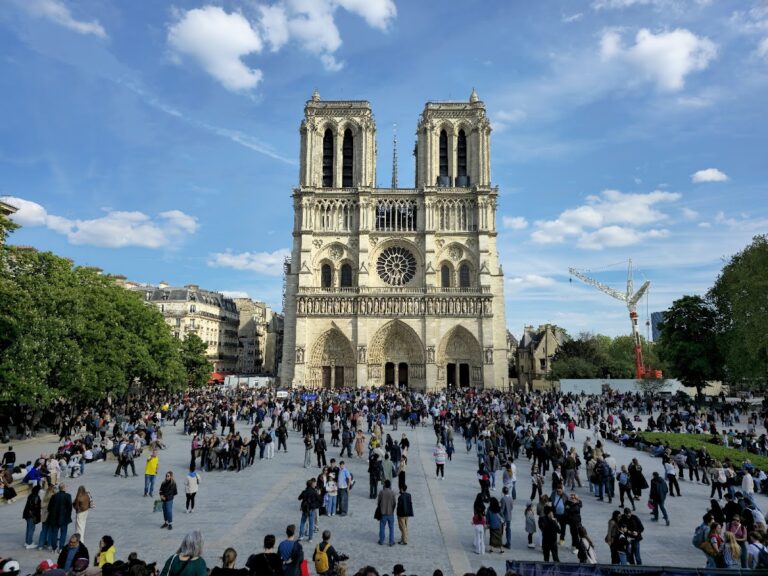
The great reliquary and other reliquaries were melted down for their precious metals, and the relics were dispersed. The Crown of Thorns eventually passed to Notre-Dame de Paris. It survived the 2019 fire there, was temporarily kept in the Louvre, and returned to Notre-Dame in December 2024.
Nineteenth-century restoration and later conservation
Plans to expand or reconstruct the Palace of Justice created a threat to Sainte-Chapelle. The decision to preserve the chapel was taken in 1836, and restoration began in 1837. Félix Duban directed the work at first, with Jean-Baptiste-Antoine Lassus serving as inspector. Lassus and Émile Bœswillwald later directed the project, which lasted approximately twenty-six to twenty-eight years and was completed in 1863.
The restoration treated the exterior stonework, portals, sculpture, painted decoration, flooring, lighting, stained glass, and spire. The reliquary tribune and its canopy were reconstructed, but the great reliquary, its enclosure grille, and a permanent high altar were not recreated. Further conservation campaigns began in 2008 and included work on the masonry, stained glass, façade, and sculpture.
Sainte-Chapelle was listed as a historic monument in 1862. Since 1991, it has formed part of the Paris, Banks of the Seine World Heritage property. The Centre des monuments nationaux administers it as a museum.
Remains
Sainte-Chapelle is a two-level Rayonnant Gothic building conceived as a monumental reliquary. Rayonnant Gothic is a phase of French Gothic architecture characterized by vertical emphasis, extensive traceried glazing, slender supports, and the visual reduction of masonry. The exterior is approximately 36 metres long, 17 metres wide, and 42.5 metres high without the spire. The present spire adds about 33.25 metres, bringing its summit to approximately 75.75 metres above ground level.
Overall structure and exterior
The two chapels are arranged one above the other and are connected by two stair turrets. The building consists of four rectangular bays, a choir bay, and a seven-sided apse, all covered by rib vaults. The upper chapel rises to approximately 20.5 metres, while the lower chapel is 6.6 metres high. Concealed iron tie-rods and chains counter the outward pressure of the vaults.
Outside, the buttresses are crowned by pinnacles, crocketed gables, gargoyles, and openwork balustrades. Lead sheets cover the roof, and a monumental statue of the Archangel Michael stands at the eastern end of the ridge. The present spire was built between 1853 and 1855. It has a wooden structure covered with decorated leadwork showing foliage, fleur-de-lis, angels carrying the instruments of the Passion, and the Apostles. The figures of Saint Thomas and Saint Philip bear, respectively, the features of Lassus and the painter Louis Steinheil.
Western façade and portals
The western façade includes a two-storey porch, octagonal stair turrets, and a large Flamboyant rose window installed in the late fifteenth century. Approximately 9 metres in diameter, the rose window contains eighty-nine panels depicting scenes from the Apocalypse.
Revolutionary damage destroyed the original portal sculpture. Adolphe-Victor Geoffroy-Dechaume reconstructed it between 1854 and 1873. The lower portal depicts the Coronation of the Virgin, while the upper portal depicts the Last Judgment. The original portal doors survive, although copies were installed because of their condition.
Lower chapel
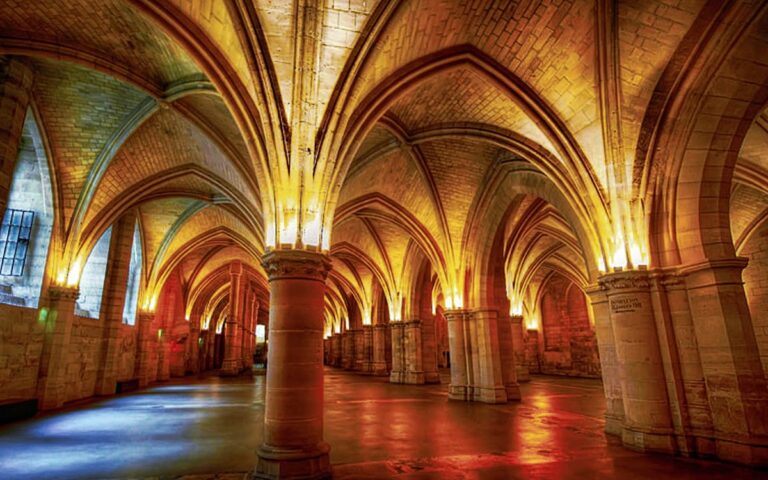
Dedicated to the Virgin Mary, the lower chapel has a central vessel about 6 metres wide and two very narrow side aisles. Its supports carry the upper chapel, and approximately 140 mid-thirteenth-century capitals are carved with acanthus leaves. Much of the visible red, blue, and gold colouring derives from the nineteenth-century restoration.
The lower chapel’s present windows were designed by Steinheil. They use grisaille, a predominantly grey stained-glass technique that admits light while providing painted decoration, and depict scenes from the life of the Virgin. A thirteenth-century mural of the Annunciation was rediscovered and restored during the nineteenth-century work. The lower chapel is currently used as a shop operated by the Centre des monuments nationaux.
Upper chapel and stained glass
The upper chapel forms a rectangle approximately 33 metres long and 10.7 metres wide, with four bays and a seven-sided apse. Its lateral windows are approximately 15.35 metres high and 4.7 metres wide, while the apse windows are approximately 13.45 metres high and 2.1 metres wide. The apse bays are slightly narrower and shorter, producing an optical effect that makes the chapel appear longer.
The single spacious vessel contains approximately 615 square metres of stained glass, excluding the western rose window. Two small royal alcoves are set into the upper chapel, with the king’s alcove on the north side and the queen’s on the south. The vaults are painted blue and scattered with small gold stars.
The fifteen principal windows and the western rose window contain an extensive narrative programme of approximately 1,113 individual scenes. The sequence begins with Genesis and continues through the history of the Hebrew people and prophetic narratives. The apse includes scenes from the New Testament, while the final southern nave window depicts Louis IX’s transfer of Christ’s relics to Paris.
During the nineteenth-century restoration, the painted decoration was reconstructed using surviving fragments, watercolours, manuscript illumination, and chemical analysis. Lassus designed the upper chapel’s stone floor from drawings by Steinheil, and Bœswillwald executed it. Its decoration includes foliage, birds, quadrupeds, heraldic emblems, the four rivers of Paradise, and the seven sacraments.
Reliquary tribune and liturgical furnishings
The Passion relics were originally displayed in the Grand Chasse, a large metal reliquary made to preserve and display sacred objects. Approximately 2.7 metres wide, it was first placed above the altar and then moved during the mid-thirteenth century to a high tribune in the apse. The tribune was reached by two wooden spiral staircases and protected by a canopy. The reliquary could rotate on its axis to assist the public display of the relics.
The original Grand Chasse carried sculpted reliefs on three sides. The west showed the Crucifixion, the north the Flagellation, and the south the Resurrection. The reliquary and most of its associated metalwork were destroyed during the Revolution. Surviving elements and historical visual evidence were used to reconstruct the tribune between 1843 and 1850.
The organ was recorded from the chapel’s earliest period and was replaced several times. The 1762 instrument was built by François-Henri Clicquot in a case designed by Pierre-Noël Rousset. It was transferred in July 1791 to Saint-Germain-l’Auxerrois.
Nearby sites