Neuenwalde Convent: A Lutheran Damsels’ Convent in Germany


Site at a Glance
- Rating
- 4.6
- Popularity
- Very Low
- Country
- Germany
- Primary era
- Early Modern
- External website
- Open
- Eras represented
- Medieval, Early Modern, Modern
- Civilizations
- Holy Roman Empire
- Site type
- Religious
- Remains
- Monastery
On this page17 sections
History
Neuenwalde Convent is a Lutheran damsels’ convent in Germany, in Neuenwalde, now part of Geestland in Lower Saxony. Six members of the Lords of Diepholz founded it as a Roman Catholic nunnery in 1219. Since 1584, it has functioned as a Protestant residential institution for unmarried women rather than as a monastery of enclosed Catholic nuns. Its long history includes two medieval relocations, territorial lordship, religious conflict, destruction during the Thirty Years’ War, and continued operation under the Bremian Knighthood.
Foundation at Midlum
The founders endowed the institution with estates and transferred it to the cathedral chapter of the Archdiocese of Bremen, the medieval ecclesiastical territory governed by the prince-archbishops of Bremen. The Diepholz family initially held the convent’s advocacy and protection, a role later taken over by the related Knights of Bederkesa. Prince-Archbishop Gebhard of Lippe confirmed the foundation in 1227, and Emperor Frederick II placed it under imperial protection in 1232.
Frederick’s document described the convent as Cistercian, although its original formal affiliation remains unclear. The nuns may have followed Cistercian customs without being formally incorporated into that order. A church at Midlum dedicated to Saint Pancras was integrated into the foundation. The convent developed its early estates into a largely self-sufficient demesne, or land retained and directly managed by the institution.
Expansion brought conflict with the free peasants of the Land of Wursten. The convent cleared dependent peasants from parts of its lands, established the Kransburg outlying farm, and acquired rights in villages including Sorthum, Northum, Wenckebüttel, Esigstedt, Krempel, and Dahlem. It also attempted to extend control over the Wursten Sietland and over commonly used forests, heaths, mires, and wastelands. These measures restricted access to fuel, timber, turf, and fertilizer.
Tensions intensified during the Wursten War of 1256 to 1258, a conflict in which the free Wursten Frisians resisted territorial expansion. After their victory and occupation of the Midlum parish, the convent’s growth was obstructed and its economic position declined. Its exposed position among hostile free peasants helped prompt a move inland.
Relocation to Wolde and Neuenwalde
In 1282 the nuns moved from Midlum to Wolde, now Altenwalde. They were described as impoverished and lacking secure supervision. Prince-Archbishop Gilbert of Brunckhorst installed them at the new site, consecrated the convent church and cloister on 20 September, and placed the community under Benedictine observance. The Benedictine rule regulated prayer, communal discipline, work, and religious life.
The convent also received control of the existing Holy Cross and Saint Willehadus Chapel on the hill. Its relic of the True Cross attracted pilgrims and increased convent revenues. The body of Gottschalk I, Lord of Diepholz, was moved from Midlum to Wolde so that the nuns could continue praying for the salvation of the founders’ souls. Further endowments from the Knights of Bederkesa, the Lappes, the Dukes of Saxe-Lauenburg, and other noble families brought the convent tithes, farms, church rights, and other income in Altenwalde and surrounding settlements.
The hill at Wolde offered little arable land, timber, or water. A watermill commissioned by Provost Nicolaus in 1332 or 1333 was built near the Westerwedele, and attacks on pilgrims by inhabitants of Wursten added to the pressure for another move. On 29 or 30 November 1334, Prince-Archbishop Burchard Grelle approved the transfer to the undeveloped area around the mill. The new settlement was called Neuenwalde, meaning “new Wolde,” while the former site gradually became known as Altenwalde, or “old Wolde.”
The move encouraged settlement along the causeway leading to the convent. By 1335 this community had become a free dam, an immunity district along a raised road whose inhabitants were directly subject to the convent rather than to ordinary archiepiscopal jurisdiction. Neuenwalde became an independent parish separated from Debstedt’s Saint Dionysius parish, and the convent church served as the parish church.
Territorial power and late-medieval prosperity
At Neuenwalde, the convent became a feudal and territorial power between the Land of Hadeln, the Land of Wursten, Hamburg’s Ritzebüttel Bailiwick, and Bremen’s Bederkesa sphere. Its bailiwick controlled Neuenwalde, Krempel, Wanhöden, the Kransburg and Neumühlen farms, and the Altenwalde mill. Its jurisdiction and dues extended across neighboring villages and estates. The convent also held or exercised church patronage over Holy Cross in Neuenwalde, Saints Cosmas and Damian in Altenwalde, Saint James the Greater in Holssel, Saint Pancras in Midlum, and Saint George in Spieka and Wanna. The right of advowson, or the legal right to present a priest to a church benefice, was contested or lost at several churches during the Reformation.
Much of the convent’s land lay on the sandy Hohe Lieth, making the institution generally poor. During the fourteenth century, however, it entered a comparatively prosperous period. About 15 to 20 nuns lived there, while the convent acquired land and tithes, produced cloth for sale, and possibly lent money to peasants. A brickworks and tile works were operating by 1389. The convent maintained roofs and repaired Holy Cross Church, while pilgrimage and religious support added to its income.
In 1383 the Wursten consuls donated estates without heirs to provide for commemorative masses. In 1399 they guaranteed safe passage through the Midlum parish for pilgrims traveling to the Holy Cross relic at Altenwalde. Indulgences were granted in 1390, probably for repairs to Holy Cross Church, and again in 1400 and 1428 for church construction and decoration. Another indulgence in 1503 supported reconstruction of the cloister. A new refectory was built in 1444.
Fire, reform, and the Reformation
On 1 January 1500, after the Wursten Frisians defeated the Great or Black Guard, mercenaries moving toward Hadeln plundered and burned the convent. Choirbooks, documents, tapestries, chasubles, and other liturgical textiles were destroyed. Around 1508, Prince-Archbishop John III reorganized the community according to the Bursfelde Reform, a Benedictine movement that promoted stricter discipline and enclosure. He removed the previous prioress and confirmed Margarethe Eytzen as her successor.
In 1509 John III confirmed the conventuals’ right to elect their prioresses, subject to the prince-archbishop’s approval, and their right to elect provosts. A provost was the male legal representative and administrator of the convent, while the prioress directed the women’s community. From 1514, Neuenwalde was associated with the Bursfelde Congregation, whose male religious superiors supervised observance and supplied confessors.
The Reformation weakened both the convent’s spiritual authority and its control over its estates. Lutheranism spread through neighboring areas, although Neuenwalde and its immediate parish remained a Catholic enclave for several decades. Tenants evaded Catholic services, refused tithes and labor obligations, and attended Lutheran worship outside the parish. In 1535 the convent established a post mill at Altenwalde, known as the Klostermühle, which remained in use until its demolition in 1913.
Prioresses Dorothea von der Hude and Anna Brummers defended Catholic practice as pressure from Lutheran authorities and conventuals increased. The last Catholic Prince-Archbishop of Bremen, George, died in 1566. Brummers resigned in 1576 after conflicts with Lutheran conventuals, and the first Lutheran pastor was recorded in 1584. Catholic nuns and Lutheran conventuals had coexisted during the transition, after which the institution was retained as a Lutheran damsels’ convent.
In 1586 the convent and the Land of Hadeln settled a boundary dispute through the Buxtehude Recess. The agreement ended the billeting of Hamburg officials in the heath villages and provided for the return of liturgical equipment removed from the Altenwalde church. Neuenwalde remained Lutheran when Bremen authorities later pressed neighboring parishes to adopt Calvinism.
War, seizure, and restoration
Administrator John Frederick issued a new convent statute in 1606 in response to disciplinary and financial disorder, withheld dues, timber theft, and irregular bookkeeping. It required teaching according to Luther’s Catechism, regular Lutheran worship, a more restrained diet, and a maximum of ten conventuals. A further reform followed in 1614. In 1620 the convent sold its Holy Cross relics to the administrator because they were considered useless under Lutheranism.
During the Thirty Years’ War, Tilly’s forces occupied the Bremen prince-archbishopric. Tilly, a leading commander of the Catholic League, issued the convent a safe-conduct on 20 January 1628. On 6 June 1629, however, a fire accidentally caused by playing children destroyed every convent building, including Holy Cross Church. Six Lutheran conventuals were sheltered temporarily, and rebuilding began at once.
The Edict of Restitution, Emperor Ferdinand II’s 1629 decree requiring the return of certain former Catholic properties acquired by Protestant institutions after the Reformation, led to the seizure of Neuenwalde. On 17 or 27 July 1630 the convent was transferred to the Jesuits of Stade, represented by Father Matthias Kalkhoven. Its revenues were used to finance the Jesuit college, while the conventuals refused to convert. Swedish and allied victories removed the occupying Catholic forces, allowing some conventuals to return.
The convent was reestablished by 1634. The conventuals elected Otto Asche Frese as provost and required him to protect their Lutheran faith according to the Augsburg Confession, the principal Lutheran confession of faith presented in 1530. Margarete Drewes became prioress in 1635, and the buildings were externally reconstructed in 1636. The institution resumed its role in educating and lodging noble girls.
The Bremian Knighthood
Secularization of the Bremen prince-archbishopric in 1648 placed Bremen-Verden under the Swedish crown. Queen Christina enfeoffed Melchior Degingk with the convent and its estates, which produced 1,214 Reichsthaler in annual revenue. He was required to support the remaining conventuals for life, but no new members were to be admitted. The institution was intended to die out.
The Bremian Knighthood, the corporate body of noble families associated with the former Bremen prince-archbishopric and later the Duchy of Bremen, opposed the closure. Its members argued that the estates had originally been donated to support unmarried noblewomen. After negotiations led by President Görd von der Lieth, King Charles XI of Sweden promised the convent to the Knighthood after Degingk’s death. Degingk died without heirs in 1683, and on 3 July that year Charles XI transferred the convent to the Knighthood for the support and education of unmarried women.
The Knighthood adopted a new statute in 1684. It regulated the election of prioresses, directors, and bailiffs, as well as admission, prayer, residence, travel, marriage, clothing, maintenance, and education. Conventuals were required to profess the Augsburg Confession, and admission initially favored women of knightly or noble descent. The reestablished convent was inaugurated on 27 August 1685.
The number of conventuals rose from eight to ten after royal support in 1716, to eleven after a donation in 1718, twelve in 1756, and thirteen by 1764. In the nineteenth century the community generally numbered fourteen; in 1840 it consisted of fifteen conventuals and one prioress. Under the Hanoverian monarchy, George I provided funds in 1716 for additional lodgings and for two more conventuals.
The Christmas Flood of 1717 and another flood in February 1718 destroyed dikes and inundated the convent’s lands at Neuenfelde in the Land of Wursten. The convent bore part of the long reconstruction costs. Between 1719 and 1721 its main building was enlarged with a southern wing. The institution continued to provide board, lodging, heating, private apartments, and annual allowances for unmarried women. Until 1689, each conventual could host a noble girl for education.
Modern transformations
French forces occupied Bremen-Verden in 1803 and again after Prussia’s defeat in 1806. King Jerome Bonaparte seized the convent and its estates on 7 October 1810, and the French government dissolved it on 27 August 1811. After French rule ended, the Knighthood recovered the institution, and the conventuals returned in 1816.
During the nineteenth century, the Kingdom of Hanover dismantled the former feudal system. Surveys and redemption procedures converted tenant dues and labor services into annuity payments. In 1852 Neuenwalde comprised about 12,226 hectares, of which about 8,624 hectares were designated for redistribution; the convent retained about 2,337 hectares as property. Payments by former tenants continued until 1876 or longer. The convent later reforested 75 hectares of sandy heath ceded by Krempel.
In 1944 and 1945, the convent housed people displaced by bombing in Bremen, Bremerhaven, and Hamburg, together with refugees and expellees from Germany’s eastern territories. They gradually moved elsewhere or into newly built homes during the 1950s. In 1963 the Lower Saxon government formally recognized the Knighthood’s ownership of the convent and estates on the basis of Charles XI’s grant of 1683. The buildings are protected as monuments for their local, regional, architectural, and settlement history.
The Bremian Knighthood remains the owner and finances the convent’s functions through its president, who may delegate authority to the prioress. Veronika von der Decken has held the office of prioress since 2007. The convent remains active, although only a small community has lived there in recent decades. Since 2012 it has cooperated with the Protestant Centre for Education at Bad Bederkesa. Parts of the premises have been adapted for educational and cultural use, and an oil-fired heating system was replaced with wood-chip heating between 2009 and 2011.
Remains
Courtyard complex
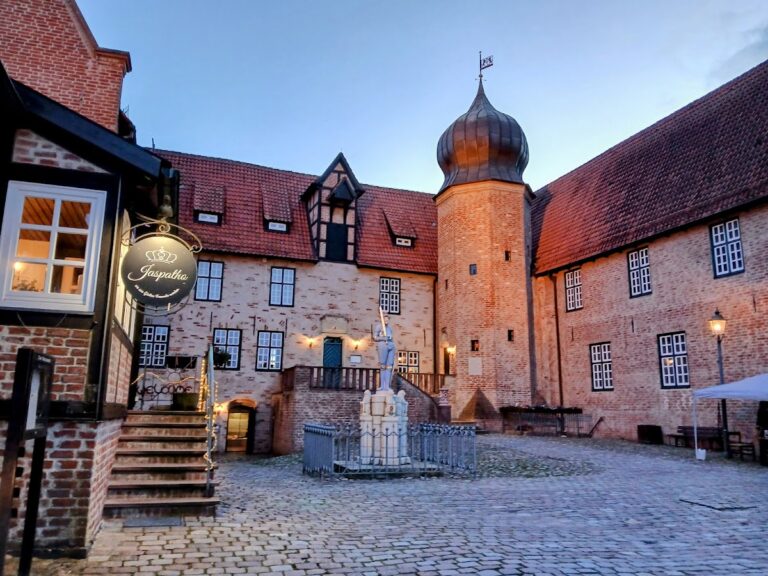
The convent and church stand on boulders on a sandy geest spit surrounded by mires. Building was difficult and extended over many years. A stream was diverted from the Westerwedele creek to provide fresh water and drainage. The surviving complex is arranged around a courtyard at the eastern edge of Neuenwalde and includes the Altes Kloster convent building, the western wing of the cloister, Holy Cross Church, the former tithe barn, and associated service buildings.
Altes Kloster
The Altes Kloster is about 45 metres long and forms part of a compound covering approximately 689.545 square metres. It is a two-storey brick building with twenty bays, gable ends, and a tiled gable roof. Its oldest western section was built around 1631 or 1634 and incorporates older elements. An inscription above the western portal gives 1636 as the year of reconstruction after the fire of 1629.
The conventual cells were arranged toward the west. Their windows were later altered, and some former openings can still be recognized where they have been blocked with handmade bricks. A long corridor along the eastern side probably connected the cells with the refectory built in 1444. On the first floor, a bridge linked the Altes Kloster directly with Holy Cross Church and its nuns’ gallery, which now serves as the organ loft.
Southern wing and shed
The southern wing was added between 1719 and 1721. It is a two-storey timber-framed structure with brick infill and a tiled half-hipped roof. A dated brick and an inscription plaque identify the construction of 1719. An additional single-storey shed was built against its south side in the eighteenth century. The shed has timber framing, rounded beam ends, stone infill, clay-filled interior walls, and a tiled hipped roof.
Former tithe barn
The former convent tithe barn stands east of the courtyard and dates approximately to 1650. In 1888 it was converted into apartments for the prioress and a conventual, and it continues to provide accommodation for conventuals. The eighteenth-century complex also included a bailiff’s office, parsonage, sacristy, watermill, and fifty-three households. A school for the children of tenant farmers was built in 1775, followed by a turf barn and granary in 1873.
Church, cloister, and waterworks
Holy Cross Church
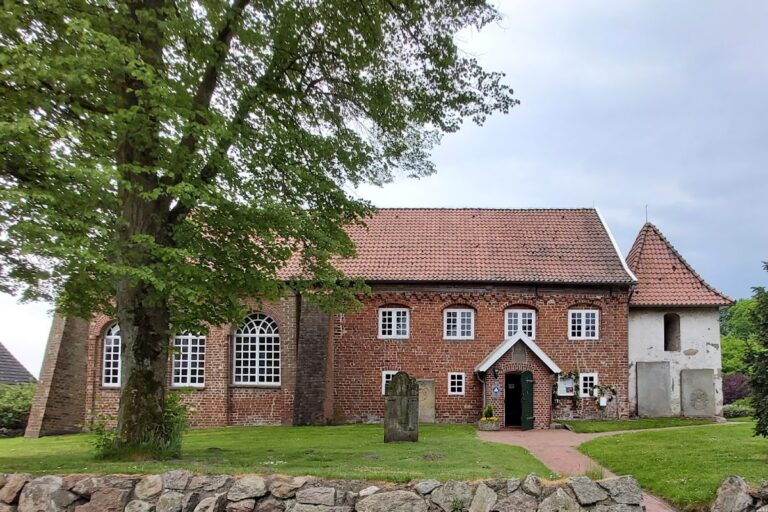
Holy Cross Church stands north of the courtyard. Built in 1334 as both convent church and parish church, it was destroyed in the fire of 1629 and restored between 1630 and 1634. Much of its interior belongs to the decades after the restoration. The surviving church forms part of the complex’s medieval and post-fire architectural sequence, alongside the remains of the medieval cloister.
Watermill and agricultural landscape
The medieval watermill near the Westerwedele, later called the Neuenwalde connecting canal, helped prompt the relocation from Wolde to Neuenwalde in 1334. The convent’s later productive landscape included the Kransburg outlying farm, the Neumühlen farm, fishponds formed by impounding streams between Holssel and Nordholz, and extensive forests, heaths, mires, lakes, and fields. Its forests included Dahlemer Holz, Fahlenbruch, Heubusch, Klosterbruch, Rhodenbruch, and Stühbusch. A brickworks was established in 1389. The separate Altenwalde post mill, built in 1535 and also called the Klostermühle, was demolished in 1913.
Seals and surviving phases
The convent possessed seals before and after its move to Neuenwalde. The earliest surviving conventual seal dates from 1289 and is broken into several pieces. A fourteenth-century seal shows a cross, while a smaller seal used until 1417 bears a cross on a shield. The earlier seals may have shown the Virgin Mary beside a cross.
The surviving buildings and archaeological fabric preserve several stages of the convent’s development. Medieval church and cloister remains stand alongside the post-fire convent building of the seventeenth century, the southern extension of 1719, the eighteenth-century shed, the former tithe barn, and later conversions for conventual and educational use.
Nearby sites