Roman Walls of Tangier: Fortified Remains at Kasbah Ghaïlan
Site at a Glance
- Popularity
- Very Low
- Country
- Morocco
- Primary era
- Classical
- Eras represented
- Classical
- Civilizations
- Roman
- Site type
- Military
- Remains
- Wall
On this page11 sections
History
The Roman Walls of Tangier are surviving kasbah walls at Kasbah Ghaïlan in Tangier, Morocco, associated with the ancient Roman port of Tingis. Their surviving fabric belongs to a site shaped by Roman rule, although the structure’s precise original function remains open to reconstruction. Tingis developed from an early settlement into the capital of Mauretania Tingitana and one of the principal urban centres of the far western Roman territories in North Africa.
From Phoenician Settlement to Roman Rule
Tingis was established as a settlement by Phoenicians no later than the tenth century BC. Carthaginian colonists settled there around the beginning of the sixth century BC, strengthening the town’s position within the western Mediterranean. After the Punic Wars, the series of conflicts that ended Carthage’s political control over its western territories, Tingis passed to the Roman-allied kings of Mauretania.
The town came under Roman rule in the first century BC. During the 70s BC, Quintus Sertorius, a Roman commander who led a major revolt against Sulla’s regime, captured and held Tingis for several years during his war in Hispania and North Africa. The city gained increasing importance under Augustus and received colonial status under the emperor Claudius, who ruled from AD 41 to 54. Its formal name became Colonia Iulia Tingi, and it became the capital of the Roman province of Mauretania Tingitana, probably with an initial administrative connection to Spain.
Growth as a Roman Provincial Capital
Tingis prospered as a port and developed a population of approximately 20,000 at its peak. Its inhabitants were largely Romanized and mostly Christian, while fish preservation formed an important part of the city’s economy. Under the emperor Septimius Severus, two roads were constructed from Tingis. One followed the Atlantic coast toward Sala Colonia, a Roman city and port, and the other crossed the mountainous interior toward Volubilis, an important city in Mauretania Tingitana.
In AD 296, the administrative reforms of Diocletian placed Mauretania Tingitana within the Diocese of Hispania, a late Roman district that grouped several provinces together. Tingis remained the provincial capital and retained its importance. During the fourth century, it surpassed Volubilis in prominence after that city lay south of the Roman defensive line and was no longer protected by Roman legions.
Vandal, Byzantine, and Early Islamic Tangier
The Vandals conquered and occupied Tingis around AD 425. Byzantine control returned between AD 534 and 682. The Byzantine Empire, the eastern continuation of the Roman Empire centred on Constantinople, fortified the city during this period, and a new church was built. Tingis’s commercial strength had declined, but its political and defensive role continued.
During the Muslim conquest of North Africa, the city came under the Umayyad Caliphate in AD 702. This early Islamic dynasty ruled a large territory during the seventh and eighth centuries, and Tingis subsequently became a smaller town more commonly known as Tangier. In AD 706, Tariq ibn Ziyad, the Muslim commander associated with the conquest of Visigothic Spain, organized the invasion from Tingis and nearby Septem, the ancient settlement at present-day Ceuta.
Christian Traditions
Christianity was present in Tingis from the second half of the first century, during the reign of Claudius. The city became associated with the martyrdoms of Saint Marcellus and Saint Cassian toward the end of the third century. The traditional date for Marcellus’s martyrdom is July 28, AD 298. A small Christian community survived in Tangier as late as the tenth century.
Remains
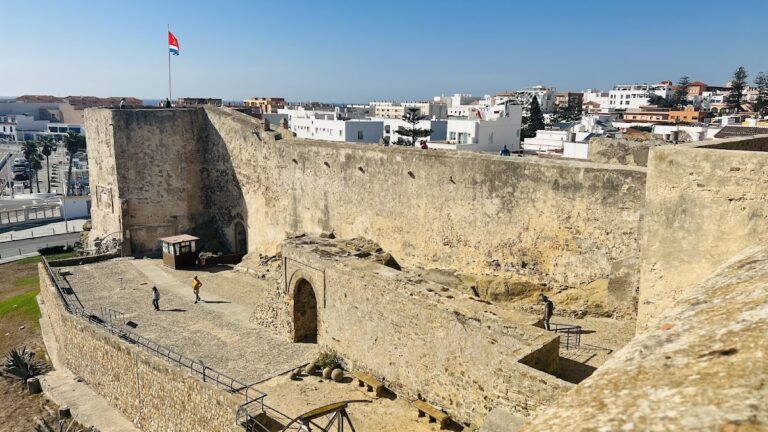
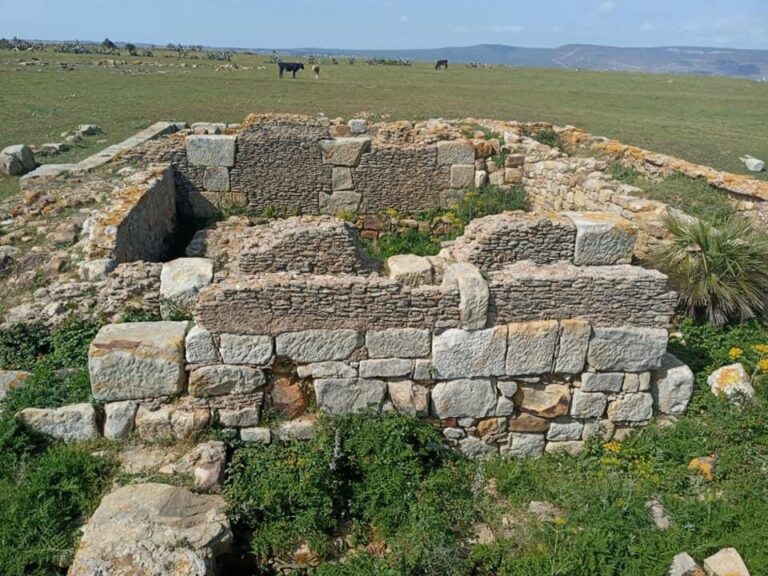
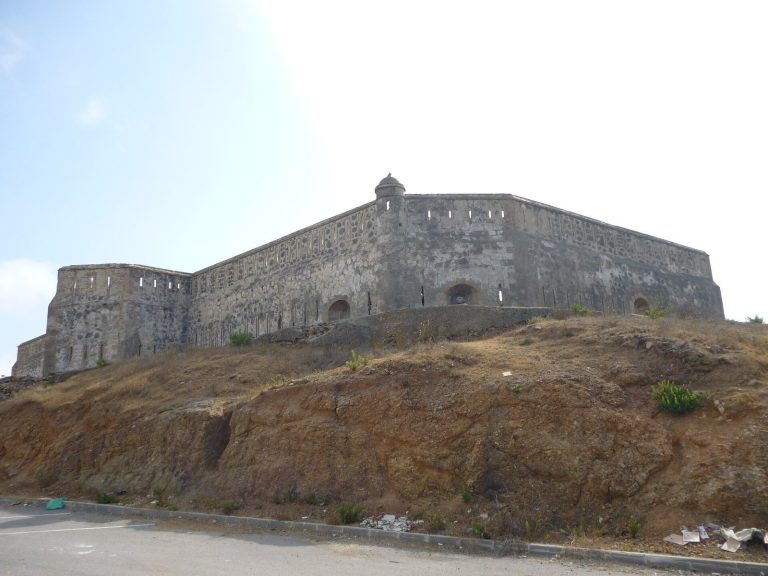
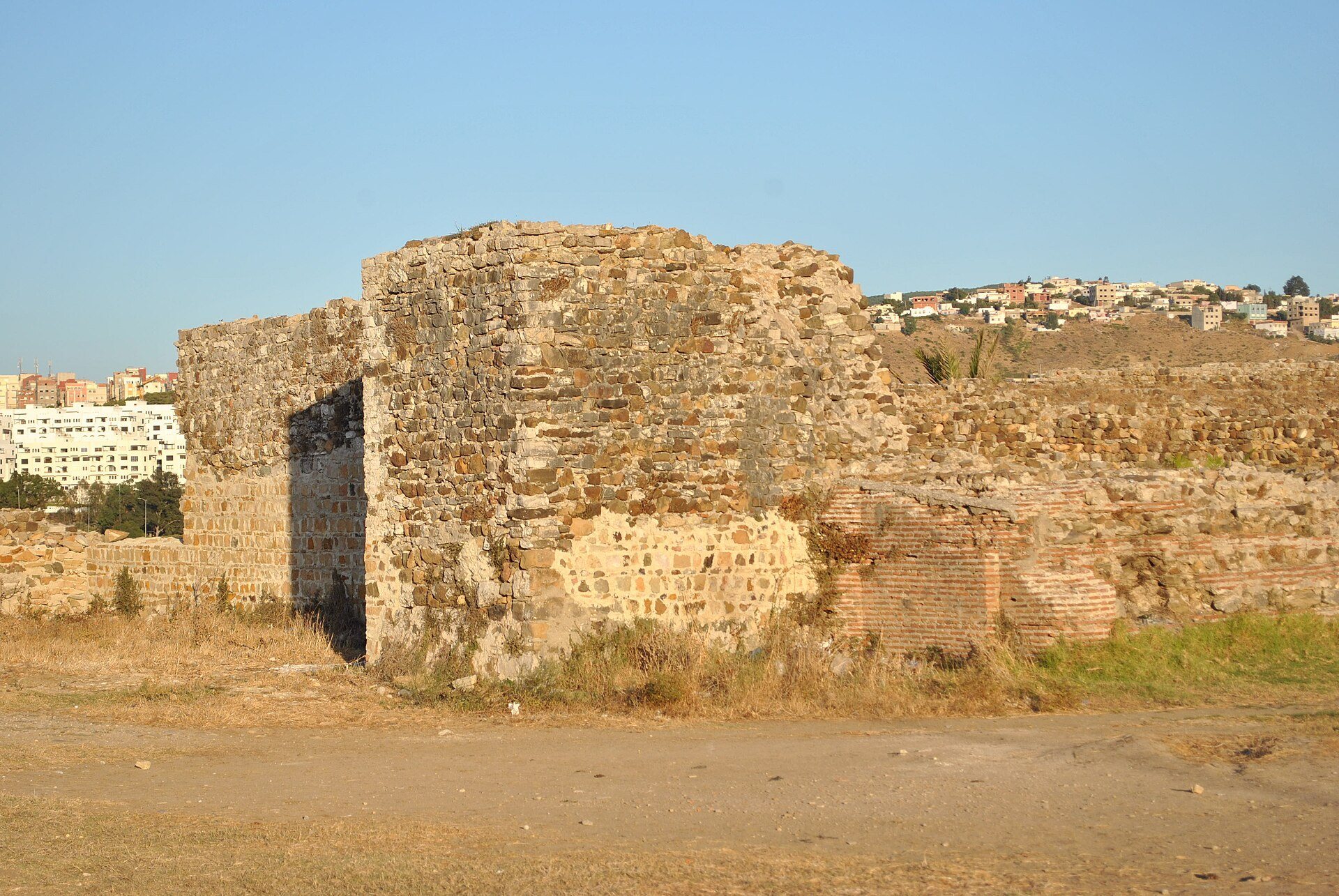
The surviving walls associated with the kasbah at Kasbah Ghaïlan stand in a broad, open landscape described as a salt marsh. The marsh can flood when the tide comes in, and this setting may have helped preserve the structure amid extensive modern construction and development in Tangier. The remaining walls require reconstruction to understand the original arrangement and purpose of the site.
Ancient Urban Setting
The settlement of Tingis was defined by burial areas on several sides. Necropolises lay to the northwest at Marshan and Avenue Cenario, to the west at Mendoubia, and to the south at Bou Kachkach. These areas formed part of the wider archaeological setting around the ancient town and help indicate the extent of its urban landscape.
Public and Religious Features
Baths and Basilica
Baths were located beneath the Casbah. On Rue de Belgique, confused remains of a monument were uncovered and interpreted as a possible Christian basilica. The feature connects the later religious history of Tingis with the built remains preserved within the modern city.
Forum and Temple
The ancient forum was thought to have occupied the site of the Petit Socco. A possible temple was associated with the site of the Great Mosque. Together, these proposed locations indicate the civic and religious structures that formed part of ancient Tingis, although the surviving kasbah walls do not by themselves make the original urban arrangement immediately clear.
Roads and Recovered Objects
The principal east-west street of the Roman town, the decumanus maximus, roughly followed the line of modern Zenga Es Siaghine. This street was the main east-west route through a Roman town or military settlement. Finds from ancient Tangier include inscriptions, several mosaic fragments, a statue of a woman described as mediocre in workmanship, and a mutilated head of the emperor Galba, who ruled briefly in AD 68 and 69.