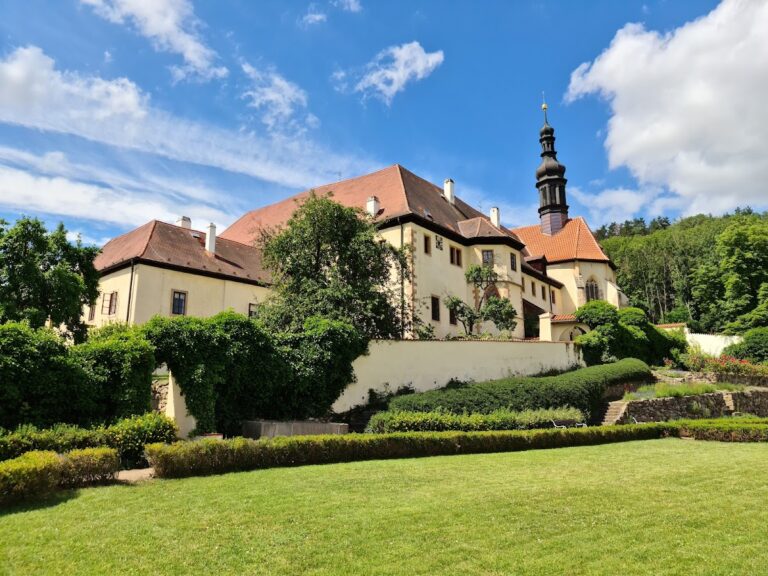
The Chateau at Klášterec nad Ohří: A Renaissance Manor and Baroque Residence


Site at a Glance
- Rating
- 4.6
- Popularity
- Medium
- Country
- Czechia
- Primary era
- Early Modern
- External website
- Open
- Eras represented
- Early Modern, Modern
- Civilizations
- Habsburg, Holy Roman Empire, Kingdom of Bohemia
- Site type
- Domestic
- Remains
- Castle
On this page10 sections
History
The Chateau at Klášterec nad Ohří is a historic residence in Czechia, established as a Renaissance manor house in 1514–1515 for the Fictum noble family, particularly Volf Dětřich Fictum. Around 1590, or at the beginning of the seventeenth century, the family expanded it into a castle with a tower and four wings.
Fictum and Thun-Hohenstein ownership
During the Thirty Years’ War, the conflict that reshaped much of central Europe in the seventeenth century, Swedish forces occupied and burned the castle twice. The Thun-Hohenstein family acquired it in 1621, after the Battle of White Mountain, where forces supporting the Bohemian revolt had been defeated near Prague. The family retained the castle, together with Pětipsy Castle, until the end of the Second World War.
The Thun-Hohensteins began rebuilding the residence as a Baroque property in 1653. From 1666, the Italian builder and stucco worker Rossi da Lucca and the Italian architect Carlo Lurago directed the work. Their reconstruction created a representative residence with a loggia and late-Renaissance stucco decoration.
Baroque transformation and nineteenth-century changes
In 1784, the builder August Grueber made late-Baroque alterations to the interiors. A terrace was added to the south wing in 1817. The Thun-Hohensteins also founded the local porcelain manufactory in 1794, establishing an industrial association that later shaped the castle’s exhibition history.
A fire in 1856 led to further alterations and architectural changes in the English Gothic Revival style. The last major structural modifications followed in 1858, according to a design by the architect Václav Hagenauer.
State ownership and restoration
After the Second World War ended in May 1945, Mathias, Count von Thun-Hohenstein, was expropriated under the Beneš Decrees, postwar Czechoslovak measures that included the confiscation of German-owned property, alongside the expulsion of Germans from Czechoslovakia. The castle became state property. Most of its old furnishings were lost, although some paintings and furniture survived.
The Renaissance interiors were restored between 1950 and 1952. From that period, the castle housed a permanent porcelain exhibition drawn from the collections of the Museum of Decorative Arts in Prague. Since 1993, the town of Klášterec nad Ohří has owned the castle and has undertaken its renovation. Further restoration was commissioned in the last decade of the twentieth century, while the castle continued to function as an exhibition venue. It is a national cultural monument of the Czech Republic and is registered in the national monument-protection system under catalogue number 1000154283.
Remains
The castle stands on a rise beside the Ohře River in Klášterec nad Ohří. Its two-storey main palace has four wings arranged around a courtyard with a tower. Two epitaphs belonging to the Fictum family are displayed in the courtyard, linking the surviving layout with the family that established the Renaissance manor.
Park and garden structures
The surrounding grounds began as a Baroque garden and later became an extensive English-style landscape park. The park contains 220 species of trees from around the world, including rare trees and shrubs and a ginkgo. Its structures and sculpture extend the historic setting beyond the palace itself.
Summer residence
A one-storey summer residence stands within the grounds. It has a terrace and an arcaded corridor, features that identify it as a separate garden building associated with the castle estate.
Sala Terrena and sculptures
Opposite the castle entrance is the Sala Terrena, a ground-level garden pavilion with a gloriette mezzanine, an elevated pavilion or belvedere forming a visual feature within the garden. Jan Brokoff made its architectural sculpture in the 1680s. Allegorical sculptures created by Brokoff between 1685 and 1687 stand in front of the pavilion and represent Africa, America, Ulysses, Asia, and Europe.
Northern park features
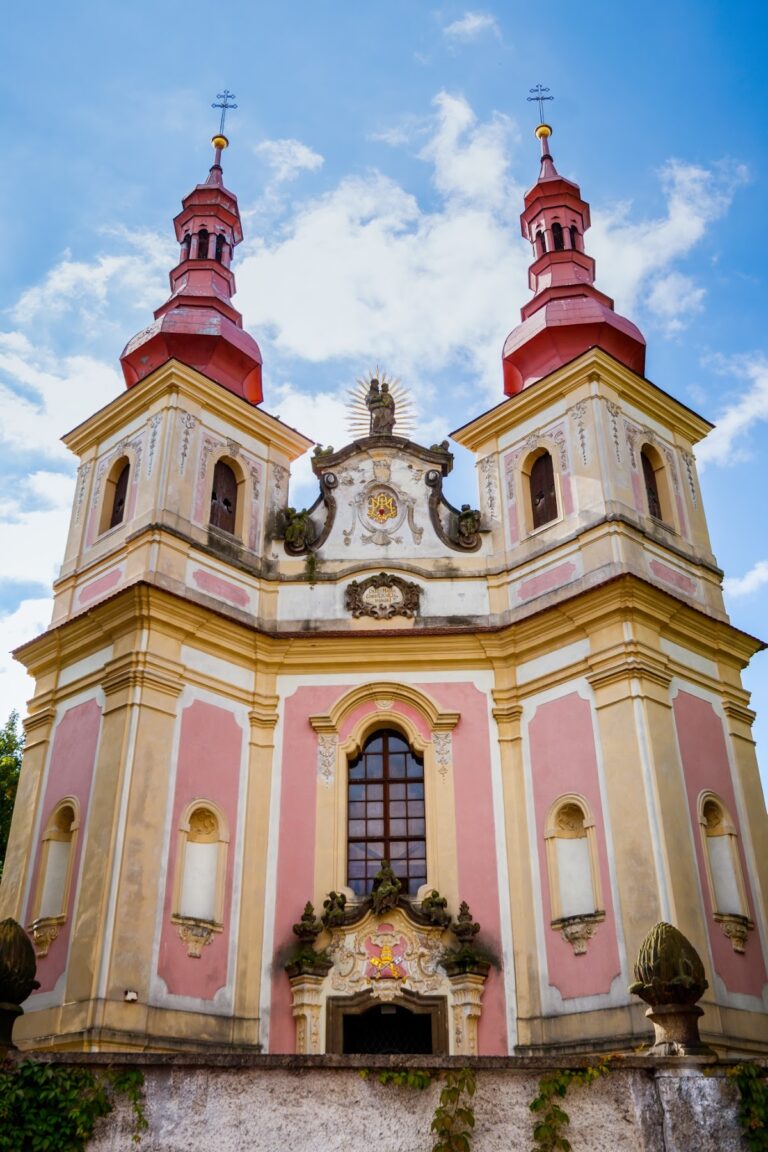
The northern part of the park contains a Stations of the Cross installation dating from the 1690s. This sequence of devotional representations commemorates episodes of Christ’s Passion. The same part of the grounds also contains the Church of the Holy Trinity and the crypt of the Thun noble family.
Porcelain Museum
The permanent Porcelain Museum of Klášterec nad Ohří occupies 21 rooms on the castle’s first floor. Its Czech collection traces more than 200 years of porcelain manufacture in Bohemia and includes products from factories in Slavkov, Klášterec nad Ohří, Březová, Kisibl, Chodov, Stará Role, Dalovice, Prague, Loket, Budov, and Ždanov.
The displays also include early Chinese and Japanese porcelain and European porcelain from Meissen, Vienna, and Nymphenburg dating from the seventeenth to the nineteenth centuries. The museum is affiliated with the Museum of Decorative Arts in Prague, whose collections provided the original permanent exhibition.
Nearby sites