Church of St. Mary of the Spring: An Eastern Orthodox Sanctuary in Istanbul


Site at a Glance
- Rating
- 4.6
- Popularity
- Low
- Country
- Turkey
- Primary era
- Modern
- External website
- Open
- Eras represented
- Modern
- Civilizations
- Ottoman
- Site type
- Religious
- Remains
- Church
On this page18 sections
History
Church of St. Mary of the Spring is an Eastern Orthodox sanctuary in Istanbul, Türkiye, built in the Byzantine period and associated with a holy spring dedicated to the Theotokos, the Orthodox title for the Virgin Mary as Mother of God. The site was in use between the late fifth and early sixth centuries, while historians Procopius and George Cedrenus attribute the construction of a major church there to Emperor Justinian I in 559–560.
Justinian’s church and the foundation legend
Justinian ordered the church near a sacred well outside the Theodosian Walls, close to the later Gate of the Spring, also called the Gate of Silivri. Materials left over from the construction of Hagia Sophia were used for the building. The sanctuary became known as the Monastery of the Mother of God at the Spring and the Life-giving Spring, names that reflected the religious importance of its water.
A different foundation story connects the site with Emperor Leo I the Thracian, who ruled from 457 to 474. According to the legend, Leo was still a soldier when he met a blind man and restored his sight with water from a nearby marsh after hearing a woman’s voice instruct him. The voice foretold Leo’s accession and declared that the place had been chosen for worship. Monks may have developed the story at a later date, although a small monastery could have occupied the site before Justinian’s church.
Repairs, destruction, and imperial use
The church required repeated repairs. Major earthquake damage led to work in 790 under Empress Irene and again after the earthquake of 869 under Emperor Basil I. On 7 September 924, Tsar Simeon I of Bulgaria burned the complex. Emperor Romanos I Lekapenos restored it soon afterward, and three years later Simeon’s son Peter married Maria, Lekapenos’s niece.
Its position beyond the city walls also made the monastery a place of exile. Georgios Monomachos was banished there in 1078, and Emperor Alexios I Komnenos confined the philosopher John Italus there in 1084 because of his Neoplatonic views, a philosophical tradition emphasizing the relationship between the material world and higher spiritual realities.
Latin occupation and the Palaiologan period
After the Latin occupation of Constantinople in 1204, Latin clergy took control of the church. Byzantine accounts connected this period with the ending of the sanctuary’s “habitual miracle,” the recurring healing associated with the spring.
In 1328, Emperor Andronikos III Palaiologos used the monastery as a base for an attack on Constantinople during his conflict with his grandfather, Andronikos II. Two years later, while gravely ill at Didymoteicho, Andronikos III drank water from the spring and recovered immediately.
Ottoman rule and reconstruction
During Sultan Murad II’s siege of Constantinople in 1422, the Ottoman ruler camped at the sanctuary. The condition of the church before the city’s conquest in 1453 is uncertain. Fifteenth-century Russian pilgrims described the spring, while by 1547 the church had disappeared. Sick people nevertheless continued to visit the water.
In 1727, Nikodemos, Metropolitan of Dercos and Neochorion, built a small chapel over the spring. An icon discovered in the foundations of the earlier church was venerated there. Armenians attempted to take possession of the spring, but official Ottoman decrees, known as firmans, secured it for the Greek community. Turkish guardians later controlled the complex and collected a tax from pilgrims that was used to maintain prisons.
The complex eventually came under the Ecumenical Patriarchate of Constantinople. Janissaries destroyed the chapel and poisoned the spring in 1821. A decree issued in 1833 allowed Patriarch Constantius I to rebuild the church, which was completed and inaugurated in 1835.
Recent history and continuing religious life
During the Istanbul Pogrom of 6–7 September 1955, a state-sponsored mob attacked the complex. The church and monastery were burned, and the sarcophagi of Ecumenical Patriarchs outside the church were opened, scattering their remains. The damage was later repaired.
The sanctuary is administered by a titular bishop, an episcopal office without the government of a territorial diocese, and remains an important pilgrimage place for Istanbul’s Orthodox Christians. Major religious and popular celebrations are held on the Friday after Easter and on 14 September. Funerals also take place for people buried in the adjoining cemetery.
Byzantine pilgrimage and ceremony
In the Byzantine period, the sanctuary ranked among Constantinople’s important pilgrimage sites. On Ascension Day, the emperor traveled by boat to a small harbor near the Golden Gate, continued to the sanctuary, and received a cross and garlands from the city’s racing factions. After changing into ceremonial clothing, he entered the church hand-in-hand with the patriarch and later invited him to dinner.
Future empresses arriving in Constantinople for their marriages were received by their future husbands at the Monastery of the Spring. The church’s dedication was celebrated on 9 July. Other observances included the Ascension, the Marriage at Cana on 8 January, and the miracle associated with Leo I on 16 August. The spring’s reputation also inspired the names of later churches and monasteries in the Greek world.
Remains
The complex lies in the Balıklı neighborhood of Istanbul’s Zeytinburnu district, a few hundred meters beyond the historic city walls and about 500 meters from the Gate of Silivri. A high enclosing wall surrounds the church, spring, cemetery, and associated buildings. Greek Orthodox and Armenian cemeteries also surround the complex, each within high walls.
The earlier Byzantine complex
Earlier church
The earlier church had a rectangular basilica plan, meaning a longitudinal church divided into aisles, with its sides arranged in a proportion of four to three. It was partly subterranean and had two outer entrance halls, or narthexes, on the east and west, together with two inner narthexes on the north and south. Frescoes decorated the building, while a dome covered in pure gold crowned it. Three surrounding chapels were dedicated to Saint Eustratius, the Theotokos, and Saint Anne.
Spring and water system
The spring was reached by descending two stairways, each with 25 steps, marble balustrades, and a marble arcade above. Water flowed into a marble basin and then passed through channels distributing it through the church. The arrangement joined the sacred water source directly to the ritual space of the earlier sanctuary.
The nineteenth-century church and underground sanctuary
Present church
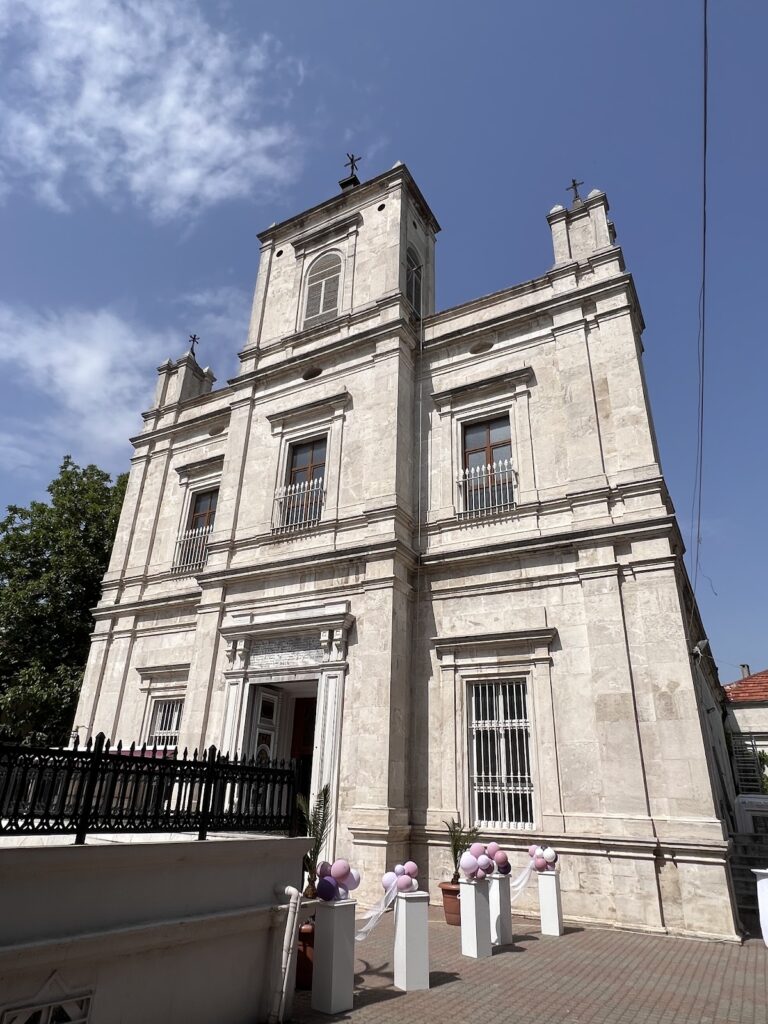
Completed in 1835, the present church retains a rectangular plan oriented approximately from east to west. Three aisles are separated by columns, and an inner narthex precedes the main interior. A metal bell tower rises at the northwest corner. Inside, a pulpit stands on the right side near the middle of the nave, while an elaborate iconostasis, the decorated screen dividing the sanctuary from the nave, closes the eastern end. An icon traditionally attributed to Saint Luke stands to the right of the iconostasis.
Crypt and spring
The spring is housed in a subterranean crypt outside the church. A stairway parallel to the church’s long sides descends to the crypt, and a symmetrical stairway connects it with the church courtyard. Paintings and icons decorate the underground space, whose dome depicts Christ beneath a starry sky.
The water enters a marble basin containing fish. Their presence over many centuries gave the complex its Turkish name, Balıklı, meaning “place where there are fish.” A later legend links the fish to the conquest of Constantinople. A monk supposedly said that he would believe the city had fallen only if the fish he was frying returned to life. The fish then allegedly leaped into the spring and began swimming.
Icon of the Virgin of the Spring
The icon of the Virgin of the Spring shows the Virgin blessing and embracing the Child. Two angels surround her, and she is generally seated on the higher of two basins supplied by a jet of water from a larger marble basin marked with a cross. The composition also includes an emperor and his guards, the patriarch and bishops, Leo I with the blind man and the city walls, and a paralytic and a madman healed by the spring water.
Courtyard cemetery
Marble tombs and patriarchal burials
The courtyard in front of the church contains a cemetery with marble tombs, most dating from the nineteenth and twentieth centuries. Many belonged to wealthy Greek Orthodox residents of Istanbul, and several Ecumenical Patriarchs are buried there.
Karamanli gravestones
The cemetery contains numerous Karamanli inscriptions. Karamanli was Turkish written in the Greek alphabet, particularly within historical Greek Orthodox communities of Anatolia and the Ottoman Empire. Together, these gravestones form the largest surviving group of such inscriptions.