Kızıl Kilise: An Early Byzantine Church in Türkiye


Site at a Glance
- Rating
- 4.6
- Popularity
- Low
- Country
- Turkey
- Primary era
- Medieval
- Eras represented
- Classical, Medieval
- Civilizations
- Byzantine
- Site type
- Religious
- Remains
- Church
On this page7 sections
History
Kızıl Kilise is a partly ruined early Byzantine Orthodox church in Türkiye, near Sivrihisar in the Güzelyurt district of Aksaray Province. It was probably built in the sixth century during the reign of Justinian I, the Byzantine emperor who ruled from 527 to 565 and supported major Christian building projects. Proposed dates range from the fifth to the ninth century. The church is considered one of the oldest freestanding Christian sanctuaries in Cappadocia, a volcanic region of central Anatolia known for its Byzantine Christian monuments.
Dedication and early traditions
The church’s original dedication is uncertain. It is probably associated with Gregory of Nazianzus, a fourth-century theologian and bishop who was one of the Cappadocian Fathers. Local usage also connected the building with Saint Panteleimon, a Christian martyr traditionally venerated as a physician and healer, and called it the Monastery of Saint Panteleimon.
Several interpretations have been proposed for the church’s original purpose. It may have served as a funerary church for Gregory of Nazianzus, as a sanctuary dedicated to local Christian martyrs, or as the cathedral of a destroyed city whose identity is unknown. Its meaning has also been linked with Christian and Muslim legends and beliefs associated with Sivrihisar.
Later use and conservation
Kızıl Kilise remained an active place of worship until 1 August 1924, serving the Turkish-speaking Christians of Sivrihisar. It ceased to function as a church after their migration to Greece during the population exchange between Greece and Turkey. Shepherds later used the building, while the removal of building materials and illegal excavations by treasure hunters contributed to its deterioration.
Gertrude Bell, the British archaeologist and writer, photographed and measured the church in 1907. In 2008, the World Monuments Watch, an international heritage program for endangered historic sites, included Kızıl Kilise on its list. Conservation and reconstruction began in 2011 under İsmet Ağaryılmaz, a retired professor of restoration techniques at Yildiz Technical University. By 2014, the work had re-roofed the dome drum and cleaned and structurally supported the exterior walls.
Remains
Church structure
The church is built from carefully cut blocks of local red volcanic stone, a material that gave Kızıl Kilise its name, meaning “Red Church.” Its cruciform plan takes the form of a three-aisled domed basilica, a type used in central and eastern Cappadocia during the fifth and sixth centuries. The central dome rests on an octagonal drum, the eight-sided section supporting the dome, whose eight windows illuminate the nave. The building is damaged and partly ruined, but its original overall form survives.
A narthex, an entrance hall attached to a church, was added later at the western end. Its ground-level remains have been demolished. High door lintels and carefully worked granite blocks have been interpreted as possible evidence for use as an imperial chapel or funerary chapel, although that interpretation remains uncertain.
Painted decoration and sacred features
Indistinct colored remnants survive from the painted decoration, especially on the arches and the faces of the piers. Busts of saints appear on the arches supporting the dome drum. Cross frescoes above the doors and windows gave the church the additional name Haçlarlar Kilisesi, meaning “Church with Crosses.” A spring at the church functioned as a holy spring, and the building and its associated celebration were linked to 27 July, the feast day of Saint Panteleimon.
Archaeological surroundings
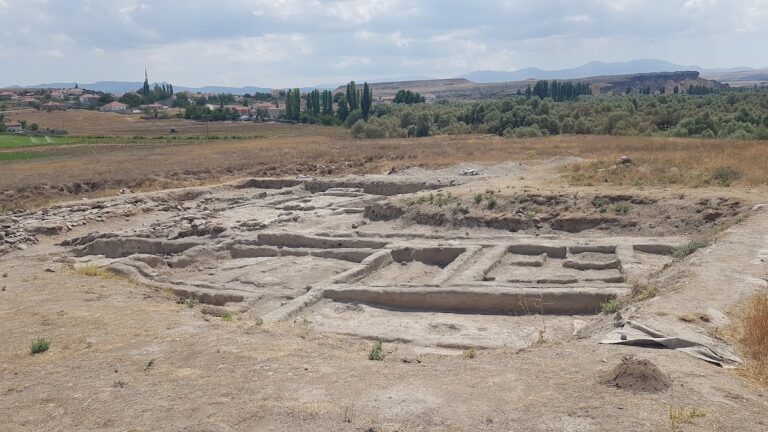
Archaeological excavations and investigations directed by the Aksaray Museum began in 2010. About 100 metres north of the church, they revealed the remains of a small village, a well, and a small chapel probably dating from the fourth century. These features are part of the archaeological setting of Kızıl Kilise, which stands in the rural locality of Çakıllık, east of Sivrihisar and approximately 5 kilometres from Güzelyurt, historically also known as Gelveri or Karvali.
Nearby sites