St. Petka Church: The Principal Monastery Church of Brajchino


Site at a Glance
- Rating
- 5
- Popularity
- Very Low
- Country
- North Macedonia
- Primary era
- Medieval
- Eras represented
- Medieval, Early Modern, Modern
- Civilizations
- Ottoman
- Site type
- Religious
- Remains
- Church
On this page6 sections
History
St. Petka Church is a medieval Orthodox church in North Macedonia and the principal monastery church of Brajchino Monastery, east of the village of Brajchino in the Resen area. It was built and painted during the last quarter of the fifteenth century. The church belongs to the Macedonian Orthodox Church–Ohrid Archbishopric, the church jurisdiction that includes it within the Prespa-Pelagonia Diocese and the Resen deanery.
After a period of abandonment, St. Petka Church continued as part of the monastery complex. It is protected as a cultural monument. The fifteenth-century paintings are associated stylistically with the Kostur School, a regional tradition of Orthodox mural painting linked to the Kostur area. Later wall paintings and icons from the sixteenth, seventeenth, and nineteenth centuries also remain in the church.
Remains
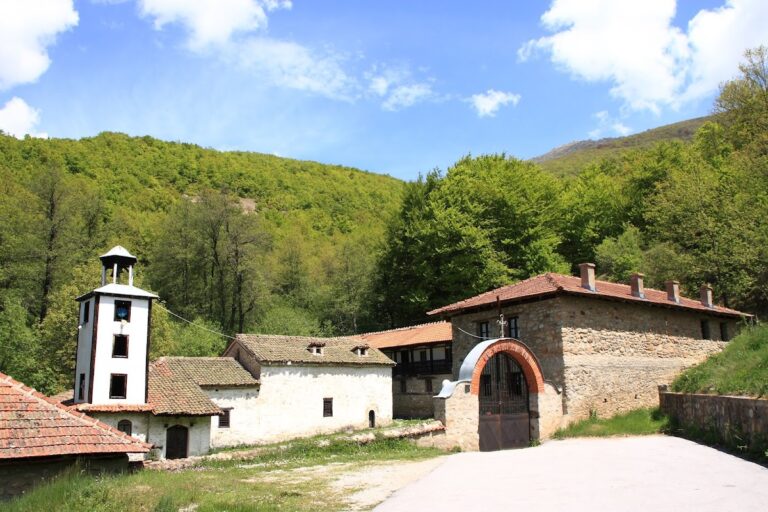
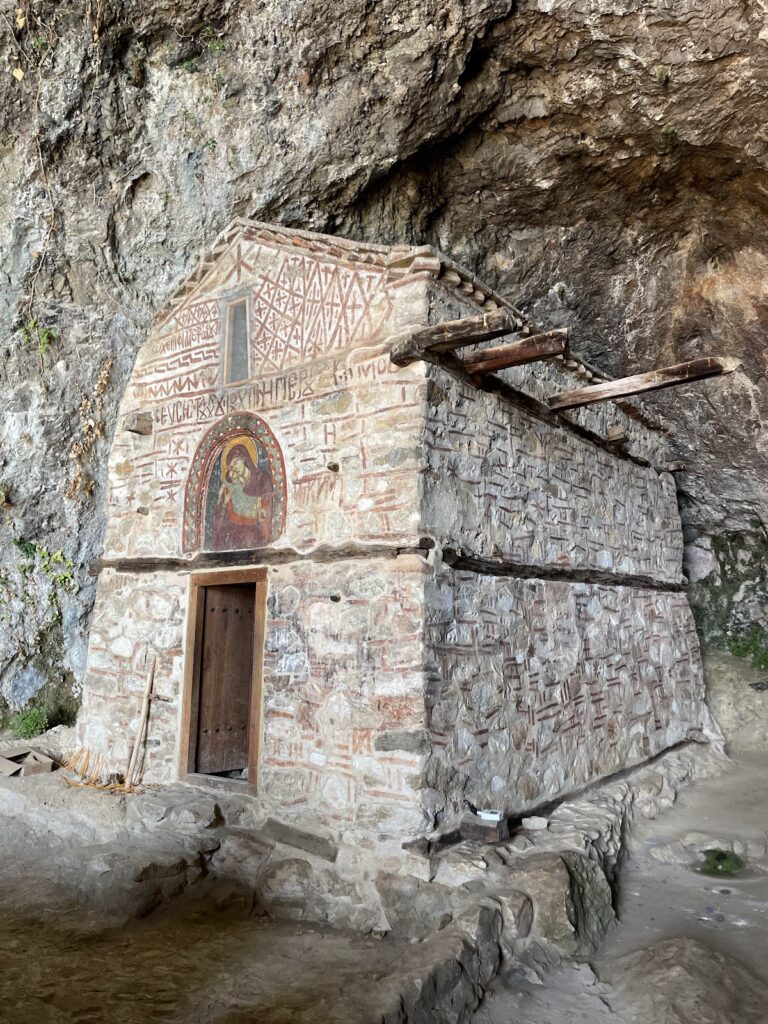
St. Petka Church stands at the center of the monastery courtyard, which is surrounded by a large meadow. The surviving building is small and single-nave, with a gabled roof, a three-sided apse, and one entrance on the west. A later extension formed a narthex, an entrance space at the western end, so the original west facade now serves as the narthex’s east wall.
Church Layout and Sacred Spring
The main worship space, or naos, occupies the original church building, while the later narthex extends it westward. Beside the north wall of the sanctuary is a spring whose water is regarded as sacred and healing. This spring remains part of the religious setting of the church.
Sanctuary Paintings
The oldest paintings survive on the east and west walls of the naos and on the former west facade, now enclosed as the east wall of the narthex. In the curved upper part of the apse, the Virgin Mary appears with the Christ Child. Below her is the Divine Liturgy, the central Eucharistic service of Orthodox Christianity, attended by Basil the Great and John Chrysostom. Between these scenes is the sacrificial Christ Child, lying in a broad vessel beside a chalice on the altar. The martyrs Simeon and Daniel stand on either side of the triumphal arch.
Painted Western Facade
The former west facade carried a Last Judgment composition, of which individual elements survive. Above it is a Royal Deesis, an Orthodox image centered on Christ as judge or enthroned ruler with intercessory figures. The patronal niche contains a half-length image of Saint Petka holding a cross in her right hand. Mounted figures of Saint Mina and Saint George flank the niche.
Side Compartments and Later Art
The prothesis niche, used for preparing the Eucharistic offerings, contains Saint Stephen, traditionally regarded as Christianity’s first martyr. The diakonikon niche, a side compartment used for liturgical service functions, contains a half-length image of Roman the Melodist, an early Christian hymn writer. Remnants of later wall paintings and icons from the sixteenth, seventeenth, and nineteenth centuries are preserved within the church.
Nearby sites