Sourp Magar: An Armenian Monastery and Cultural Centre in Cyprus


Site at a Glance
- Rating
- 4.7
- Popularity
- Very Low
- Country
- Cyprus
- Primary era
- Medieval
- Eras represented
- Medieval, Early Modern
- Civilizations
- Armenian, Byzantine, Ottoman
- Site type
- Religious
- Remains
- Monastery
On this page11 sections
History
Sourp Magar is an Armenian monastery in Cyprus, founded in the early eleventh century and dedicated to Saint Macarius of Alexandria, an early Christian ascetic associated with the origins of Egyptian desert monasticism. Also known as Magaravank and Armenomonastiro, meaning “Armenian monastery,” it is regarded as the only Armenian monastery on the island and one of Cyprus’s most important Armenian ecclesiastical monuments.
From Coptic foundation to Armenian monastery
The monastery initially appears to have belonged to the Coptic Orthodox Church. Its dedication recalled Saint Macarius, who lived from 306 to 395. Sometime before 1425, the complex was transferred to the Armenians of Cyprus, probably during the growth of the Armenian-Cypriot community after the fall of the Armenian Kingdom of Cilicia in 1375. The Armenian Apostolic Church, an independent Oriental Orthodox church with its own hierarchy and liturgy, thereafter shaped the monastery’s religious life.
Ottoman inscriptions indicate that Sourp Magar became Armenian property during the fifteenth century. Land deeds issued in 1642 and 1701 confirmed Armenian ownership and recognized the monastery’s exemption from taxation as ecclesiastical property. The exemption was renewed in 1660. Armenian control continued through both the Venetian and Ottoman periods, preserving the site as a religious institution within the changing political history of Cyprus.
Religious, charitable, and communal roles
Sourp Magar served successively as a hermitage, monastery, school, pilgrims’ rest house, orphanage, refuge for Armenian refugees, and summer retreat for the Armenian community of Nicosia. Its last use as a functioning monastery was around 1800, but it remained an important Armenian religious and cultural centre. In the 1890s, it also provided a safe house for Armenians fleeing Ottoman massacres.
The monastery was renovated in 1735, 1814, and 1947–1949. Work between 1811 and 1818 included the construction of a larger chapel, inaugurated in 1814. In 1929, repairs or new construction affected the pilgrims’ rooms, storeroom, chapel vestibule, and bell tower. Water-distribution and electrical systems were installed in 1948. These changes supported the complex’s continuing communal use without ending its older monastic associations.
Before 1974, furnished rooms accommodated pilgrims, while the monastery served in summer as a retreat for the catholicoses of Cilicia and other clergy. A catholicos is a senior Armenian ecclesiastical leader. In 1935, seventeen people were reported to live at Sourp Magar permanently, and nearby summer camps accommodated students from the Melkonian Educational Institute and Armenian scouts. Pilgrims came especially on weekends, religious holidays, and the December feast of Saint Macarius.
The annual pilgrimage, traditionally held on the first Sunday of May, became known as “Pilgrimage Day” and included the communal preparation of harissa, a thick Armenian porridge or stew made from grain and meat. The cultivated estate generated an annual income of about 8,000 Cypriot gold pieces for the Armenian Apostolic Prelacy before 1974. Sourp Magar also maintained close ties with the Catholicosate of Cilicia, an autonomous hierarchical see of the Armenian Apostolic Church that had been based in Antelias, Lebanon, since 1930.
War, abandonment, and renewed pilgrimage
The Turkish invasion and occupation of northern Cyprus in 1974 placed Sourp Magar under Turkish control. The monastery was abandoned and became inaccessible to its legal owners. Looting and destruction continued in subsequent years, damaging a complex whose lands and buildings had previously been active and well maintained.
Proposals to convert the monastery into a hotel were made in the late 1990s and again in 2006, while a related proposal was advanced in 1999. Armenian-Cypriot and Armenian institutions, the Republics of Cyprus and Armenia, and international organizations helped prevent these plans from proceeding. From 2005, Turkish authorities rebuilt and re-roofed several rooms on the southern side of the precinct, but further development was not completed. The complex remains ruined and urgently requires restoration, while vandalism and the removal of building materials continue to threaten its surviving fabric.
The Armenian-Cypriot community revived its annual pilgrimage on 6 May 2007, when about 150 Armenian-Cypriots, including visitors from abroad, reached the monastery for the first such pilgrimage in 33 years. Pilgrimages continued between 2009 and 2016. During the 2007 gathering, Armenian-Cypriots assembled in the chapel and sang the Lord’s Prayer under the leadership of the Catholicosal Vicar and priests, despite a prohibition on religious ceremonies by the authorities. Catholicos Aram I visited Sourp Magar in the summers of 2008 and 2019. Since 1974, the monastery has remained in the occupied part of Cyprus while retaining strong symbolic and religious importance for the Armenian-Cypriot community.
Remains
Setting and monastery precinct
Sourp Magar stands in a wooded valley on the slopes of the Pentadaktylos mountain range, at an elevation of about 530 metres. The ground slopes gently from west to east, with distant views towards the Mediterranean and the Taurus Mountains. The historic estate covered about 9,000 donums, a traditional unit of land area, and extended from the mountain crest to the northern coast of Cyprus. It included around 30,000 olive and other fruit trees, as well as the villages of Halevga, Kharcha, and Atalia. A substantial part of Atalia’s population consisted of Armenians known as “monastery-dwelling Armenians.”
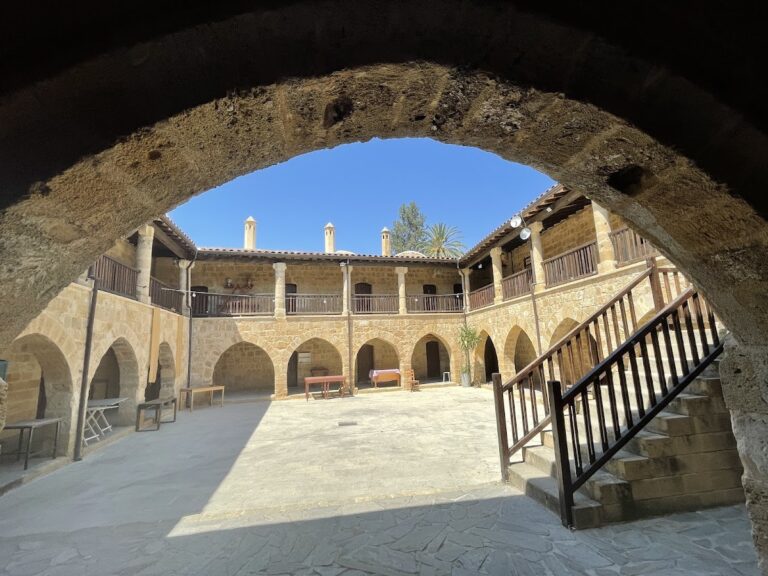
The complex forms an irregular rectangle of two-storey residential buildings arranged around a large central precinct, an enclosed area surrounding a religious or institutional complex. Despite its ruined state, these buildings are extensive surviving examples of late-medieval domestic architecture in Cyprus. On the mountain crest within the former estate is a place called the Cilician Observatory. Catholicos Sahak II of the Great House of Cilicia gave it this name after reportedly watching the Taurus Mountains from there at sunrise and remembering his Cilician homeland.
Residential buildings
The residential buildings on the north and east sides probably date from the fifteenth century. Their Gothic windows and doors, including pointed arches, may connect their construction with the period when Armenians first took possession of the site. One window has a chevron design characteristic of later Gothic construction in Cyprus, a form also found in buildings in Coptic Cairo.
Inside the residential range, a simple arcade, or series of arches supported by columns or piers, occupies the lower level, while a walkway runs above it. The walkway was originally bordered by stone posts carrying wooden lintels. Roofs rested on wooden beams and were covered with curved tiles. From the 1920s onwards, modern tiles and other additions were inserted in various parts of the complex. Later rebuilding used reinforced concrete, including a concrete awning with steel beams inserted into a medieval window and part of the interior walkway floor.
Chapels and earlier church
Two surviving chapels
Two small churches or chapels stand side by side in the northeastern part of the central courtyard. The larger chapel was built in 1814, and its vault remains in place. The older chapel is considerably smaller and has also survived. Their position and form preserve the later religious arrangement within the monastery’s central precinct.
Earlier church and hermit cells
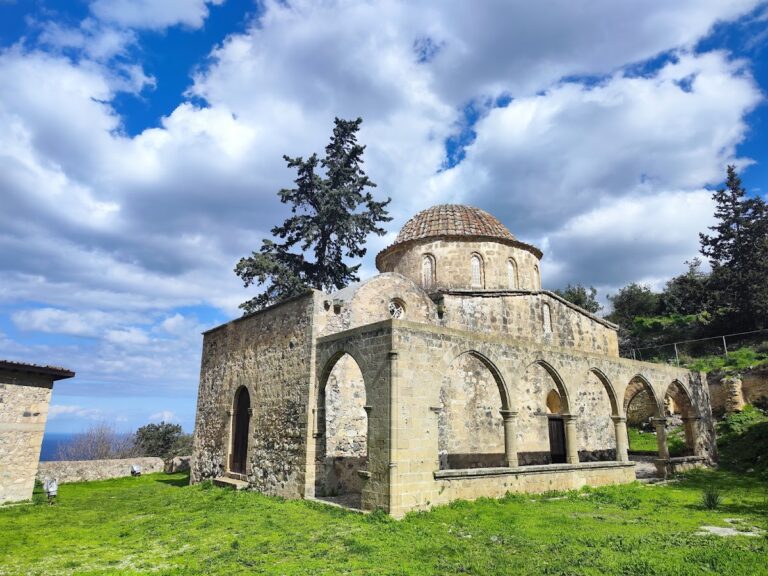
The two chapels appear to represent the side aisles of an earlier, relatively large church. A side aisle is a passage running alongside the principal central space, or nave, of a church. The nave has largely disappeared, but its former position is represented by a large rebuilt arch and the shared vestibule between the chapels. The masonry of the apses, the rounded or polygonal ends of churches, resembles that of eleventh-century churches at Lythrangomi and Aphendrika on the Karpas Peninsula, suggesting comparable antiquity.
Cave-like cells near the chapel served as accommodation for hermits. They remain visible and preserve physical evidence of the monastery’s early eremitic use. The ruins of a church dedicated to Saint George also lie near Atalia village within the wider monastery landscape. Saint George is a widely venerated Christian martyr and saint.
Manuscripts and sacred objects
Sourp Magar once held a substantial collection of manuscripts, miniatures, icons, and other sacred objects. The oldest recorded manuscript was written in 1202. Particularly valuable works included a Gospel decorated with miniatures from 1293 and a hymnal dated 1678. Before the 1974 invasion, 56 manuscripts were moved to the Cilicia Museum at the Catholicosate of Cilicia in Antelias. Their relocation preserved them during the invasion and separated these surviving records of the monastery’s intellectual and religious life from the ruined complex.