Antiphonitis: A Byzantine Greek Orthodox Monastery Church in Cyprus


Site at a Glance
- Rating
- 4.3
- Popularity
- Very Low
- Country
- Cyprus
- Primary era
- Medieval
- Eras represented
- Medieval
- Civilizations
- Byzantine, Crusader, Kingdom of Cyprus
- Site type
- Religious
- Remains
- Church
On this page9 sections
History
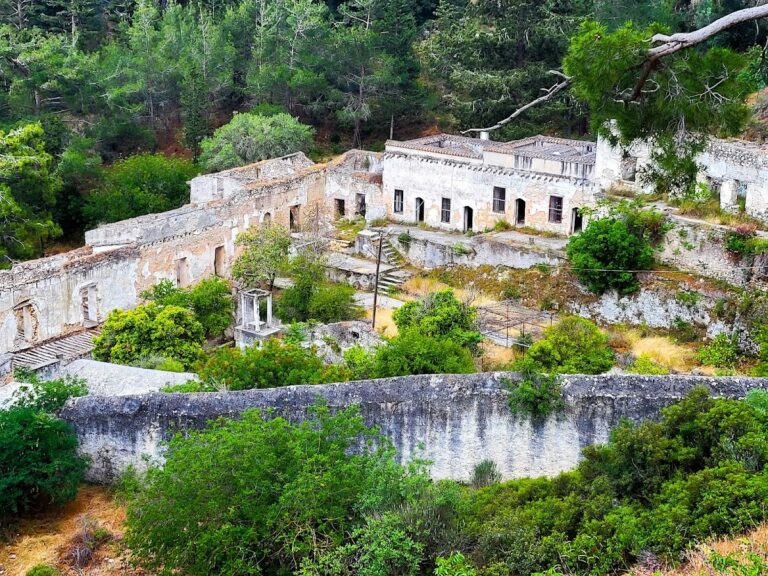
Antiphonitis, formally the Church of Christ Antiphonitis, is a Byzantine Greek Orthodox church and former monastic foundation in Cyprus, near Kalograia in the Kyrenia Mountains. One tradition attributes the foundation to the seventh century, while the surviving church and monastery buildings were substantially rebuilt during the twelfth century. The church served as the katholikon, or principal church, of the monastery and is now associated with the Archangel Antiphonitis Monastery under the Kyrenia Metropolis, a diocesan jurisdiction of the Church of Cyprus.
Foundation and medieval development
The name Antiphonitis means “Christ who responds” or “Christ who answers.” It is linked to a tradition about a miraculous icon that answered a dispute over repayment of a debt. The name is known from the late medieval period, although no surviving account of the Cypriot icon is known.
Antiphonitis underwent major changes during the later medieval period, probably in the fifteenth century and perhaps into the early sixteenth century. The western entrance vestibule, or narthex, was added during this phase, together with a southern arcade or open loggia, a covered passage formed by arches. A further extensive campaign of wall painting also transformed the church’s interior.
Lusignan associations
In the sixteenth century, Stefano Lusignan, a member of the Lusignan family and a writer on Cyprus, described Antiphonitis as a fief of his family. He stated that his maternal grandmother, Isabella Perez Fabricius, founded the monastery, and that his brother John died there after becoming a monk under the name Hilarion.
Later history and protection
The church belonged to Kykkos Monastery in the 1930s. It is now classed as a museum and has also been described as unoccupied. The site remains under the de facto control of Northern Cyprus.
After 1975, some of the frescoes were stolen and sold on the international art market. The iconostasis, the decorated screen separating the sanctuary from the nave, was also removed. Panels from it were traced to a private collector in the Netherlands, after which the Government of Cyprus undertook legal action and four icons were repatriated in September 2013. A fifteenth-century icon of the Virgin Mary located in Athens had already been returned to Cyprus on 14 September 1998.
Graffiti and pilgrim records scratched into the lower frescoes preserve evidence of visits by ordinary Cypriots during the eighteenth, nineteenth, and twentieth centuries. The inscriptions are predominantly in Greek, with some written in the Ottoman Turkish alphabet. Recorded dates include 1803, 1888, 1891, 1896, 1902, 1903, 1904, 1910, 1911, 1919, 1930, and 1958.
Remains
Antiphonitis is a single-domed church set among forests on the northern slopes of the Kyrenia Mountains, near Kalograia, at the head of a valley and beside a natural spring. Its central space is covered by a spacious dome carried on eight pillars or supports rather than the more usual four. The walls beneath it contain eight semicircular windows. This arrangement is described as the only surviving Cypriot example of its type. The irregular form of the dome may reflect damage caused by the Cyprus earthquake of 1222.
Medieval church structure
The western narthex and southern arcade belong to the later medieval alterations. The arcade is an open, covered passage with vaulted arches resting on columns, extending the church beyond its earlier core. Comparable arrangements are recorded at the ruined and partly restored church in Saint Hilarion Castle and at a former church in the centre of the Monastery of Saint John Chrysostomos at Koutsovendis. The latter building was rebuilt at the end of the nineteenth century.
Twelfth-century paintings
The oldest frescoes date from the end of the twelfth century. They represent a local interpretation of the late Comnenian style, a Byzantine artistic tradition associated especially with the imperial dynasty that ruled from 1058 to 1185. In the apse, the semicircular sanctuary end of the church, the paintings include the Virgin Mary and prelates. Other early scenes and figures portray saints in the sanctuary, deacons, martyrs, stylites, and a Baptism on the nave’s southwestern pillar. The apse paintings of the Virgin and prelates were damaged when first studied, while the sanctuary saints remained comparatively well preserved.
The dome contains Christ Pantocrator, the image of Christ as universal ruler, surrounded by angels. Studies carried out in the 1960s and 1970s already described these paintings as badly damaged. The heads of the twelfth-century angels in the apse were also damaged and partly removed.
Fifteenth-century fresco cycle
Most of the surviving frescoes date from the fifteenth century. They were painted in a local revival style that combined Byzantine traditions with elements of fourteenth-century Italian iconography. One prominent image shows the Virgin and Child accompanied by the archangels Michael and Gabriel.
A Tree of Jesse once covered the south wall, while an elaborate Last Judgment occupied the north wall. The Tree of Jesse was removed, and the Last Judgment was severely damaged. Its imagery, including Christ and Satan in Hell, contains elements described as nearly identical to those in Giotto’s frescoes at the Scrovegni Chapel in Padua. Giotto was a major Italian painter of the late thirteenth and early fourteenth centuries, and the chapel is known for his narrative fresco cycle.
The narthex paintings have faded through exposure to sunlight. They include an unusually large representation of Saint George, a Christian martyr and military saint widely venerated in Eastern Christianity.
Iconostasis and surviving movable works
The iconostasis was painted blue and gold, and its doors bear the date 1650, during the reign of Mehmed IV, the Ottoman sultan who ruled from 1648 to 1687. Most of the icons associated with it were made in the seventeenth century. One of them, an icon of the Archangel Michael, is dated 1659. The removal of the screen and the later return of four icons form part of the continuing history of the church’s surviving artistic remains.