Gomionica Monastery: A Serbian Orthodox Monastery in Bosnia and Herzegovina


Site at a Glance
- Rating
- 5
- Popularity
- Very Low
- Country
- Bosnia and Herzegovina
- Primary era
- Medieval
- Eras represented
- Medieval, Early Modern
- Civilizations
- Kingdom of Bosnia
- Site type
- Religious
- Remains
- Monastery
On this page11 sections
History
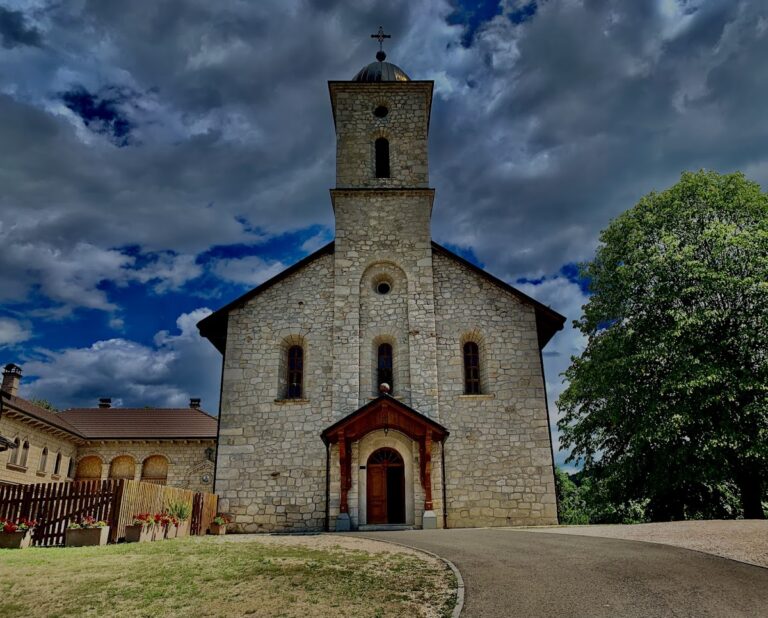
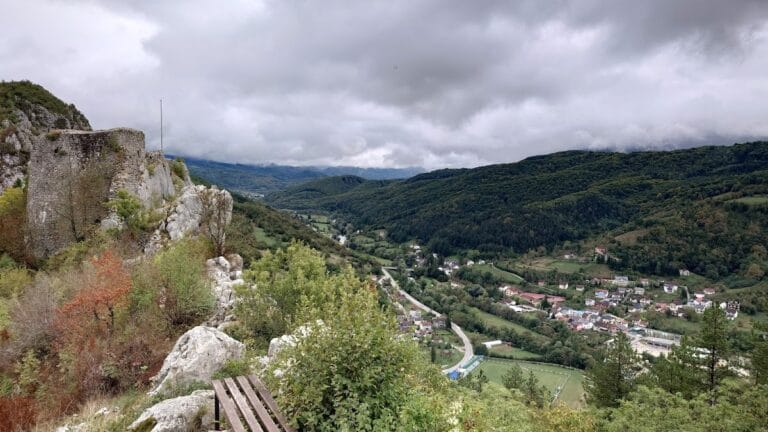
Gomionica Monastery is a Serbian Orthodox monastery in Bosnia and Herzegovina, located at Kmećani near Bronzani Majdan. Its church is dedicated to the Presentation of the Virgin Mary, a Christian feast commemorating Mary’s presentation in the Temple. The monastery belongs to the Banja Luka Eparchy, an Orthodox ecclesiastical district governed by a bishop. Its exact foundation date and founder remain uncertain, but its origins are most often placed in the late fifteenth century, shortly before the Ottoman conquest of the Kingdom of Bosnia.
Origins and Ottoman-era records
The monastery has also been assigned to the fifteenth or sixteenth century, while architectural comparisons have been used to suggest a possible fourteenth-century context. Another interpretation places its beginnings before the establishment of the Jajce Banovina. These differing views reflect the limited evidence for its earliest history. The church itself was probably built before 1560.
Several traditions name possible founders or benefactors. One tradition attributes Gomionica to Stefan Nemanja, founder of the medieval Serbian Nemanjic dynasty, and his son Saint Sava, the first archbishop of the independent Serbian Orthodox Church. Other accounts identify Mara, described variously as an empress, a sultana, or the wife of a sultan or Austrian ruler, or Prince Obrad, who had served the Ottoman authorities and distinguished himself during the capture of Bihac. Traditions concerning Mara have been connected with Mara, daughter of Despot Djuradj Brankovic and wife of Sultan Murad II, and with Mara, daughter of Despot Jovan and wife of Ferdinand Frankopan. These identifications have not been historically established, while a separate Serbian tradition remembers Mara as the monastery’s benefactor.
The first written reference to Gomionica dates from 1536. An Ottoman defter, an administrative register used for taxation, landholding, and population records, mentioned Abbot Andrija, who had reportedly led the monastic community for twenty-four years. In 1560, a local pasha wrote to the Sublime Porte, the central government of the Ottoman Empire, and identified the monastery with Zaluzje, also known as Gomionica.
The monastery continued to function as a religious and literary centre. Its oldest preserved object is a typikon, a monastic rule regulating liturgical and communal observance, dated 1599 and now held in the library of the Eparchy of Arad in Arad, Romania. In 1649, Jovan Svetogorac, a Serbian Orthodox monk and scribe, produced the Flower Triod at Gomionica. The book is an Orthodox liturgical work used especially during the pre-Paschal period. Serbian Patriarch Arsenije IV stayed at the monastery on 27 March 1727.
Wartime movements and nineteenth-century life
Gomionica’s community was displaced during the Great Turkish War, the late-seventeenth-century conflict between the Ottoman Empire and a European coalition. The monks left in the late seventeenth century, taking the monastery’s most valuable relics with them. They found refuge at Hodos Monastery in Banat, where the community remained until 1714.
In 1738, during the Austro-Turkish War of 1735–1739, the monks moved again because of fears of reprisals by Ottoman troops. They settled at Pakra Monastery in Slavonia and remained there until 1747. The church at Gomionica was renovated several times during the eighteenth and nineteenth centuries, sustaining the monastery’s religious life through these periods of disruption.
Education and clerical life also formed part of the monastery’s nineteenth-century history. A monastery school was established in 1882, and the writer Petar Kocic attended it. Gerasim Kocic became a monk and priest at Gomionica in 1880. In 1883, the community included Abbot Partenije Davidovic, Isaija Kostic, and Gerasim Kocic.
The monastery received support from Kosta Vuckovic, a merchant, benefactor, and parliamentary deputy, who donated 1,000 florins for the soul of his father. His father, Todor, had entered monastic life under the name Dionysius and served as abbot until his death in 1879. The donation connected a local family’s religious patronage with the continuing life of the monastery.
War, supervision, and restoration
Gomionica suffered serious damage during the Second World War. German aircraft bombed the monastery on 9 December 1941, damaging the monks’ residence and the school building. In the same year, the Ustaše, a Croatian fascist movement that governed the wartime Independent State of Croatia, killed Abbot Serafim Strkic.
From 1951, Bishop Varnava Nastic lived at Gomionica under the supervision of the Yugoslav Ministry of Internal Affairs. The monastery was converted into a women’s monastery in 1953. Jefimija Maksimovic served as abbess from 1973 to 2014, after which Metodije Kragulj became abbot. Twelve resident nuns were recorded in 2006.
After the war in Bosnia and Herzegovina, the monastery was restored and reconsecrated on 21 September 1998. Gomionica is listed as a National Monument of Bosnia and Herzegovina, a status that recognizes the historic and architectural value of the surviving complex.
Remains
Monastic complex and church
Church of the Presentation of the Virgin Mary
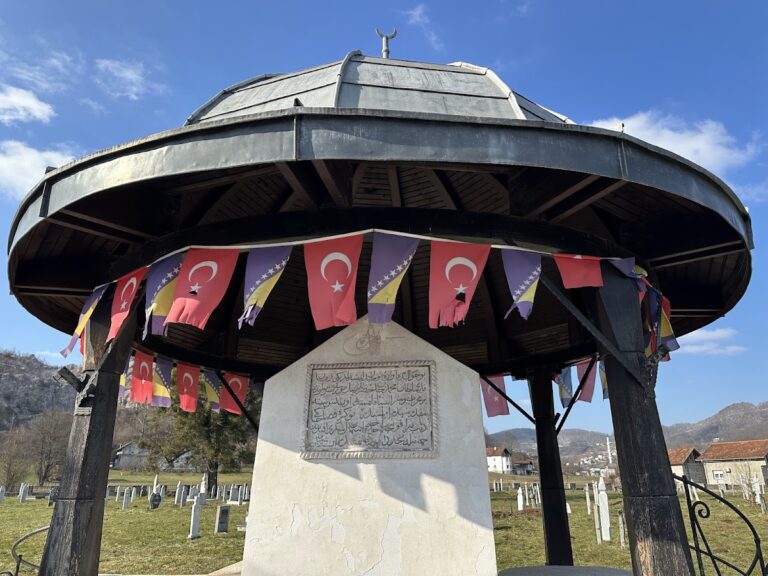
The surviving complex comprises the church, the old konak, a residential or lodging building within a Balkan monastery, part of the old wall, an old fountain in the cemetery, and the old village cemetery near the monastic grounds. The church is a single-nave building organized around a central dome, a semicircular altar apse marking the sanctuary, and a narthex, the entrance or vestibule area. Reinforcing arches run along the longitudinal walls.
Inside, the vaults rest on projecting pilasters, shallow rectangular supports engaged with the walls. Their lower sections contain arched passages, creating an interior arrangement that gives the single-nave church the appearance of a three-nave plan. Architectural comparisons connect the building with the churches of Rmanj, Krupa, and Krka, whose own origins may reach back to the fourteenth century. The comparison emphasizes the arrangement of four supports in the nave, two additional supports in the narthex, and the dome.
Residential and cemetery features
The old konak forms part of the monastery complex alongside the church. The old wall, the cemetery fountain, and the nearby village cemetery add to the surviving physical setting of the religious foundation. The monks’ residence and school building were damaged by the bombing of 1941, while the complex as a whole underwent restoration after the war in Bosnia and Herzegovina.
Paintings and monastery treasury
Wall paintings
The church’s wall paintings have stylistic links with the masters associated with the Peć Patriarchate and the narthex of Gracanica. Related artistic work is also connected with the church of Lomnica Monastery and with renewed frescoes at Studenica, Mileseva, and Banja near Priboj. Earlier paintings were rediscovered during research and study work in the 1980s and 1990s. The associated works are generally placed in the later sixteenth century.
Books, icons, and crafted objects
The monastery treasury holds icon collections dating from the sixteenth to the nineteenth centuries. Among them are icons from the late seventeenth and early eighteenth centuries by unidentified artists. The treasury also contains manuscripts, religious books, and objects of artistic craftsmanship, including books dating from the fourteenth to the seventeenth centuries.
A gilded silver cross made in 1640 by Stefan Ivanovic Sarajevac of Sombor is now held in the collection of the University of London. Together with the monastery’s books, icons, and liturgical objects, it reflects the artistic and religious activity associated with Gomionica across several centuries.