Zemen Monastery: A Bulgarian Orthodox Monastic Complex




Site at a Glance
- Rating
- 4.6
- Popularity
- Medium
- Country
- Bulgaria
- Primary era
- Medieval
- External website
- Open
- Eras represented
- Medieval, Early Modern, Modern
- Civilizations
- Bulgarian, Byzantine, Serbian
- Site type
- Religious
- Remains
- Monastery
On this page7 sections
History
Zemen Monastery is a Bulgarian Orthodox monastery in Bulgaria, located near the town of Zemen. Founded in the eleventh century, it is associated with the medieval cross-domed church of Saint John the Theologian, the Christian apostle traditionally linked with the Gospel of John and other New Testament writings. The church and its paintings preserve evidence of the monastery’s long religious and artistic history.
Foundation and fourteenth-century restoration
The monastery was founded in the eleventh century. In the fourteenth century, the Serbian nobleman and despot Dejan restored it and made it his endowment together with his wife, Doya, also known as Theodora. In the medieval Balkans, despot was a high-ranking title used by rulers and nobles. Dejan was related by marriage to Emperor Stefan Dušan and was the father of Constantine Dragaš. Their commemorative founder portraits, known as ktitor portraits, and several Serbian inscriptions remain in the church. A ktitor was a founder, patron, or donor represented in a church.
A major cycle of wall paintings was created in 1354. The frescoes include biblical and Gospel scenes, along with episodes drawn from apocryphal stories and popular religious traditions. One scene shows the preparation of the nails for Christ’s Crucifixion. The church also preserves a portrait of Saint John of Rila, the tenth-century Bulgarian hermit associated with the Rila Monastery.
Ottoman rule and nineteenth-century renewal
During Ottoman rule, the period when the Islamic-ruled Ottoman Empire governed much of southeastern Europe, the monastery was abandoned while its church continued to stand. The complex underwent several restorations during the nineteenth century. The church was strengthened in 1830 and again in 1860.
In 1867, the master builder Milenko Velev of Blateshnitsa constructed the first monastery building. Ignatius, Metropolitan of Kyustendil, consecrated it on 20 May, the feast of Saint John the Theologian. Since then, an annual spring gathering in honor of the saint has been held on that day. In the early twentieth century, Priest Yanaki Mitov built a new two-storey monastery building measuring 40 metres in length.
Protection and museum use
The church was declared a monument of Bulgarian architecture and painting in 1966, and restoration work began in the 1970s. The monastery was converted into a museum, and since 2004 it has been a branch of Bulgaria’s National Historical Museum. It is currently inactive and is not inhabited by monks.
Remains
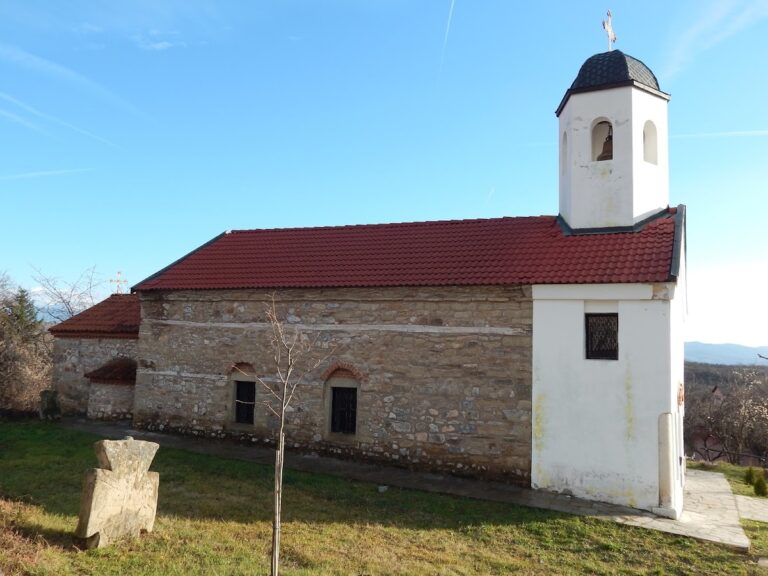
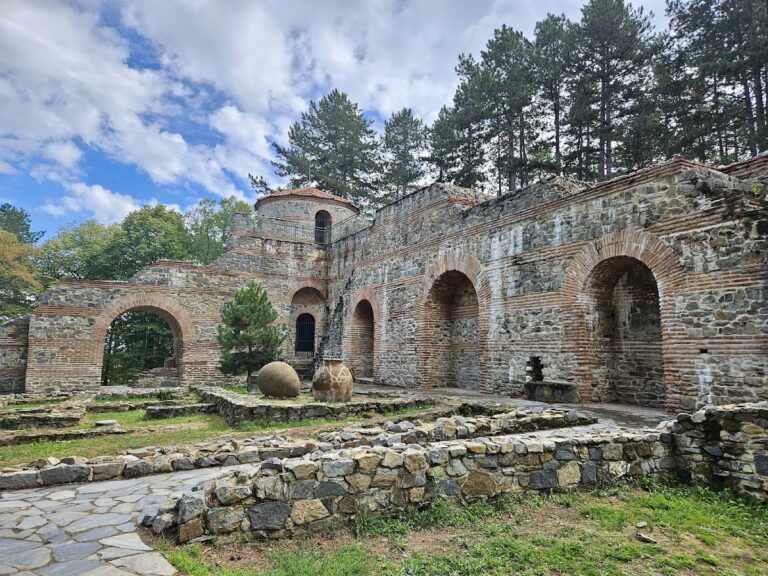
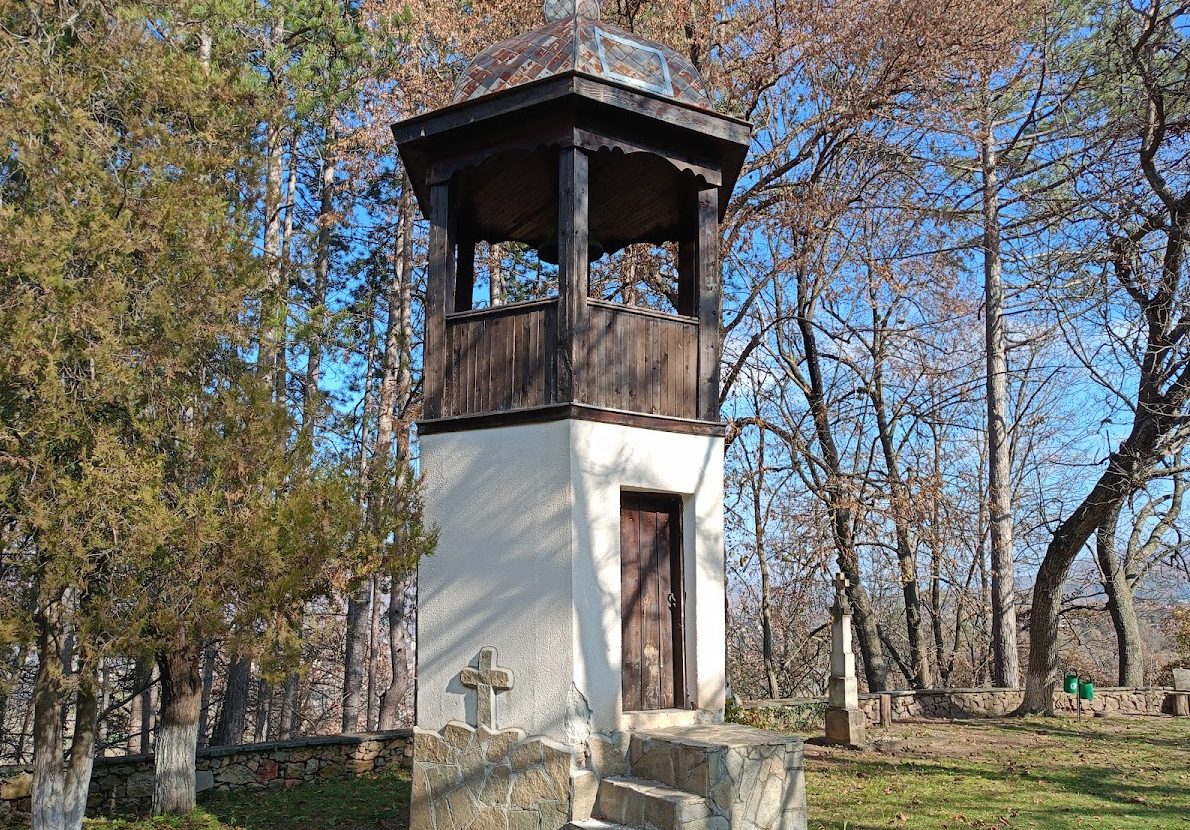
The complex stands on a northeastern slope of the Konya Mountain, at the beginning of the Zemen Gorge and on the left bank of the Struma River, approximately one kilometre southeast of Zemen. Its surviving components include the Church of Saint John the Theologian, a bell tower, and two residential or monastic buildings.
Church of Saint John the Theologian
The church belongs to the monastery’s eleventh-century foundation. It is a simple cube-shaped, cross-domed building, with a central dome carried above the crossing of arms that form a cross-shaped structural plan. The plan measures about 9 by 9 metres, more precisely 9.18 metres in length and 8.71 metres in width. Its walls rise about 7 metres, reaching 11.20 metres with the dome. Carefully dressed tuff blocks joined with mortar form the walls. The stone dome rests on a tall cylindrical drum decorated with blind arches, and the building is covered by a hipped roof.
Inside, a monolithic stone altar stands with a floor of multicolored stone slabs incorporating antique bricks. The earliest painting layer dates to the second half of the eleventh century, and an image of Saint Anne survives from that phase. The principal fresco cycle, painted in 1354, covers biblical and Gospel subjects as well as scenes derived from apocryphal narratives and popular traditions. Six ktitor portraits occupy the southwestern corner. They depict Dejan and Doya, an unidentified local feudal lord and his wife, and rank among the earliest representations of Bulgarian boyars, members of the hereditary or high-ranking aristocracy. The church’s paintings also include Saint John of Rila and several Serbian inscriptions.
Monastic buildings and bell tower
The church forms part of a complex that also contains a bell tower and two residential or monastic buildings. The first of these was built in 1867 by Milenko Velev of Blateshnitsa, while the early twentieth-century building constructed by Priest Yanaki Mitov has two storeys and extends for 40 metres. These structures belong to the monastery’s nineteenth- and early twentieth-century rebuilding history, while the church preserves the medieval core of the site.
Nearby sites