Makrinitissa Monastery: A Byzantine Orthodox Monastic Complex in Greece


Site at a Glance
- Rating
- 4.9
- Popularity
- Very Low
- Country
- Greece
- Primary era
- Early Modern
- Eras represented
- Early Modern
- Civilizations
- Ottoman
- Site type
- Religious
- Remains
- Monastery
On this page9 sections
History
Makrinitissa Monastery is a Byzantine Greek Orthodox male monastery in Greece, at Makrinitsa near Volos in Thessaly. It was founded on Mount Drongos by the Thessalian magnate Constantine Maliasenos of Demetrias around 1205–1209, making it an early thirteenth-century monastic foundation.
Foundation and ecclesiastical status
The monastery was dedicated to the Theotokos, the Christian title for Mary, mother of Jesus, under the devotional designation “of the Swift Visitation,” which refers to her prompt visitation or intercession. Its early endowment included the Hilarion monastery at Halmyros as a metochion, a dependent monastic property whose administration or revenues were connected to a larger monastery.
The foundation date is linked to a grant by a “Conte” associated with the Hilarion property. Some scholars identify this figure as William of Champlitte, the Frankish Prince of Achaea from 1205 to 1209, while another possibility is Berthold II von Katzenelnbogen, the German nobleman who held Velestino. The monastery’s stauropegic status, meaning exemption from the local bishop’s ordinary authority and direct dependence on a patriarchate, was first recorded in 1215 by Arsenios, Bishop of Demetrias.
Arsenios’s successors repeatedly sought to place Makrinitissa under the Diocese of Demetrias. Patriarchs Germanos II, Manuel II, and Arsenios Autoreianos issued declarations defending its direct patriarchal status between 1233 and 1256. The final intervention followed a petition from Nicholas Maliasenos, Constantine’s son. The Hilarion property also changed hands during this period. Latin rulers of Thessaly removed it, Michael II of Epirus restored it, and Arsenios Autoreianos reconfirmed it while recognizing the canonical rights of the Bishop of Velestino. After the Maliasenos family fell out with the rulers of Epirus, the property was removed again.
The Maliasenos family and later decline
Constantine Maliasenos and his son Nicholas eventually entered the monastery as monks, taking the names Konstantios and Joasaph. Both died and were buried there. An imperial document issued by Michael VIII Palaiologos in 1274 ordered that Makrinitissa and the nearby women’s convent of Nea Petra at Portaria should pass to Nicholas’s son John Maliasenos Palaiologos after his parents’ deaths. John, who became a monk under the name Neilos, apparently carried out extensive reconstruction and was called the monastery’s “second founder” in his funerary inscription.
John restored the Hilarion property in 1260, after capturing Thessaly from Epirus. Nea Petra had been founded by Nicholas Maliasenos and his wife Anna in 1271–1272. Makrinitissa reached its high point in the thirteenth century, when its ecclesiastical privileges, family connections, and accumulated possessions made it an important foundation in the region.
After 1700, landslides caused substantial damage to the monastery, possibly including its principal church. Parts of the complex were rebuilt, but the monastery eventually ceased to function. In 1743, the two-storey chapel of Saint Nicholas and All Saints was rebuilt. The Church of the Dormition of the Theotokos followed in 1767, erected on the site of the ruined principal church.
Remains
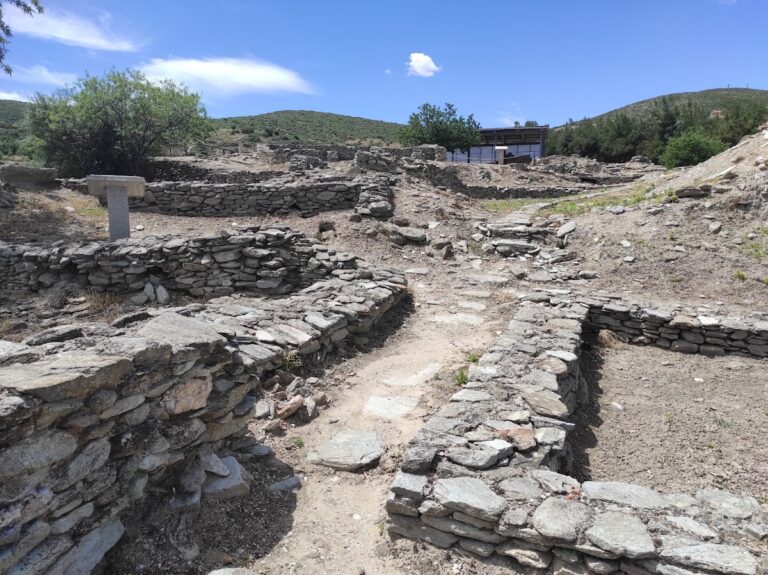
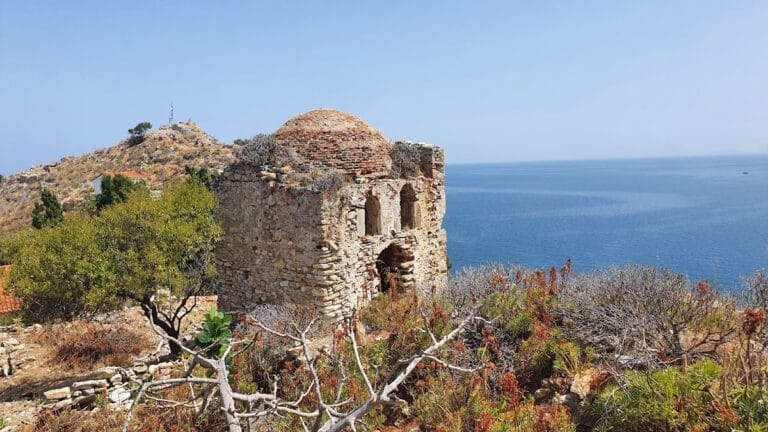
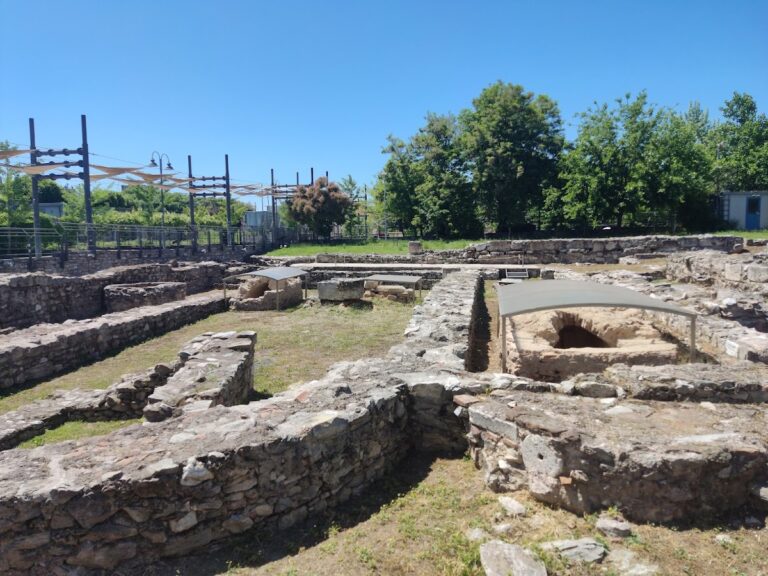
Makrinitissa survives as a Byzantine monastic complex on Mount Drongos in the Makrinitsa area near Volos. Its principal church was the monastery’s katholikon, the main church of an Orthodox monastery. Landslide damage left that building ruinous, and a later church reused masonry and parts of its decoration.
Monastic churches
The ruined katholikon
The monastery’s katholikon formed its principal ecclesiastical building. Established with the monastery around 1205–1209, it later suffered major damage from landslides and became a ruin. Its masonry and decorative elements were incorporated into the Church of the Dormition of the Theotokos, preserving parts of the earlier building within the later complex.
Church of the Dormition of the Theotokos
The Church of the Dormition of the Theotokos was built in 1767 on the site of the ruined katholikon. Builders reused masonry from the earlier church as well as portions of its decoration. Among the reused elements is a relief depicting the Theotokos of the Swift Visitation, the dedication associated with Makrinitissa Monastery.
Chapel of Saint Nicholas and All Saints
The two-storey Chapel of Saint Nicholas and All Saints stood southwest of the katholikon and was rebuilt in 1743. Its reconstruction belongs to the later phase of the site, after landslides had damaged the monastery and before the Church of the Dormition replaced the ruined principal church.
Family tombs
Fragments of the Maliasenos family tombs are dispersed among churches in the surrounding region. They preserve a physical connection with the family that founded Makrinitissa, supplied several of its monastic figures, and shaped its history through successive endowments and interventions.