Church of St. Nicholas Bolnichki, Ohrid: An Orthodox Church and Medieval Monument


Site at a Glance
- Rating
- 4.6
- Popularity
- Very Low
- Country
- North Macedonia
- Primary era
- Medieval
- Eras represented
- Medieval, Modern
- Civilizations
- Byzantine, Ottoman, Serbian
- Site type
- Religious
- Remains
- Church
On this page16 sections
History
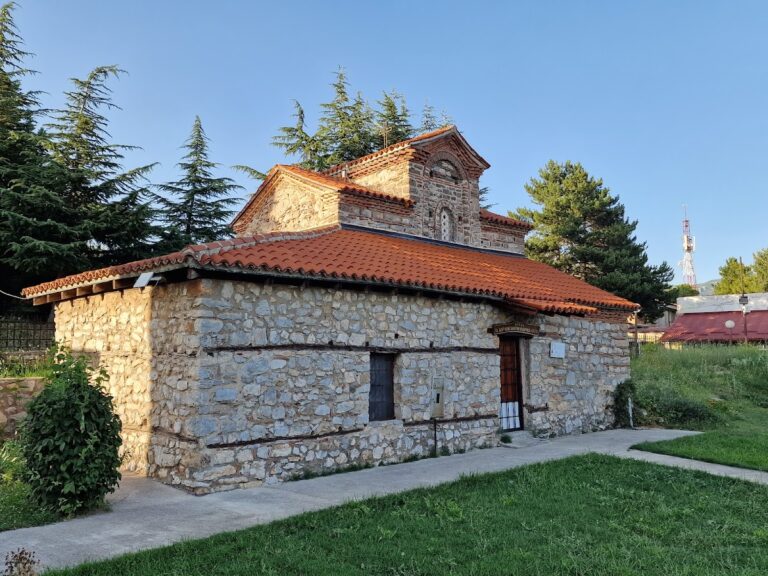
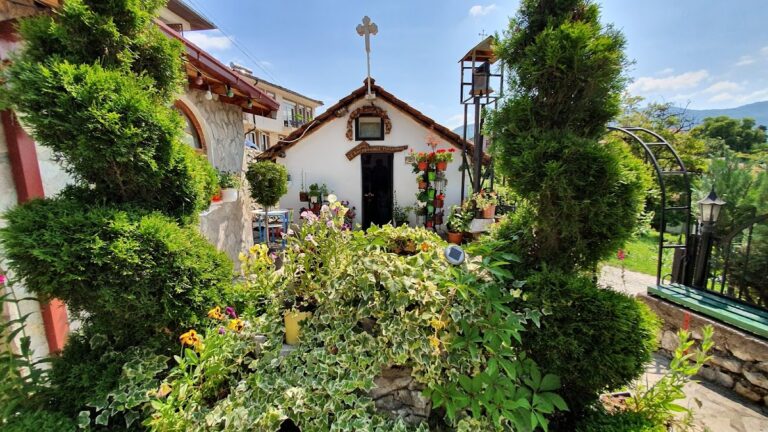
The Church of St. Nicholas Bolnichki is an Eastern Orthodox church in Ohrid, North Macedonia, built and painted in 1313–1314. It stands in the old part of the city, in the Varosh quarter near the Lower Gate, and is dedicated to Saint Nicholas the Wonderworker, the Christian bishop and saint traditionally associated with generosity, care for vulnerable people, and miracle stories. The church remains a functioning place of worship and has the status of a cultural monument.
A medical station at the Lower Gate
The church and the neighbouring Church of the Holy Mother of God Bolnichka take their names from their former use as medical stations. Travellers entering medieval Ohrid through the Lower Gate underwent health checks there. The two churches also gave their name to the surrounding quarter, linking the religious buildings with the city’s system of controlling movement and protecting public health.
The painter responsible for the original construction and decoration is unknown. A framed inscription beside the iconostasis on the south wall preserves the year of the church’s construction and painting. The building is first documented in a record from 1342–1345 concerning properties belonging to the Church of the Holy Mother of God Perivlepta.
Fourteenth-century additions and paintings
In 1345, the exterior south wall was painted when the south porch was formed. During the fifteenth century, another layer of exterior painting was added, although only fragments of it survive in the porch. A chapel dedicated to the Holy Apostles was also built on the south side in the fifteenth century. Its surviving apse preserves a depiction of the Communion of the Apostles.
The exterior west wall was painted completely in 1480–1481, as stated by a preserved inscription. Conservation work also revealed older painting in the niche above the west entrance. A rubble-stone porch was added along the south and west sides in 1929, giving the church part of its present external arrangement.
Remains
Church structure and interior
Main building
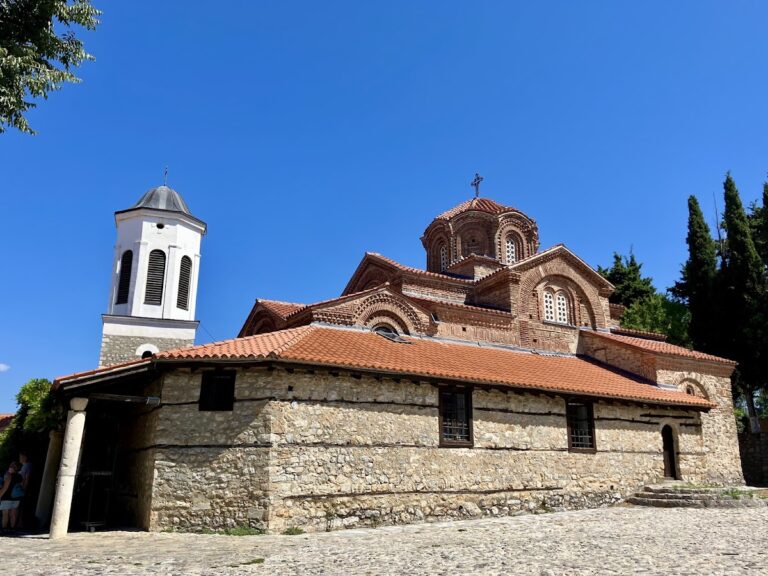
The church stands on Tsar Samuil Street near Ohrid’s Lower Gate, between the harbour and the Robevci House, directly opposite the Church of the Holy Mother of God Bolnichka. It is a single-nave building made of rubble stone set in mortar. The nave is covered by a semicircular barrel vault, while the eastern end terminates in a three-sided apse. Within the east wall are the proskomedia, the part of an Orthodox sanctuary where the Eucharistic bread and wine are prepared, and the diaconicon, a service chamber for liturgical vessels, vestments, and related preparations.
Interior frescoes
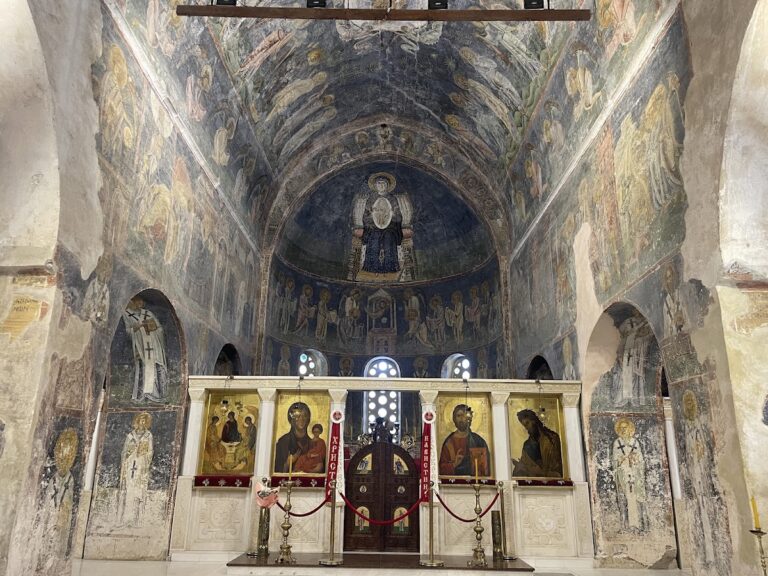
The fresco programme begins in the apse with the Adoration of Christ the Lamb in the first zone. The apse conch contains the Virgin Orans, shown praying with raised hands, between the archangels Michael and Gabriel. The Annunciation occupies the two sides of the apse.
On the north wall of the nave, full-length warrior saints occupy the first zone from west to east, followed by a Deesis, an image of Christ accompanied by the Virgin Mary and John the Baptist in intercession. Saint Spyridon appears in the altar area. The south wall carries full-length figures of Saints Nicholas, Clement, and Panteleimon, while Saints Cosmas and Damian stand west of the south door.
The second zone on both nave walls contains medallions with half-length martyrs, warriors, and bishops. The Great Feasts are arranged on the eastern and western walls and across the vault. The west wall also includes the Dormition of the Virgin and the Transfiguration.
Exterior features and painted surfaces
South porch and wall
The south exterior preserves portraits of Archbishop Nicholas I of Ohrid, King Stefan Dushan, his wife Helena, their son Stefan Urosh V, Sava of Serbia, and Simeon Nemanja. These figures include medieval Orthodox ecclesiastical and dynastic personalities. The later fifteenth-century painting layer survives in fragments within the porch. The eastern part of the porch retains the Communion of the Apostles from the former Chapel of the Holy Apostles.
West entrance
Above the west entrance, a niche contains the Virgin and Child. South of the entrance are a full-length Virgin from the Annunciation and a half-length Saint Nicholas. Five medallions with half-length bishops appear above them, with the Miracle of the Loaves higher still.
On the northern side of the west exterior wall, the paintings show the Wedding at Cana and, above it, Christ appearing to the Apostles at the Sea of Tiberias. The upper triangular section presents Christ blessing with both hands, accompanied by the archangels Michael and Gabriel.
Bell cote and courtyard remains
Bell cote
A distinctive bell cote rises on the west side of the church. Described as unique in Macedonia, it reflects Adriatic or coastal architectural influence. Its construction alternates rows of stone and brick, and it has a tiled gable roof pierced through its thickness by a bifora, a two-light arched opening divided by a central support.
Fortification remains
Two fragments from an earlier sacred building are embedded in the south wall to the right of the entrance. In the courtyard, remains of the city walls form part of the fortifications that descended from Samuil’s Fortress toward the lake. Samuil’s Fortress is the principal medieval fortress associated with Ohrid and the rule of Tsar Samuil in the late tenth and early eleventh centuries.
Icons associated with the church
Processional icon
A processional icon depicting Saint Naum on one side and the Archangel Michael on the other dates from the second half of the fourteenth century. It is painted in tempera on a wooden panel prepared with a gesso ground and measures 91.5 by 70 by 3.5 centimetres. The icon is now held in the Ohrid Icon Gallery, a museum collection devoted to historic icons from the Ohrid region.
Later icons
The church’s associated icons include the Martyrdom of Saint James the Persian, from the second half of the sixteenth century. It is a tempera painting on a gesso-ground wooden panel measuring 50.5 by 38.5 by 3 centimetres and is now in the Ohrid Icon Gallery. The Ascension of Saint Elijah, dated to the late seventeenth or early eighteenth century, is also painted in tempera on a gesso-ground wooden panel. It measures 91.5 by 59 by 4.5 centimetres and is preserved in the same collection.