Church of Hosios David: A Byzantine Monastic Church in Thessaloniki


Site at a Glance
- Rating
- 4.8
- Popularity
- Low
- Country
- Greece
- Primary era
- Medieval
- Eras represented
- Classical, Medieval, Early Modern
- Civilizations
- Byzantine, Ottoman
- Site type
- Religious
- Remains
- Church
On this page10 sections
History
The Church of Hosios David is a Byzantine church in Thessaloniki, Greece, built in the late fifth or early sixth century on the site of a Roman structure. Designed with a cross-in-square plan, it served as the principal church, or katholikon, of the Latomos Monastery in the city’s Upper City. Its early decoration included a major apse mosaic and rich marble and painted ornament, placing the building within the early Christian and Byzantine development of Thessaloniki.
Early Byzantine monastery
The church was originally dedicated to Christ the Savior of Latomos. Another tradition identifies its first dedication as the Prophet Zachariah. During the Byzantine period, it functioned as the monastery’s central church and was decorated with mosaics and frescoes. Earthquakes during the Middle Byzantine period caused damage, including the collapse of parts of the building such as the tribelon, an opening or passage formed by three arches. Marble decoration and another cycle of frescoes were added during this period.
The decoration was renewed or supplemented between the twelfth and fourteenth centuries. Frescoes from approximately 1160–1170 belong mainly to the Middle Byzantine period, while several scenes were probably painted around 1300 during the Palaiologan period, the era of the Byzantine Palaiologos dynasty. These successive campaigns gave the church a layered artistic history.
Ottoman conversion and return to worship
Under Ottoman rule, the church was converted into a mosque. The date is uncertain: the change may have followed the Ottoman conquest of Thessaloniki in 1430, or it may have taken place during the sixteenth century. The building was known at different times as the Suluca, Sulitze, Murad, or Keramettin Mosque. Its relatively remote position near the mountains and its simple exterior have contributed to the view that conversion did not necessarily occur immediately after the conquest.
During its use as a mosque, plaster covered the wall paintings and other decoration, while a minaret was added at the southwestern corner bay. The building returned to Christian worship in 1921. It now functions as an Orthodox church under the Metropolis of Thessaloniki and is also described as a chapel of the Monastery of Saint Theodora. The Church of Hosios David forms part of the Paleochristian and Byzantine Monuments of Thessaloniki, inscribed on the UNESCO World Heritage List in 1988 under criteria (i), (ii), and (iv).
The church’s present dedication is associated with David the Dendrite, a Christian ascetic traditionally linked with living in a tree, which explains the epithet “Dendrite,” or “tree-dweller.” This dedication became established in the early twentieth century.
Remains
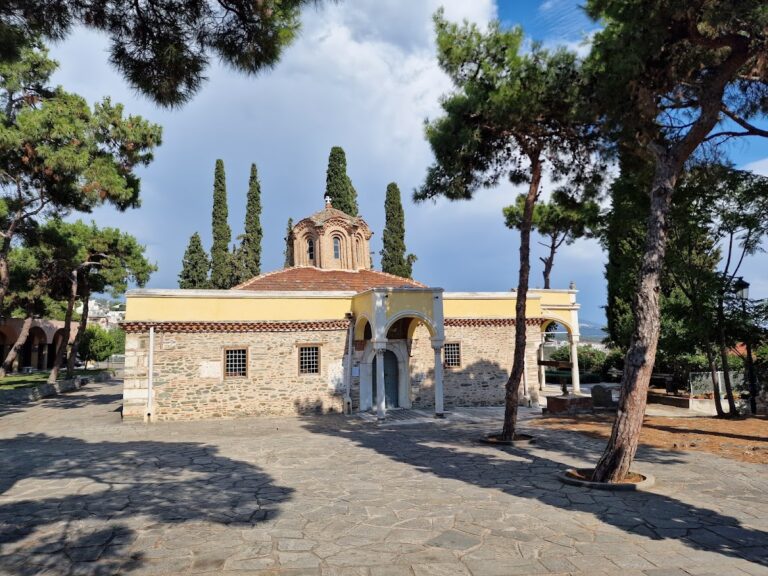
The surviving church retains a roughly square plan organized around a central cross-shaped space. An eastern apse and four small corner compartments form the arms of the inscribed cross. Passageways connect the corner compartments with the central area, and the compartments also open toward the exterior. The building originally carried a dome, later replaced by a tiled roof. The western side, where the original entrance stood, has been destroyed, so the present entrance is on the southern side. The exterior remains simple in appearance, while the interior preserves evidence of elaborate marble and painted decoration.
Church interior
Apse mosaic
The apse contains the late fifth-century mosaic known as the Icon of Christ of Latomos. It presents a Theophany, a manifestation of God, in a naturalistic style. At the center, Christ Emmanuel, meaning “God with us,” appears as a youthful figure seated on a rainbow. He holds an inscription translated as: “Behold our God, in whom we hope and rejoice in our salvation; may he grant rest to this house.”
Four rivers of Paradise flow beneath Christ’s feet: the Pishon, Gihon, Tigris, and Euphrates. The four Evangelists appear through their traditional symbols, with Matthew represented by a human or angelic figure, Mark by a lion, Luke by an ox, and John by an eagle. The composition also includes the prophets Ezekiel and either Habakkuk or Isaiah on opposite sides, beside the River Chebar or possibly the Jordan. Fish swim in the river, alongside an old male figure who may personify it according to Hellenistic artistic conventions.
The placement of this subject in the apse is described as unique. A tradition says that the mosaic was miraculously created in the third century, but the surviving work is dated to the late fifth century.
Medieval frescoes
Frescoes were found beneath the plaster applied during the Ottoman period. Most date from approximately 1160–1170. In the eastern portions of the northern and southern barrel vaults, the surviving scenes include the Nativity, the Presentation in the Temple, Our Lady of the Passion, Christ on the Mount of Olives, the Entry into Jerusalem, and the Theophany. Decorative panels imitate marble slabs, extending the visual relationship between the painted surfaces and the church’s marble ornament.
The southern barrel vault also contains the Baptism and the Transfiguration. Our Lady of the Passion, the Entry into Jerusalem, and Christ on the Mount of Olives were probably added around 1300, during the Palaiologan period. The compositions use relatively few borders between individual scenes, an unusual feature for their period. Many paintings have been damaged by time, earthquakes, water leakage, and the plaster that covered them during the mosque’s use.
The interior marble decoration includes swirling representations of crosses, vines, and leaves. Together with the mosaic and frescoes, these elements preserve the changing decorative programs that accumulated as the church was renewed during the Byzantine centuries.
External remains
Minaret base
At the southwestern corner bay, the remains of the minaret added during the building’s use as a mosque survive with its spiral staircase. This fragment preserves a physical trace of the Ottoman transformation of the former monastic church.
Holy Girdle spring
Northeast of the church, at 13 Timotheou Street, the Holy Girdle spring emerges from multicolored rock with stalactites and forms a small pool. The spring may have been related to the Latomos Monastery complex. Its name refers to the Holy Girdle, the belt or sash associated in Orthodox tradition with the Virgin Mary.