Saint Achillius Church: A Medieval Episcopal Church in Arilje, Serbia


Site at a Glance
- Rating
- 4.9
- Popularity
- Low
- Country
- Serbia
- Primary era
- Medieval
- Eras represented
- Medieval
- Civilizations
- Serbian
- Site type
- Religious
- Remains
- Cathedral
On this page12 sections
History
Saint Achillius Church is a late thirteenth-century Serbian Orthodox church in Arilje, Serbia, built in the Raška architectural tradition a few years before 1296. It stands on the site of an earlier monastery complex that became the seat of the Moravica bishopric in 1219, one of twelve dioceses established by Archbishop Sava. The church and monastery therefore formed an important religious center in the medieval Serbian state.
The Moravica bishopric and the medieval church
The present church was probably constructed during the reign of King Stefan Dragutin, traditionally regarded as its patron. Another interpretation proposes that Dragutin, King of Srem, and his younger brother Stefan Uroš II Milutin, King of Serbia, jointly sponsored the building. Surviving historical records do not identify the builder or patron directly. The attribution is based on Dragutin’s donor portrait, in which he holds a model of the church, and on an inscription in the dome ring that dates the completion of the wall paintings to 1296.
Saint Achillius served as an episcopal see and later became the seat of the Moravica Metropolitanate. The metropolitanate was associated with the monastery from the early fourteenth century until the middle of the fifteenth century. After the Serbian Patriarchate was proclaimed in 1346, the Moravica bishopric was raised to metropolitan status. A manuscript-copying workshop also operated at the monastery during the medieval period, adding an intellectual and literary function to its religious role.
The church is dedicated to Saint Achillius of Larissa, a fourth-century Christian bishop traditionally remembered as an opponent of Arianism and as a participant in the First Council of Nicaea in 325. The dedication reflects the church’s place within the Orthodox Christian tradition, while its paintings connect the local see with the history of the Serbian Church and the Nemanjić dynasty, the medieval Serbian ruling house associated with the consolidation of the state and its independent Orthodox Church.
Ottoman rule, decline, and renewal
Following the Ottoman conquest of the Serbian Despotate in 1459, Saint Achillius and other Orthodox centers entered a period of decline. The monastic community began to re-form after 1557, when the Peć Patriarchate was restored, but it numbered no more than three monks. By 1650, the monastery was recorded as deserted.
In 1735, at the beginning of the Russo-Turkish War, the church and monastery were looted and desecrated. Their buildings were then used as stables. From the middle of the nineteenth century, Saint Achillius functioned as a parish church, and its bells rang again in 1833. By the end of that century, the church contained an empty tomb of Saint Achillius. Serbian genealogical traditions also place the burial of Dragutin’s younger son Urošic there and associate his relics with the flow of myrrh. Urošic is described in this tradition as having died young after becoming a monk.
Archaeology and protection
Archaeological investigations conducted by the Republic Institute for the Protection of Cultural Monuments between 1971 and 1981 revealed building remains from three earlier successive periods and a necropolis, an organized cemetery or burial area. Conservation of the church was completed in 1996. Saint Achillius was declared a Monument of Culture of Exceptional Importance in 1979 and remains protected by the Republic of Serbia. It belongs to the Serbian Orthodox Church and the Diocese of Žiča.
Remains
Setting and architectural form
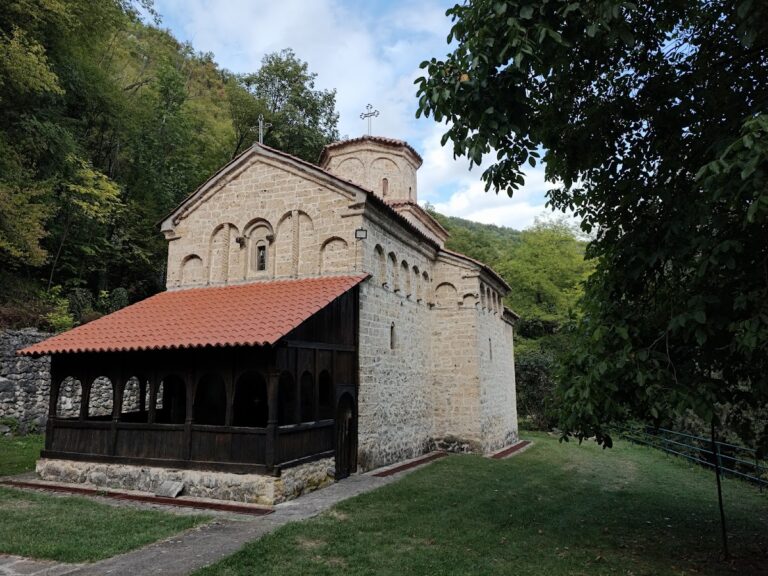
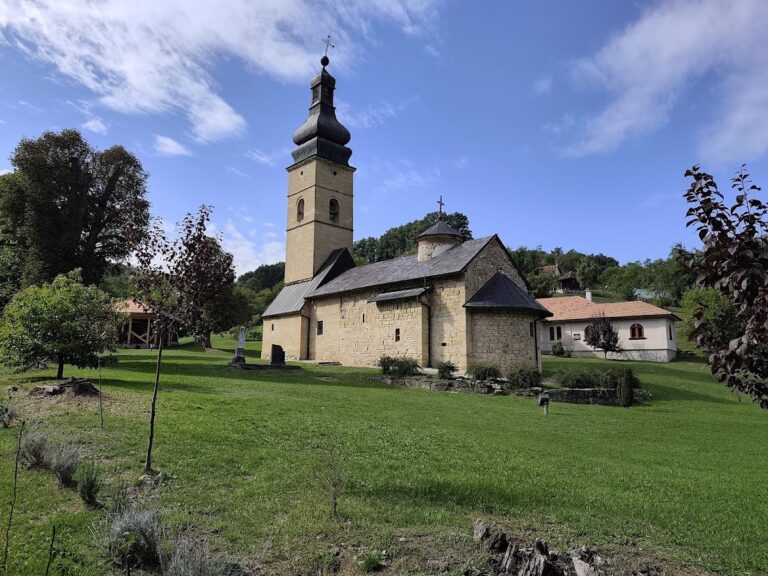
Saint Achillius stands on an elevated plateau in the center of Arilje, above the valley formed by the Moravica and Big Rzav rivers. Its position made the building visible from a considerable distance. The church has a single-nave plan organized around a dome, with a narthex, or entrance vestibule, and a later-added exonarthex, an outer vestibule beyond the narthex. This developed arrangement belongs to the Raška style, a medieval Serbian tradition that combines Romanesque exterior treatment with Byzantine planning and interior space.
The interior includes a lowered transept incorporating the side choirs, together with the diakonikon and prothesis, service chambers beside the altar used for liturgical preparation and vestments. The altar area is divided into three parts and ends in a semicircular apse. Rectangular side choirs extend from the central plan. Above them, the dome rises from a cubic base. Its dome drum, the structure supporting the dome, contains six windows, an unusual arrangement among Serbian churches.
Exterior and entrances
The exterior combines Romanesque wall treatment with a Byzantine spatial concept. Pilasters and blind arcades, recessed arches used as wall decoration rather than open passages, articulate the façades. The building is externally plastered, and an arcade frieze continues along the façades and the upper part of the dome drum. Alternating courses of stone and brick form part of the construction technique. The main entrance is placed on the south side rather than in the more usual western position, and the church does not have the bell-tower arrangement associated with the outer narthexes of other episcopal churches.
Medieval wall paintings
The surviving frescoes were completed in 1296. Their painters are not named, but preserved textual evidence identifies them as Greek artists invited from Thessaloniki. The paintings are partly preserved, with the largest surviving groups in the narthex, less complete decoration in the naos, the main worship space, and small surviving fragments in the exonarthex. Their style and iconography represent an important stage in the development of Serbian mural painting.
The narthex portraits and dynastic imagery
The lower zone of the narthex contains the donor portrait of King Stefan Dragutin holding a model of the church. He appears with his wife Katalin, their sons Vladislav and Urošic, and his brother, King Stefan Uroš II Milutin. Other narthex paintings show Serbian rulers, members of the Nemanjić family, Serbian archbishops, and the bishops and metropolitans of Moravica.
The narthex also contains the Tree of Jesse, an image tracing the ancestral line of Christ, together with scenes and figures connected with the Old Testament, the ecumenical councils, and the history of the Serbian Church. These subjects place the local monastery within both the wider Christian tradition and the institutional history of medieval Serbia.
The naos and liturgical scenes
The naos contains standing figures from the Nemanjić dynasty alongside Serbian bishops and archbishops. Its narrative cycles include the life of the Virgin Mary, the Great Feasts of the Orthodox calendar, and the Passion, meaning the suffering and death of Christ. The west wall preserves portraits of the dynasty’s founders, Stefan Nemanja and Stefan Prvovenčani, as well as its last representative, Stefan Uroš V.
The decoration also includes an image of Stefan Nemanja condemning Bogomilism, a medieval Christian movement with dualist beliefs that established churches condemned as heretical. Portraits of Stefan Uroš II Milutin and Stefan Dragutin appear within the wider program. In the dome drum, biblical prophets surround the windows, extending the painted hierarchy into the upper part of the church.
The altar and side choirs
The apse contains Eucharistic themes, referring to the central Christian sacrament commemorating Christ’s Last Supper. The diakonikon contains scenes from the life of Saint Nicholas, while the southern choir includes an image of Saint Achillius. Together, these paintings relate the altar and adjoining service spaces to the liturgical life and dedication of the church.
The Blue Angel
A fresco of the Archangel Gabriel, known as the Blue Angel, is distinguished by strong modeling, a warrior-like figure, a richly worked garment, and refined execution. It is regarded as one of the outstanding works of Serbian mural painting. Its survival forms part of the broader fresco program that links dynastic portraiture, biblical subjects, church history, and Orthodox liturgical imagery within Saint Achillius Church.