Saint Nedelya Church: Sofia’s Metropolitan Cathedral


Site at a Glance
- Rating
- 4.8
- Popularity
- Medium
- Country
- Bulgaria
- Primary era
- Modern
- External website
- Open
- Eras represented
- Modern
- Civilizations
- Bulgarian, Ottoman
- Site type
- Religious
- Remains
- Cathedral
On this page17 sections
History
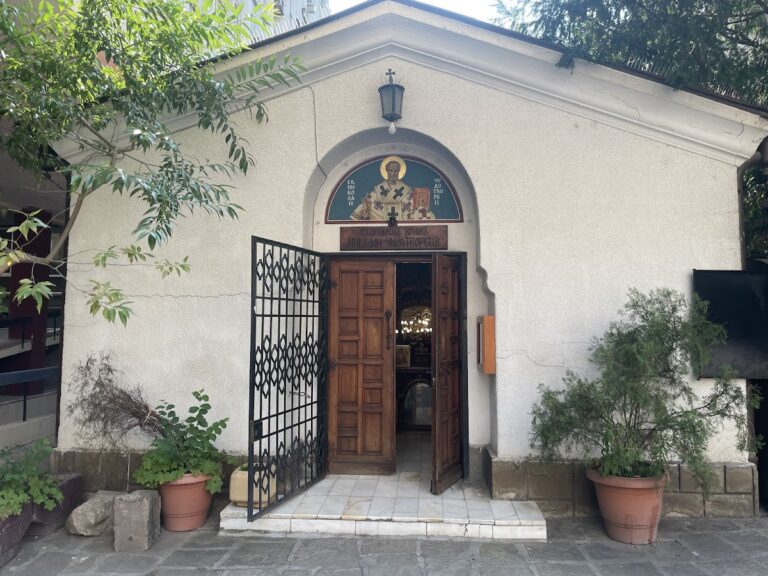
Saint Nedelya Church is an Eastern Orthodox cathedral in Sofia, Bulgaria, serving as the cathedral of the Metropolitan of Sofia and the Sofia Diocese of the Bulgarian Orthodox Church. Its present building is a Byzantine Revival cathedral reconstructed between 1927 and 1933, but its history reaches back to an uncertain early foundation in the centre of the city.
Early church and medieval expansion
The beginnings of Saint Nedelya Church are not certain. One tradition, associated with the church historian Christo Temelski, places a family chapel here in the early fourth century and says that it became a public city church late in that century. Another account dates the construction of the original church to the tenth century. During the rule of the Asen dynasty, which governed the Second Bulgarian Empire from 1187 to 1280, the building was expanded.
The church’s name also has an uncertain history. In 1578, the German traveller Stephan Gerlach recorded it under names translated as “Church of the Lord” and “Church of Jesus Christ,” while also using the Greek name Kyriaki. This may have referred to Saint Nedelya, the Bulgarian name associated with Saint Kyriaki, a Christian martyr traditionally dated to the third century, or to the Greek expression connected with the Lord’s Day. “Nedelya” is also the Bulgarian word for Sunday.
Ottoman period and the relics of Stefan Milutin
It is uncertain whether the church was damaged or destroyed during the Ottoman invasion at the end of the fourteenth century. It was certainly burned after the Chiprovtsi Uprising of 1688, an anti-Ottoman revolt in northwestern Bulgaria. Two monks from Mount Athos and Sofia’s guilds helped finance and organize its rebuilding, which was completed in 1698. After this work, Saint Nedelya became the cathedral of the Sofia Diocese.
Around 1460, during a plague epidemic, the relics of the Serbian king Stefan Urosh II Milutin were brought to Bulgaria. They were kept successively at several churches and monasteries before being transferred to Saint Nedelya, probably in the early eighteenth century. The church then became the metropolitan church, and the presence of the relics gave it the alternative name “Holy King,” which remained in use into the early twentieth century.
The earlier church had stone foundations and a wooden upper structure. It stood partly below ground level, reportedly because Ottoman regulations prevented a church from rising higher than a mounted soldier. This form survived until the nineteenth century, despite repeated repairs. A major renovation took place between 3 August and the end of November 1820, but by the middle of the 1840s the building was again considered to be in poor condition.
Nineteenth-century rebuilding
In the early 1850s, the Sofia Diocese and the city’s church community decided to replace the old cathedral. An Ottoman reform decree issued by Sultan Abdülmecid I in 1856 broadened Christian rights, including the right to construct new churches. The earlier building was demolished on 25 April 1856, and construction of its replacement began that year under Petar Kazov.
An earthquake seriously damaged the unfinished structure in 1858. In 1860, after allegations that donations had been misappropriated and after the funds had run out, Kazov stopped the work and protected the building with a temporary gabled roof. The church council resumed construction in 1863 under Ivan H. Boyanin. He completed the building in the autumn of that year, and it was consecrated on 11 May 1867.
During the temporary Russian administration of Bulgaria from 1877 to 1879, Prince Alexander Mikhailovich Dondukov-Korsakov donated eight bells of different sizes. The church’s small bell towers could not hold them, so a separate belfry was erected in the southern part of the churchyard. It was consecrated on 9 May 1879.
Urban transformation and the 1925 bombing
As central Sofia underwent major urban changes, the church council commissioned Nikola Lazarov’s architectural office in 1898 to give the cathedral a more representative appearance and reinforce its surroundings. Completed by 1901, the redevelopment introduced National Romantic and Byzantine Revival elements. The three domes of the 1860s church were replaced by one large central dome and four smaller domes, the white facades were patterned with longitudinal red-brick bands, and a representative western bell tower was added.
The church became the burial place of important Bulgarian Orthodox leaders. Exarch Joseph I of Bulgaria was buried beside it in 1915, followed by Metropolitan Parthenius of Sofia on its northern side in 1918. Patriarch Neofit of Bulgaria was later buried at the church in 2024.
On 16 April 1925, a bomb concealed in the main dome exploded during the funeral service for General Konstantin Georgiev. Members of the Military Organization of the far-left wing of the Bulgarian Communist Party organized and carried out the attack, which targeted Tsar Boris III, Prime Minister Aleksandar Zankov, and senior military and administrative officials. The falling debris killed 193 people and injured approximately 500. A memorial plaque at the church commemorates the victims.
Reconstruction and later conservation
Architects Ivan Vasilyov and Dimitar Tsolov won the competition to reconstruct the cathedral. The work began in July 1927 and continued until spring 1933. The rebuilt church was consecrated on 7 April 1933, creating the structure that stands today.
Bombing during the Second World War damaged the roof and the roof of the outer entrance vestibule between January and April 1944. Repairs continued in stages until 1948. Between 1971 and 1973, a team led by Professor Nikolay Ev ensure?ov Rostovtsev decorated the interior with frescoes. The floor was repaired and the northern colonnade glazed between 1992 and 1994. The exterior facade was thoroughly cleaned in 2000, and an automatic bell-ringing mechanism was installed in 2002.
Saint Nedelya’s patronal feast is celebrated on 7 July. The relics of Stefan Urosh II Milutin are commemorated on 30 October, with a procession through the church on the preceding evening. The observance regularly attracts pilgrims from Serbia. After the Russo-Ottoman War of 1877–1878, Bishop Meletius promoted the name “Holy King” in connection with Russian and Serbian diplomatic representatives.
Remains
Building and external arrangement
Reconstructed cathedral
The present cathedral is a Byzantine Revival building measuring approximately 30 metres in length, 15.5 metres in width, and 31 metres from the ground to the top of the dome. Travertine from present-day North Macedonia forms the principal building stone. Its large central dome rises above a main worship space, while the form of the dome and its windowed drum was designed as a homage to Hagia Sophia in Istanbul.
Entrances and bell tower
A transverse western structure contains the inner narthex, an entrance hall, while the outer narthex surrounds both the inner narthex and the main worship space. The bell tower rises above the principal entrance. The terrace supporting the church was reinforced during the 1898–1901 redevelopment and equipped with broad external stairways on its northern, western, and southern sides.
Interior and sacred furnishings
Altar area and relic shrine
East of the main worship space, a second transverse structure enlarges the altar area and leads to the altar apse, the rounded terminal space containing the sanctuary. Three altars occupy this area. The central altar is dedicated to Saint Nedelya, the northern altar to the Archangel Michael, and the southern altar to Saint Stephen the Protomartyr and Archdeacon. The shrine containing the relics of Stefan Urosh II Milutin stands before the southern altar.
Narthex and furnishings
The western part of the church contains the narthex, baptistery, church office, and candle shop. It also retains the bishop’s throne and the tsar’s throne made by Ivan Travnitzki. The interior floor is paved with slabs of Rapakivi granite imported from Russia.
Iconostasis and frescoes
Anton Stanishev carved the iconostasis, the screen separating the sanctuary from the main worship space, between 1863 and 1865. Some of its icons were painted by Stanislav Dospevski. The surviving two-row gilded screen was returned to the church after the 1925 bombing. The interior frescoes were produced between 1971 and 1973 by a team led by Nikolay Rostovtsev, including Karl Yordanov, Georgiev and his sons Kostadin and Nikola, and Dimitar Bakalski. Saints of the Bulgarian Orthodox Church and other Orthodox churches appear on the north and south walls of the main congregational space.
Bells and burial places
Belfry
The bell tower contains eleven bells. Eight were donated by Dondukov-Korsakov in 1879, two were made in Serbia, and one was cast in Bulgaria. The largest weighs 1,700 kilograms.
Church burials
Burial places associated with the church include the tomb of Exarch Joseph I beside the southern side of the building, the grave of Metropolitan Parthenius on the northern side, and the burial of Patriarch Neofit.
Nearby sites