Monastery of the Holy Trinity, Meteora: A Greek Orthodox Monastery


Site at a Glance
- Rating
- 4.8
- Popularity
- Medium
- Country
- Greece
- Primary era
- Medieval
- External website
- Open
- Eras represented
- Medieval, Early Modern
- Civilizations
- Ottoman
- Site type
- Religious
- Remains
- Monastery
On this page13 sections
History
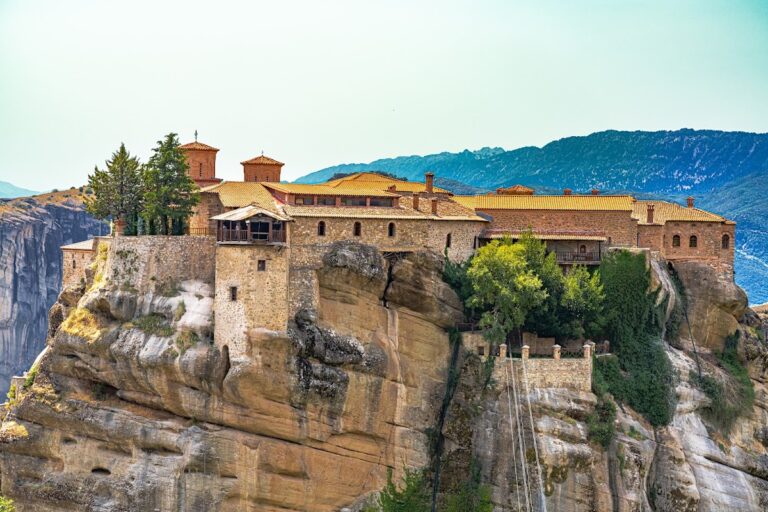
The Monastery of the Holy Trinity is a male Greek Orthodox monastery in Greece, located at Kalabaka in the Pineios Valley of Thessaly. Also known as Agia Triada, it is one of the six surviving monasteries of Meteora and one of the oldest monasteries still existing there. Its foundation date remains uncertain, although its cathedral was built around 1475 to 1476.
Origins at Meteora
Monks had established hermitages at the foot of the Meteora cliffs by the eleventh century. During the political upheavals of the fourteenth century, monastic communities moved onto the cliffs for greater security. John Uroš, the titular emperor of the Serbs and Greeks, became a monk at Meteora and supported, rebuilt, and founded monasteries in the area.
A local tradition attributes the foundation of the Monastery of the Holy Trinity to the monk Dometius, who is said to have arrived at the site in 1438. An earlier historical reference names the Monastery of the Holy Trinity together with the Great Meteoron in an order issued by Simeon Uroš Palaiologos in 1362. By the end of the fifteenth century, twenty-four monasteries had been established at Meteora.
Construction and Monastic Development
The monastery’s cathedral was erected around 1475 to 1476, and an inscription on its southern facade gives 1476 as the construction date. Its decoration developed over several later phases. The nave was painted in the late seventeenth century, while the main church received its frescoes in 1741. The names of Damascene, Jonah, and Parthenios appear on the monastery walls in connection with benefaction or restoration.
At its height, the monastery housed fifty monks. By the beginning of the twentieth century, its community had declined to five monks, and it was still regarded as one of the poorer monasteries of Meteora several decades ago. Before the twentieth century, reaching the monastery involved crossing the valley and climbing through the rock formation. Supplies were lifted in baskets using rope ladders, later replaced by a winch-operated system.
War, Continuity, and Heritage
German forces occupied the monastery during the Second World War. Precious manuscripts and other treasures from the rock-cut chapel of Saint John the Baptist were looted during the occupation.
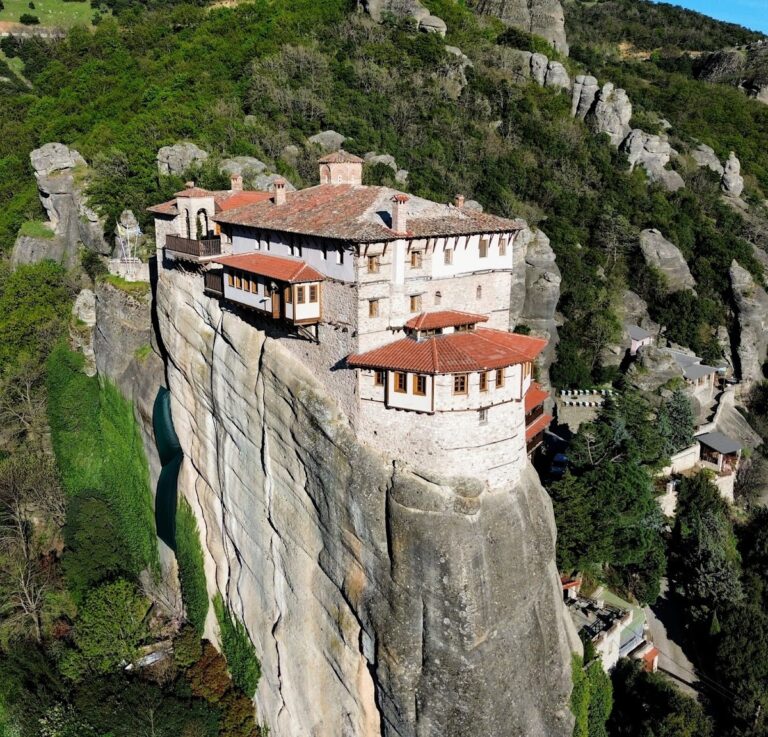
The Monastery of the Holy Trinity remains occupied and active. Together with the Great Meteoron, Varlaam, and Saint Stephen monasteries, as well as the extant but inactive monasteries of Rousanou and Saint Nicholas Anapausas, it forms the Meteora World Heritage Site. The six surviving monasteries were inscribed on the UNESCO World Heritage List in 1988 as the cultural property “Meteora,” under criteria concerning exceptional artistic achievement, cultural interchange, architectural history, traditional settlement, and the natural landscape.
The monastery was also used as a filming location for For Your Eyes Only in 1981 and Tintin and the Golden Fleece in 1961, and partly for Boy on a Dolphin in 1957.
Remains
Cliff-top Setting and Layout
The monastery occupies the summit of a rocky precipice more than 400 metres high, at about 570 metres above sea level. Its grounds include a garden of approximately 0.8 hectares. The surrounding Meteora cliffs consist of sandstone and conglomerate shaped by fluvial erosion. Their sediments were deposited in an inland sea during the Pliocene epoch, and chemical analysis dates the formations to about 60 million years ago. Later earthquakes raised the sediments into steep columns.
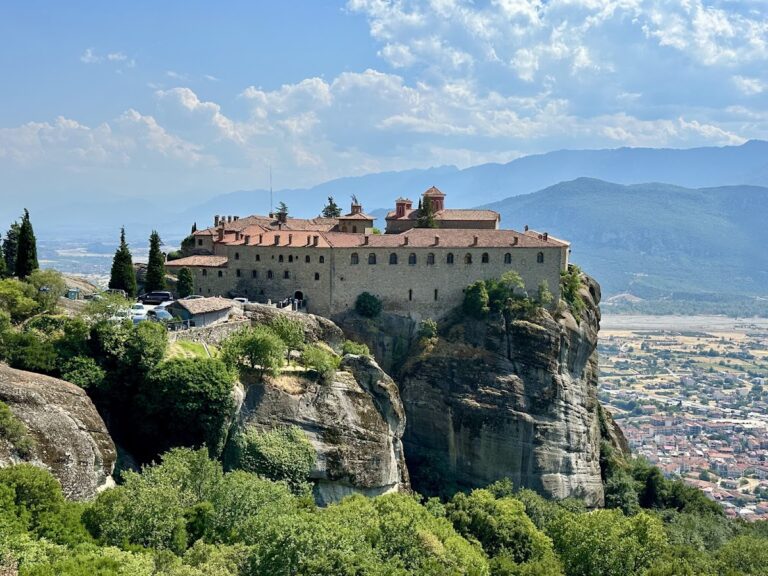
The Monastery of the Holy Trinity and the Monastery of Saint Stephen stand apart from Meteora’s principal northern group. The complex contains the cathedral, the rock-cut chapel of Saint John the Baptist, a skeuophylakion, or treasury for sacred furnishings, a sacristy, an altar area, monastic cells with low vaults, a balcony structure, tunnels, and a stone stairway of 130 steps.
Churches and Monastic Buildings
Cathedral
The cathedral has a cruciform plan, a vaulted two-column design, and a dome. Its nave is cross-shaped and has a three-sided dome, a single two-light window, and imitation arches on three sides. A low doorway in the southern wall provides entry, while three passages connect the nave with the main church.
Chapel and Supporting Rooms
The small chapel of Saint John the Baptist is cut into the rock and contains seventeenth-century frescoes. It formerly held valuable manuscripts and was richly decorated. A chapel dedicated to Saint Athanasius of Tzertzi lies northeast of the monastery.
The sacristy beside the altar was added in 1648. A small skeuophylakion was built beside the church in 1684. The broad, barrel-vaulted entrance hall was constructed in 1689 and embellished in 1692. The complex also preserves monastic cells, tunnels, a balcony structure, and the stone staircase connecting its levels.
Frescoes of the Cathedral
Nave Paintings
The cathedral’s frescoes were created in two principal phases. The nave paintings belong to the earlier phase. Inscriptions state that work began in 1692 under Arsenius, metropolitan of Stagon, at the initiative of Miho Kurikas Kyriakos of Velona. John Damascene, the monastery’s hieromonk and abbot, assisted the project, which was carried out by John Rizos and Athanasius. Another inscription dates their work to 1699. The painters are identified with the Cretan School, a post-Byzantine tradition of icon painting known for ordered compositions and refined details.
The nave dome shows Christ Pantocrator, the all-ruling Christ, surrounded by angels, with the Virgin Mary and fifteen prophets below. The Annunciation occupies the two eastern triangular areas. The eastern wall includes Saints Ananias, Azarias, and Misael, together with figures of the forefathers.
Scenes and figures fill the nave’s columns and arches, including the Supplication of the Virgin Mary and the Forerunner, Christ, Saint Zosimas, Saint Ephraim the Syrian, and the Hospitality of Abraham. The inner arch contains Saints Matthew, Barnabas, Timothy, Agathius, Cyriacus, Barbara, Irene, Adrian, Natalia, Elizabeth, and the prophet Zechariah.
The southern wall presents the Agony in the Garden, the Betrayal of Judas, the Last Supper, the Washing of the Disciples’ Feet, the Trial before the Sanhedrin, and the Denial of Peter. Its lower zone contains the martyrs Saints Cosmas and Damian, Panteleimon, and Nestor, together with the archangel Michael. The western wall has a monumental Dormition of the Virgin. Below it are the Trial of Pilate, the Repentance and Hanging of Judas, Saints Constantine and Helena, Theodosius the Cenobiarch, Sabbas the Sanctified, Euthymius, Anthony, and the archangel Gabriel.
The northern wall depicts the Guarding of the Tomb, the Resurrection, and the Stone, along with the assembly of bishops and Pharisees, the Washing of Pilate’s Hands, the Flagellation, and the Mocking of Christ. It also includes George of Cappadocia, the Great Martyr Demetrius the Myrrh-streaming, Theodore the Tyro, Theodore Stratelates, Eustathius, James the Persian, Mina, and other saints. The paintings are noted for their bright colors, varied subjects, carefully arranged scenes on relatively small surfaces, expressive faces, and finely rendered clothing.
Main Church Paintings
The main church was decorated in 1741 under Theophanes, metropolitan of Stagon. Parthenios, the monastery’s abbot, was involved with the work, together with the hieromonks Yanis and Daniel, the priest Stephen, and Constantine. The brothers Yanis and Anastasius Makri financed the project, which was executed by the priest-brothers Anthony and Nicholas on 6 October. These frescoes cover older painted layers.
The dome shows Christ Pantocrator surrounded by angels, with the Virgin Mary to the west and the Forerunner to the east. Below them are the prophets Elisha, Elijah, Daniel, Isaiah, Zechariah, Jeremiah, Moses, David, Solomon, Malachi, Obadiah, Habakkuk, Hosea, Ezekiel, Amos, and Jonah. The pendentive areas contain the Evangelists and their symbols, except for Luke, who is shown painting the Virgin Mary. Other spaces depict Christ and the patriarchs Isaac, Abraham, and Jacob.
The sanctuary includes the Virgin Mary among angels, the Platytera, a representation of the Virgin associated with the sanctuary, the Apostles’ Communion, and the joint liturgy of Gregory the Theologian, Basil the Great, John Chrysostom, and Gregory the Dialogist. Pentecost and the Holy Trinity appear in the vault.
Additional scenes include the Deposition, the Purification, the archangel Michael, an unidentified saint, the Vision of Saint Peter of Alexandria, and Saint Cyril of Alexandria celebrating the liturgy. The southern wall shows Saint Ignatius the God-Bearer, while the area above the hearth contains the archangel Gabriel.
The southern-arch vault depicts the Annunciation and the Baptism, with older figures of Saints Constantine and Helena visible beneath the Annunciation. Other southern scenes include Christ Emmanuel, the Nativity, the Presentation, Saints Nicholas, Spyridon, Charalambos, Procopius, Nicetas, and Onuphrius, the Feast of Herod, the Beheading of the Forerunner, Saint Laurence, and the apostles Peter and Paul.
The northern vault contains the Transfiguration and the Crucifixion, with an older image of the archangel Gabriel beneath the latter. Its other paintings include Christ, the Raising of Lazarus, the Entry into Jerusalem, Saint Catherine, Mercurius, Artemius, Bessarion, archbishop of Larissa and Trikala, Achilles of Larissa, Mary of Egypt, the prophet Elijah in the desert, and Saint Moses the Ethiopian.
Surrounding Rock Features
A fresco of Saint Sisois contemplating the skeleton of Alexander the Great appears on the monastery walls. From the balcony behind the cathedral, the monasteries of Saint Stephen, Rousanou, Varlaam, and the Great Meteoron can be seen, together with the rock formations known as Alice and Saint Modestus. Earlier monasteries occupied both rocks: the Monastery of Saint Modestus was built in the twelfth century, while the Monastery of Saint Peter was founded around 1400.
Nearby sites