Church of the Theotokos of Zaum: A Medieval Orthodox Church beside Lake Ohrid


Site at a Glance
- Rating
- 4.6
- Popularity
- Low
- Country
- North Macedonia
- Primary era
- Medieval
- External website
- Open
- Eras represented
- Medieval
- Civilizations
- Byzantine, Serbian
- Site type
- Religious
- Remains
- Church
On this page8 sections
History
The Church of the Theotokos of Zaum is a medieval Orthodox church in North Macedonia, built in 1299 in the Ohrid region. The Theotokos is the Christian title for Mary, the mother of Jesus. Also known as Zaum or the Monastery of Zaum, the church is associated with the Macedonian Orthodox Church–Archbishopric of Ohrid and the Debar–Kichevo Diocese. Its position beside Lake Ohrid and its surviving medieval decoration place it within the religious and artistic history of the region.
Foundation and fourteenth-century painting
The church’s patron was Caesar Grgur, a high-ranking court noble identified as a member of the Brankovic family and the brother of Vuk Brankovic. The painting campaign took place on August 25, 1361, during the reign of Stefan Uros. Bishop Gregory of Devol was also a patron of the frescoes and was one of the leading dignitaries of the Ohrid Archbishopric, a major medieval Orthodox institution centered on Ohrid and responsible for a broad area of southeastern Europe.
The frescoes were made by painters whose names are unknown. One artist employed a manner different from that of other contemporary painters in Ohrid, and the style may reflect training in Thessaloniki. The monastery also became the burial place of Ostoja Rajakovic, a nobleman described as a relative of King Marko.
Later history and living tradition
The monastery was ruined in 1898 and was later reconstructed. Conservation and restoration of the frescoes have continued from 2012 onward. From 2014, work also began on rebuilding a lodging house for female monastics on the site of earlier ruins and foundation remains. The church is a protected cultural monument and remains an active place of worship.
Worship was revived on July 4, the day after the summer feast of Saint Naum of Ohrid, and on September 21, the Feast of the Nativity of the Theotokos. Saint Clement and Saint Naum of Ohrid were major medieval Christian missionaries and disciples associated with the Christianization and literary culture of the Ohrid region. The July observance includes a church service, a communal celebration led by a ritual sponsor from Trpejca, and the distribution of a meatless meal.
A widespread local tradition connects the name Zaum with a royal woman who tried to measure the depth of Lake Ohrid. A storm nearly sank her boat, and she promised to build a monastery on the shore where she was rescued. In the tradition, the name recalls both her fear and the danger of entering the lake.
Remains
Setting and church plan
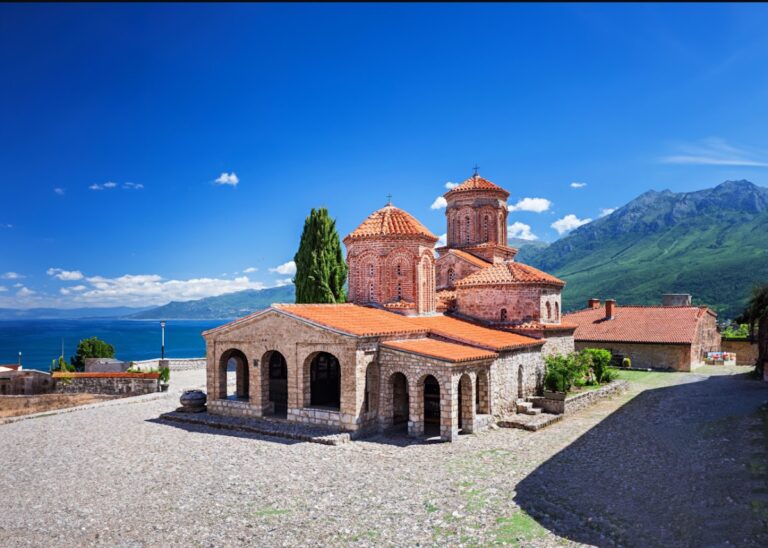
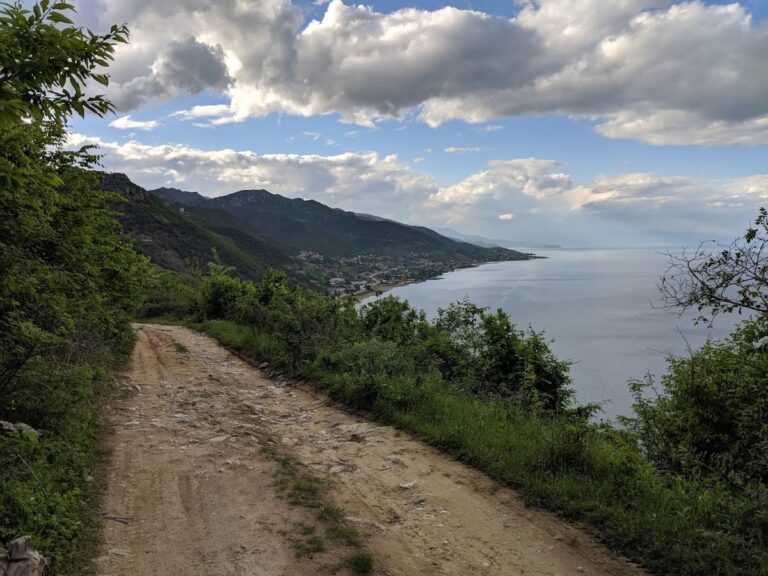
The church stands immediately beside the eastern shore of Lake Ohrid, between Trpejca and Ljubaništa, at the foot of Mount Galicica. It lies below the rocky ridge called Golem Osoj, at approximately 695 metres above sea level, while the ridge rises to about 1,005 metres. Steep eastern cliffs make the site almost inaccessible, and the lake lies directly to the west. The deepest point of Lake Ohrid is close to the church.
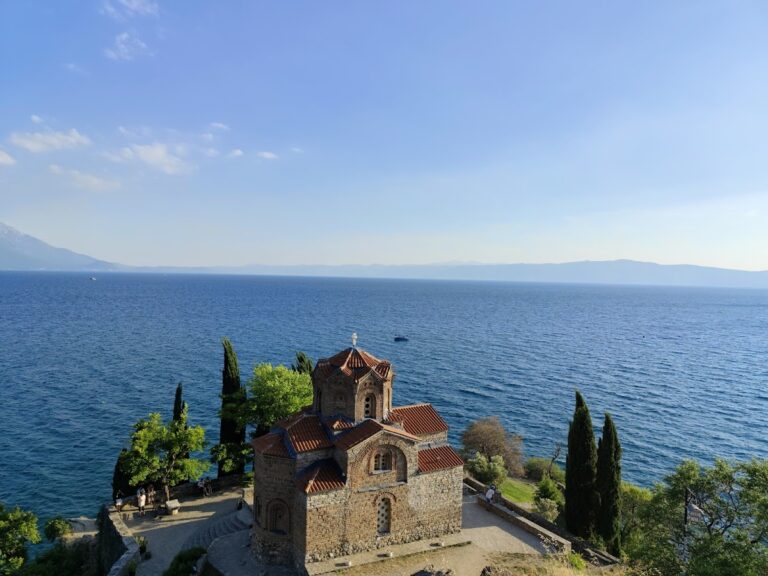
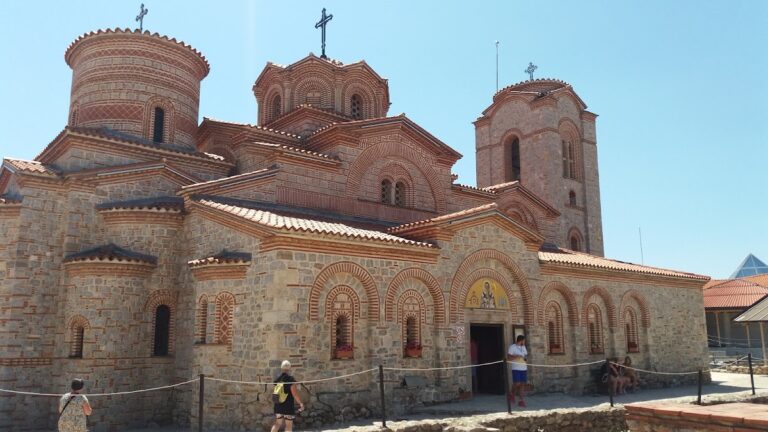
The building has an inscribed-cross plan, meaning that a cross-shaped layout is enclosed within a roughly square structure, with a dome over the crossing. The central dome rests on four columns and has an octagonal drum on the interior. The church is built from tuff, stone, and brick, and its strongly vertical form gives it a slender, elegant appearance. The combination of its architectural form and decoration is unusual among medieval churches in the Ohrid region and beyond. Its arrangement of dome and columns has been compared with the churches of Saint John at Kaneo and the Virgin Peribleptos in Ohrid.
Architectural decoration
The four columns end in different kinds of capitals. Two capitals in the altar area carry acanthus leaves, while the two western columns have white-marble impost capitals. These pieces were reused from earlier archaeological remains. Another white-marble impost capital was accidentally found in the churchyard in 1960.
Brick ornament forms checkerboard fields, diagonal meanders, crosses, and toothed patterns across the façades. The three-sided apse is articulated with blind arches, which are recessed arch-shaped decorations rather than openings. The original church also had a narthex, an entrance vestibule at the western end, covered by semicircular vaults. The western porch facing the lake has collapsed, although fragments of its former fresco decoration remain above and beside the entrance door.
Frescoes
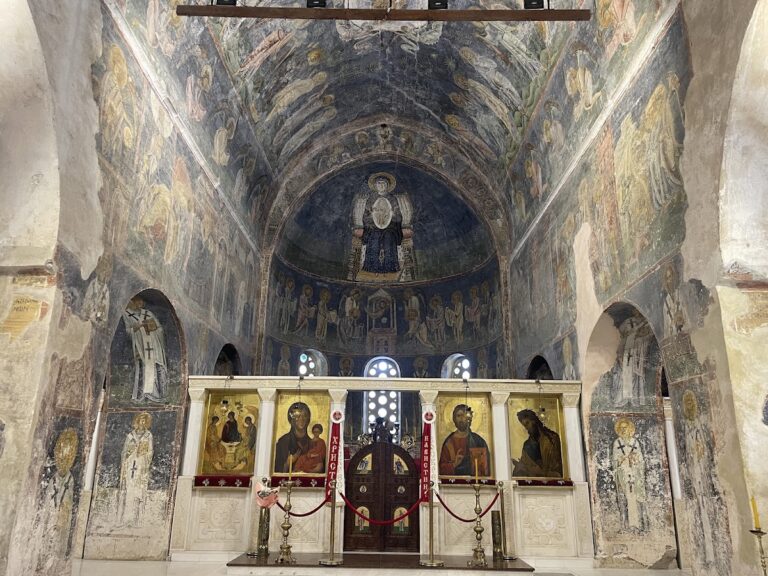
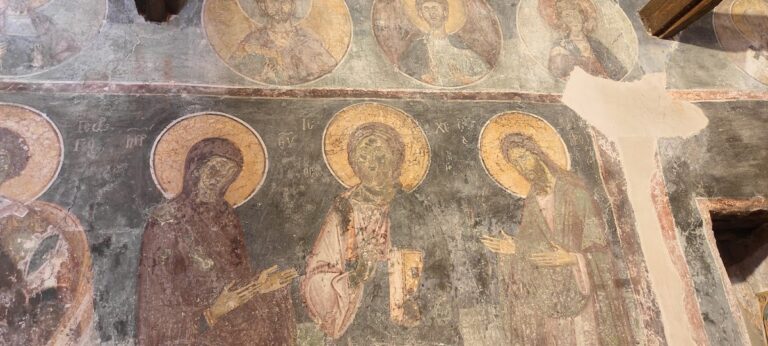
The painted interior has suffered heavy damage, particularly in the vaults and dome. The first zone preserves full-length figures of Saint Clement of Ohrid, Saint Naum of Ohrid, Jesus Christ, the Theotokos, and other saints. These figures are larger than life-size. A second zone contains scenes from the cycle of the Theotokos, while the remaining zones present narrative scenes from the life of Christ.
One notable scene shows Saint Anne nursing the young Mary. Its treatment gives particular attention to maternal affection through a realistic representation. In the other compositions, the painter uses more natural proportions and a vivid palette dominated by violet, orange, and light blue.
Archaeological remains
Material from the Early Christian period and a medieval settlement survives beside the church. Some of the earlier material was reused in the church, especially in architectural decorative elements. Nearly circular, earth-sheltered houses were also found in the northern part of the churchyard while holes were being dug for fruit trees. Their possible connection with the place-name Zaum remains a possibility rather than an established explanation.
The site has traditionally been approached from the lake because of its difficult setting. A forest path was later cut through the surrounding woodland, but the final part of the approach crosses shallow lake water. This unusual physical isolation remains part of the church’s archaeological and architectural setting.
Nearby sites