Château de Clairvaux: An Early Renaissance Château in France


Site at a Glance
- Rating
- 3.9
- Popularity
- Very Low
- Country
- France
- Primary era
- Early Modern
- External website
- Open
- Eras represented
- Medieval, Early Modern, Modern
- Civilizations
- French
- Site type
- Domestic
- Remains
- Castle
On this page13 sections
History
Château de Clairvaux is a private château in Scorbé-Clairvaux, France, whose principal buildings belong to the early sixteenth century and form part of the early Renaissance heritage of Poitou. The Renaissance was a European cultural and artistic period that renewed interest in classical antiquity while introducing new architectural forms alongside medieval traditions. Construction and alteration continued from the fifteenth through the eighteenth century, giving the residence a long and complex building history.
Foundation in the Valley
In 1470, a quarrel between the two lords of Clairvaux, Christophe de la Tour Landry and Renaud Chabot, led Renaud Chabot to descend into the valley and begin a new château beside the fairground. The site stood in the town center, on the square once known as Place du Champ-de-Foire and now called Place Étienne Chérade de Montbron.
The Villequier and Aumont Lords
René de Villequier de La Guerche acquired the two Clairvaux domains in 1580 and raised the lordship to a county. He abandoned Haut Clairvaux as his residence, settled in the valley, and enlarged and embellished the new château. His position brought the estate into the orbit of the French monarchy. He governed Paris and Île-de-France, served as Henri III’s favorite, and had been the king’s treasurer and chamberlain while Henri ruled Poland. After Charles IX died, Villequier helped Henri escape from the Royal Palace of Kraków. Henri III, king of France from 1574 to 1589 and previously king of Poland, frequently received him at Clairvaux.
Villequier was the first holder of the Order of the Holy Spirit, a French chivalric order founded during Henri III’s reign. A room in the château’s large tower still bears Villequier’s name. His grandson César d’Aumont, governor of Touraine, secured the elevation of the county to a marquisate through letters patent issued by Louis XIII in 1620. Letters patent were formal royal documents used to grant or confirm titles and privileges. César d’Aumont also added the barony of Thuré to the new marquisate.
The Fouquet Building Campaign
In 1660, Anne d’Aumont, Marchioness of Clairvaux and Viscountess of La Guerche, married Gilles Fouquet, first equerry of the King’s Great Stables. Fouquet was the brother of Nicolas Fouquet, Louis XIV’s superintendent of finances. Gilles undertook extensive improvements at Clairvaux, but the campaign ended abruptly after Nicolas Fouquet was arrested at Nantes by d’Artagnan, a French military officer whose name became associated with the tradition of the king’s musketeers. Gilles Fouquet and his brother were exiled to Pignerol, where Gilles died in 1694.
Étienne Chérade, a member of a cloth-merchant family from Angoulême who was ennobled in 1693, bought the estate in Paris in 1704. His family retained Clairvaux until 1867. During the eighteenth century, further construction continued to shape the château, including the addition of a residential block by Adrien-Étienne Chérade, Count of Montbron and Étienne Chérade’s grandson.
Revolution, War, and Restoration
Construction stopped during the French Revolution. The château escaped demolition because one of Étienne Chérade’s sons had served in the revolutionary army, but the Committee of Public Safety ordered the destruction of the coats of arms on the façades. The Committee was the revolutionary governing body that exercised executive authority during the most radical phase of the Revolution. The destruction included the escutcheon associated with the Sun King’s Great Stables.
During the Second World War, the château housed the German Kommandantur, a military command headquarters or administrative office in occupied territory. It was later used as a refugee camp and then hosted holiday colonies. These successive uses caused extensive damage. After Roland Caude purchased the property, restoration took place with support from the French historic-monuments authorities. The château has been classified as a French historic monument since 1929 and remains privately owned while open to the public.
In 1990, the château became home to the International Chess Museum as well as a permanent exhibition devoted to Henri III. The museum displays about one hundred chess sets from regions throughout the world, including Napoleon I’s campaign chess set. This collection places the museum among the largest chess museums in France.
Remains
The surviving château combines a sixteenth-century early Renaissance residence with later additions and service buildings. Its principal entrance, courtyard, moats, bridges, pavilions, tower, and park reflect successive campaigns carried out by the Villequier, Fouquet, and Chérade families. The site’s buildings occupy the former valley residence established beside the fairground, while the surviving elements preserve both medieval defensive arrangements and Renaissance architectural forms.
Entrance and Residential Buildings
Monumental Entrance
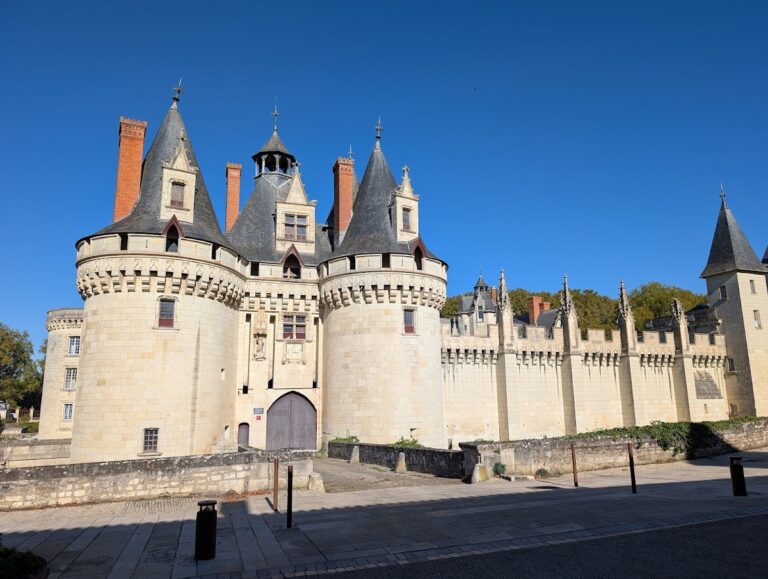
René de Villequier created a monumental entrance composed of a main residential block flanked by two square pavilions. A portal opens at the center, organizing the approach to the residence. During Villequier’s period, a decorated balcony was added and attributed to the Renaissance architect Philibert de l’Orme. The arrangement expresses the transition from older fortified residences toward the more ordered architectural language of the Renaissance.
Later Residential Block
Adrien-Étienne Chérade replaced the earlier drawbridge with a stone bridge and attached a new residential block to the older buildings. A drawbridge was a movable bridge traditionally used to cross a moat. Each façade of the new block has a projecting central section topped by a triangular pediment, the upper section of a classical or Renaissance façade. These additions remain part of the layered appearance created by the château’s long building history.
Moats, Pavilions, and Service Buildings
Moated Enclosure
Gilles Fouquet developed the château’s enclosure around a main courtyard and four corner pavilions. The pavilions stood at the corners of the rectangle formed by the moats, which carried running water. Fouquet also altered the entrance postern, a small secondary entrance in a fortified or enclosed building. Together, these elements preserved the site’s enclosed character while accommodating the expanded residence.
Service Buildings and Park
Fouquet built extensive service buildings around the main courtyard and created a very large park. The gardens are attributed to André Le Nôtre. The service buildings supported the enlarged household and estate, while the park formed part of the improvements made during the Fouquet period.
Large Tower and Present Collections
A room in the large tower is associated with René de Villequier and bears his name. The tower forms part of the older architectural fabric, alongside the later residential buildings and altered entrance. The château’s present interior uses include the Henri III exhibition and the International Chess Museum, whose collection contains approximately one hundred chess sets from around the world, including Napoleon I’s campaign set.
Nearby sites