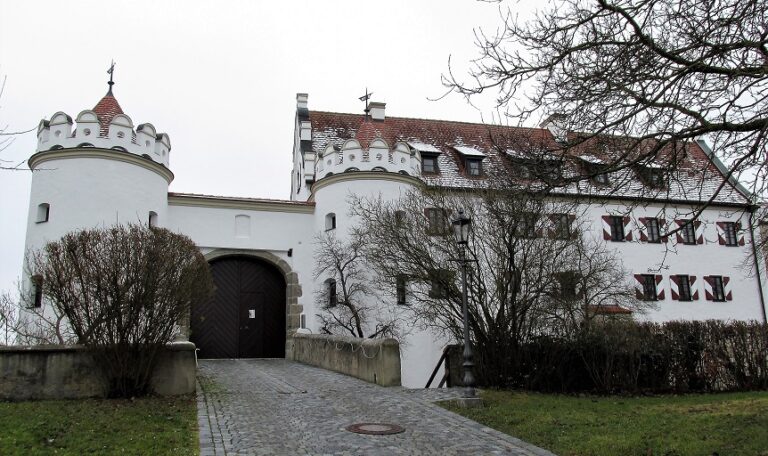
Hohenburg Castle: A Medieval Noble Stronghold in Germany


Site at a Glance
- Rating
- 3.5
- Popularity
- Very Low
- Country
- Germany
- Primary era
- Medieval
- Eras represented
- Medieval
- Civilizations
- Holy Roman Empire
- Site type
- Military
- Remains
- Castle
On this page7 sections
History
Hohenburg Castle is a medieval hilltop castle in Germany, built before 1140 and associated with the noble Hohenburg family. The family belonged to the Edelfreie, medieval high nobles who held privileged status independent of a feudal lord. The castle stood between Fronhofen and Thalheim in the municipality of Bissingen, in the Dillingen an der Donau district of Swabia, Bavaria.
The Hohenburg Family
Odelricus and his son Fridericus de Hoenburch appear in 1140 as witnesses to a donation charter issued by the related noble lords of Fronhofen for Berchtesgaden Abbey. Their appearance places the Hohenburg family within the region’s noble network by the mid-twelfth century. The family was probably prosperous, but its recorded line ended by the close of the thirteenth century. Friedrich von Hohenburg was last mentioned in 1270.
Oettingen Administration and Later Ownership
By 1299 at the latest, the lordship of Hohenburg had passed to the Counts of Oettingen. Their bailiffs, officials who administered a lord’s territory or property, managed the estate. In 1327, Counts Ludwig and Friedrich pledged the castle to the knight Kunrad von Zipplingen. From the middle of the fifteenth century, Oettingen bailiffs again administered Hohenburg.
Hans Schenk von Schenkenstein bought the lordship from the Counts of Oettingen in 1455 for 9,500 Rhenish guilders. His descendants sold it in 1557 to Sebastian Schertlin von Burtenbach, an Augsburg military commander. Disputes with the Counts of Oettingen over hunting rights and jurisdiction led Schertlin to sell Hohenburg in 1568 to Konrad von Bemelberg the Younger.
Abandonment and Ruin
Konrad von Bemelberg the Younger preferred to live at the associated Bissingen Castle, and Hohenburg was abandoned. By 1598, the castle was already ruinous. In 1661, the lordship of Hohenburg-Bissingen returned to the Counts of Oettingen-Wallerstein. Two years later, Emperor Leopold I, the Habsburg ruler who was Holy Roman Emperor from 1658 to 1705, approved its separation from the Kocher Knights’ Canton, a regional organization of the imperial knights of the Holy Roman Empire. The resulting legal dispute continued until a settlement was reached in 1740.
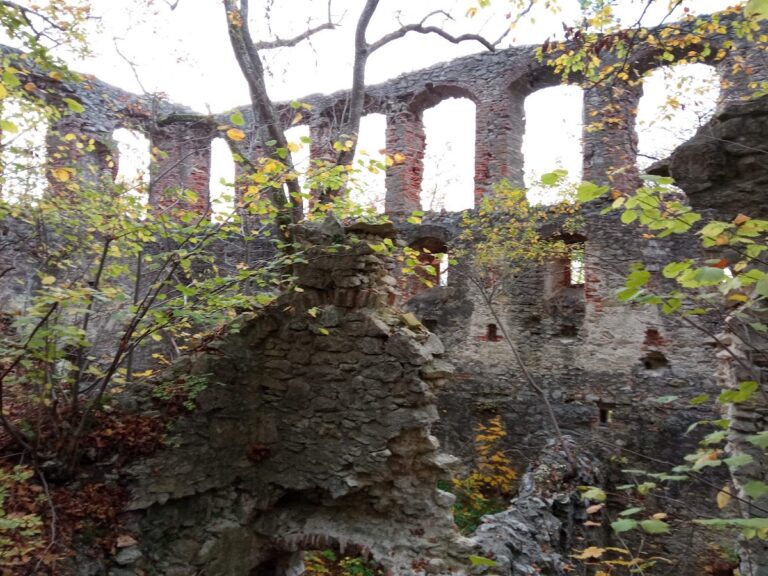
The remaining keep and curtain wall collapsed in 1871. From 1908, the owner of Hohenburg Mill used the ruins as a quarry. Castle stone was reused in the mill and in stream-control structures at the foot of the castle hill, extending the castle’s masonry into later local construction.
Remains
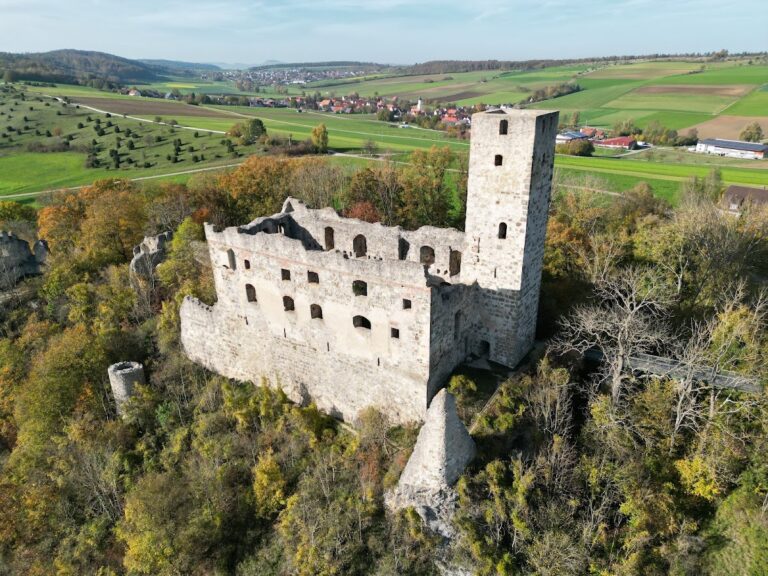
Hohenburg occupies an isolated limestone outcrop known as Castle Hill, approximately 511 metres above sea level, within a loop of the Kesselbach in the Kessel Valley. The rectangular main castle was accompanied by a smaller outwork, a defensive enclosure outside the principal fortification, on its northeastern side. A curved neck ditch separated the two areas, while the approach to the gate climbed southward along the ditch.
Outer Defences and Gateways
Fragments of the ditch lining, curtain wall, and gate fortifications survive as standing or visible masonry. A semicircular shell tower, a tower with a curved outer wall and an open or mostly open side toward the interior, remains standing at the former outer gate. A second similar defensive tower protected the entrance to the main castle about 20 metres farther west, and its masonry survives at the entrance area.
Keep and Main-Castle Plateau
The plateau of the main castle contains an oval mound about five metres high. It preserves the sparse remains of the keep, the principal strong tower of a medieval castle. The ground plan indicates that the tower was probably circular. Trees and dense undergrowth now cover most of the main castle, while reused castle stone remains incorporated in the mill and in stream-control works below Castle Hill.
Nearby sites