Grudinovka Manor: A Neoclassical Palace-and-Park Estate in Belarus


Site at a Glance
- Rating
- 4.6
- Popularity
- Very Low
- Country
- Belarus
- Primary era
- Modern
- Eras represented
- Early Modern, Modern
- Civilizations
- Russian
- Site type
- Domestic
- Remains
- Manor House
On this page6 sections
History
The Tolstoy Estate
Grudinovka Manor is a palace-and-park ensemble in Grudinovka, Belarus, developed between the late eighteenth and early nineteenth centuries in the Neoclassical style. Neoclassicism drew on ancient Greek and Roman architecture and commonly used columns, symmetry, domes, and formal staircases. The estate was formerly owned by the Counts Tolstoy.
During the War of 1812, the conflict between Napoleon’s forces and the Russian Empire, Dmitry Alexandrovich Tolstoy served as governor of Mogilev Governorate from 1812 to 1813. A governorate was an administrative province of the Russian Empire. The estate remained associated with his family, and the Grudinovka church later became his burial place in 1832.
The Last Owner and Later Uses
The last owner was Countess Alexandra Grigoryevna Tolstaya, born Princess Shcherbatova. In 1899, she financed Ryzhkovskaya Hospital near Grudinovka, which survives. The hospital employed leading doctors of Mogilev Governorate, while the countess paid its medical staff from her personal savings. She visited the estate and hospital every year with her two daughters and supplied newborns with special baby trousseaus. In 1905, she served on the Bykhov district committee of the Red Cross, an international humanitarian organization whose national committees provided medical and relief services. She died and was buried in Paris in 1925.
During the Second World War, the manor building was converted into a hospital. After the war, it served successively as a secondary school, an orphanage, and a sanatorium boarding school for children with rheumatism. Grudinovka Park received republican-level designation as a natural monument and monument of garden-and-park art in 1963. The estate is also recognized as a historical and cultural value of the Republic of Belarus under code 512G000216.
Remains
Manor House
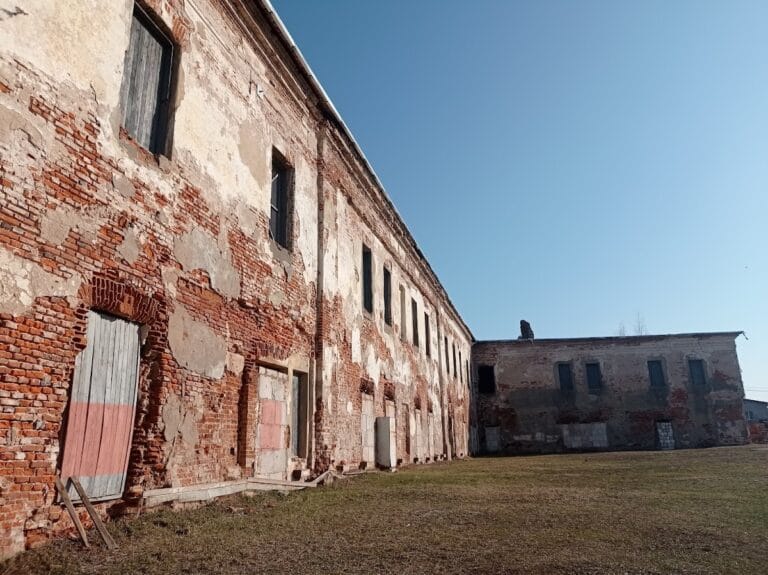
The surviving manor is a small two-story palace with a dome crowned by a spire. Columns, a ceremonial staircase, and an open terrace facing the park form its principal Neoclassical features. Two single-story wings adjoin the central structure, while a semicircular two-story veranda is attached to the building.
Park and Associated Church
An English-style park extends across 10 hectares in front of the manor. The house stands at the edge of the park, and a pond occupies its center. The planting includes oaks, birches, pines, spruces, arborvitae, and Siberian cedar, with more than 40 plant species represented.
The Grudinovka church is associated with the estate and served as the burial place of Dmitry Alexandrovich Tolstoy in 1832.