Birkendegård: A Historic Manor Estate near Kalundborg, Denmark


Site at a Glance
- Rating
- 3.9
- Popularity
- Very Low
- Country
- Denmark
- Primary era
- Modern
- External website
- Open
- Eras represented
- Modern
- Civilizations
- Danish
- Site type
- Domestic
- Remains
- Manor House
On this page5 sections
History
Birkendegård is a manor house and estate near Kalundborg in Denmark, with a present main building constructed in 1854 in Renaissance Revival and neoclassical styles. Its history reaches back to the period when it belonged to the Roskilde Bishopric, the ecclesiastical territory governed by the bishop of Roskilde.
From Church Property to Crown Estate
Birkendegård was confiscated by the Crown in 1536 during the Reformation, when the Danish monarchy seized the property of the Catholic Church. Because the estate was small, it was placed under Kalundborg Castle. The name appeared in the form Byrchinge in 1663, while the later Birkingegaard gradually developed into the present name, probably through alteration of the original form.
In 1672, the Crown granted Birkendegård to Jørgen Bielke, a Danish nobleman and landowner, as compensation for losses suffered during the Second Northern War, a seventeenth-century conflict involving Denmark and other northern European powers. In 1674, Bielke received permission to dissolve the village and replace it with a single manor. That process was completed in 1700.
Eighteenth-Century Ownership
Jørgen Hansen acquired the estate in 1686. After his widow died, Birkendegård returned to the Crown. In 1693, the Crown transferred it to Sophie Amalie Bielke, Jørgen Bielke’s only surviving child, in return for her surrendering her father’s outstanding claims against the Crown.
Sophie Amalie Bielke sold Birkendegård in 1700 to Johan Christopher Schönbach, who was county governor of Kalundborg, Sæbygård, and Drahsholm counties and, from 1707, also of Holbæk County. The ownership then passed through Hans Hansen Hvalsøe and the Schönbach family before Terkel Terkelsen acquired the estate in 1735. After the death of Schönbach’s second wife, the heirs had tried unsuccessfully to sell Birkendegård at three auctions.
Christian Lerche bought Birkendegård in 1743. In 1755, he received permission to turn his holdings into a stamhus, a legally restricted landed estate intended to remain intact through inheritance. Such an estate could not be freely divided, sold, or pledged. After Lerche died in 1757, his widow retained Birkendegård until her death.
The Lerche and Faye Families
In 1818, Christian Cornelius Lerche combined Birkendegård with Lerchenborg and other estates to form the Countship of Lerchenborg, a hereditary territorial estate associated with a count’s title. Lerche had inherited Lerchenborg in 1804 and was ennobled as a count on 26 May 1818. Before his death in 1852, he applied to dissolve the stamhus, after which land outside the countship was divided among his four sons.
Birkendegård passed to Lerche’s son, Vilhelm Cornelius Magnus Lerche, and later to Vilhelm’s son Gustav Lerche, who was described as a farmer. Two brothers named Jacobsen acquired the estate in 1921 and sold it later that year to Aage Faye. Faye had succeeded his father, Gerhard Faye, as manager of the Nakskov Sugar Factory. His father had been a pioneer of the sugar-beet industry on Lolland-Falster.
After Aage Faye’s death, Birkendegård passed to his eldest son, Gerhard Faye, and then to his grandson Jørgen Faye. The estate remained with the Faye family from 1921, passing from Aage to Gerhard in 1949 and from Gerhard to Jørgen in 1999.
Remains
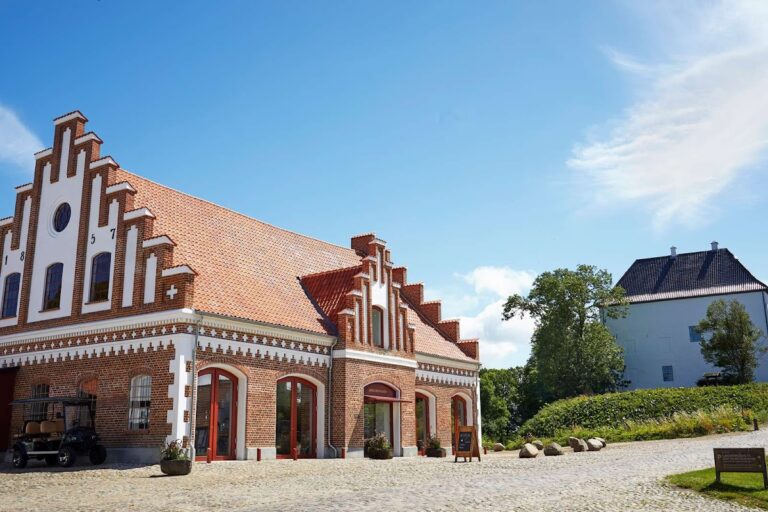
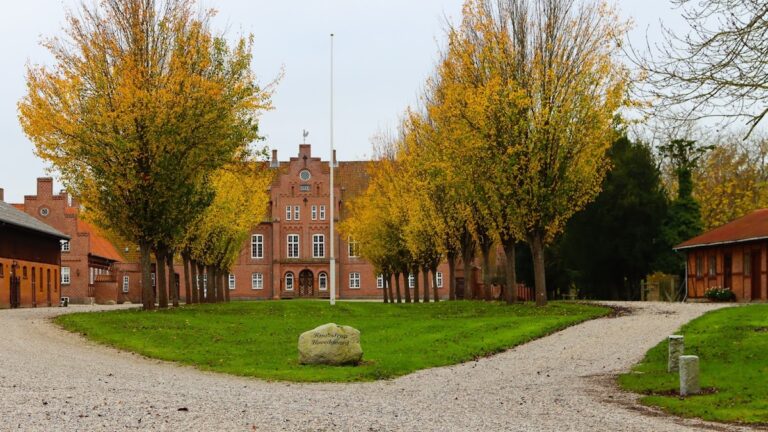
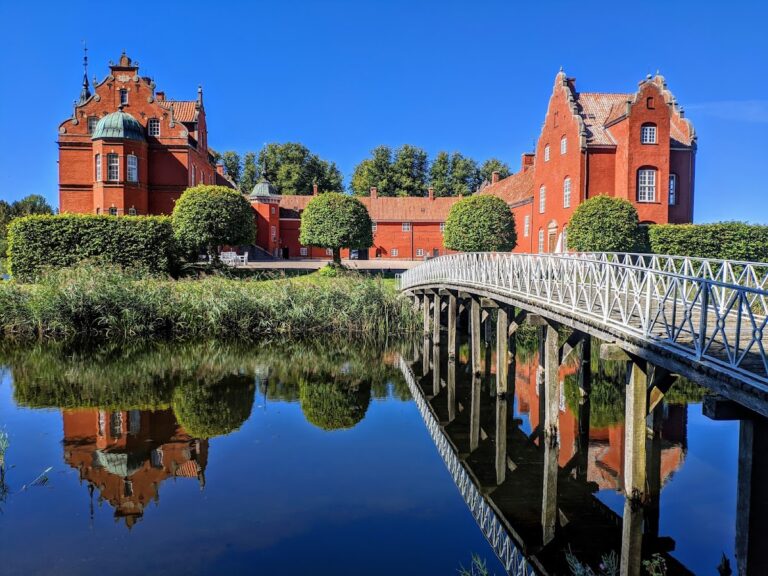
The surviving manor house is a two-storey main building erected in 1854. Its design combines Renaissance Revival, which reinterprets forms associated with Renaissance architecture, with neoclassical features based on the proportions and forms of classical Greek and Roman architecture. Stepped gables rise in successive levels, while dormer windows project from the sloping roof. The building is attributed to the designer Christian Tybjerg.
Nearby sites