Dragsholm Castle: A Medieval Fortress and Baroque Residence in Denmark


Site at a Glance
- Rating
- 4.5
- Popularity
- Medium
- Country
- Denmark
- Primary era
- Early Modern
- External website
- Open
- Eras represented
- Medieval, Early Modern, Modern
- Civilizations
- Danish
- Site type
- Domestic
- Remains
- Castle
On this page13 sections
History
Dragsholm Castle is a historic castle in Hørve, Denmark, whose origins lie in a medieval palace probably established around 1215 by Peder Sunesen, Bishop of Roskilde. One of Denmark’s oldest surviving secular buildings, it began as a high-status episcopal residence and was progressively transformed into a fortified castle during the Middle Ages.
Medieval palace and fortress
The site was first recorded under the name Draugsholm in 1336. Its earliest building consisted of a hall with residential and service rooms beneath it. Medieval rebuilding gradually strengthened the complex, turning it into one of the country’s strongest fortresses. A large tower was added at the northeast corner, and the castle’s defensive character became central to its role.
Dragsholm demonstrated its military importance during the Count’s Feud, a Danish civil war fought from 1534 to 1536 during a succession crisis. It was the only castle on Zealand to withstand the forces of Count Christoffer. Johann von Hoya reportedly besieged it for five months without capturing it.
Crown property and prison
The Reformation, the sixteenth-century religious and political transformation that established Protestant churches in Denmark, transferred Dragsholm and other Catholic Church possessions to the Danish Crown. From 1536 to 1664, the castle was Crown property administered as a fief, an estate or jurisdiction granted by a ruler in return for service or loyalty.
In 1551, Eiler Hardenberg received Dragsholm again as a fief and raised the future King Frederik II there until 1554. During its period under the Crown, the castle also served as a prison for noble and ecclesiastical prisoners. Among those confined there were Joachim Rønnow, the last Catholic Bishop of Roskilde and the castle’s former owner; James Hepburn, Earl of Bothwell, the Scottish nobleman who was the third husband of Mary, Queen of Scots; and the squire Ejler Brockenhuus.
Destruction and rebuilding
Swedish troops captured Dragsholm during the wars against Sweden in 1657. The castle was blown up in 1660 and subsequently remained a ruin. In 1664, King Frederik III transferred the ruined castle and its associated estate to Heinrich Müller as compensation for outstanding royal debts. The value assigned to the property exceeded its actual value, leaving Müller with financial difficulties. He consequently mortgaged Dragsholm to Isaac Chaim Senior Teixeira, a merchant based in Hamburg.
Frederik Christian Adeler acquired Dragsholm in 1694. From 1697, he and his wife, Henriette Margrethe von Lente, rebuilt the ruined stronghold as the present Baroque residence. Baroque architecture was an early-modern style based on formal composition, dramatic massing, and richly ordered design. The reconstruction retained many elements of the medieval fortress, while giving the exterior its present character.
Adeler ownership and later history
Under the Adeler family, Dragsholm became a barony in 1784, meaning a hereditary noble estate or jurisdiction held by a baronial family. It was renamed Adelersborg in 1785. Georg Frederik Otto Zytphen-Adeler initiated the drainage of the Lammefjord, a former fjord whose waters and adjoining land were drained and reclaimed during the nineteenth century. The historic name Dragsholm was restored in 1868.
The Adeler line ended in 1932, after which the castle returned to the Danish state. The state land authority then sold it to J. F. Bøttger with part of the main estate, and the Bøttger family has managed the property since that time. The castle has been used as a hotel since 1937 and also contains restaurants and a farm shop. A major restoration around 1919, after the First World War, gave parts of the interior a Late Romantic character. Later conservation and refurbishment adapted the property for its continuing hotel and restaurant uses, while the Bøttger family added accommodation in the porter’s lodge.
Traditions and earlier occupation
Dragsholm is associated with a local haunting tradition involving a Grey Lady, a White Lady, and Lord Bothwell. Bothwell is said to appear in the courtyard in a horse-drawn carriage. Graves associated with the Ertebølle culture have also been found south of the castle. The Ertebølle culture was a late Stone Age hunter-fisher-gatherer culture of southern Scandinavia, generally dated to the fifth and fourth millennia BC.
Remains
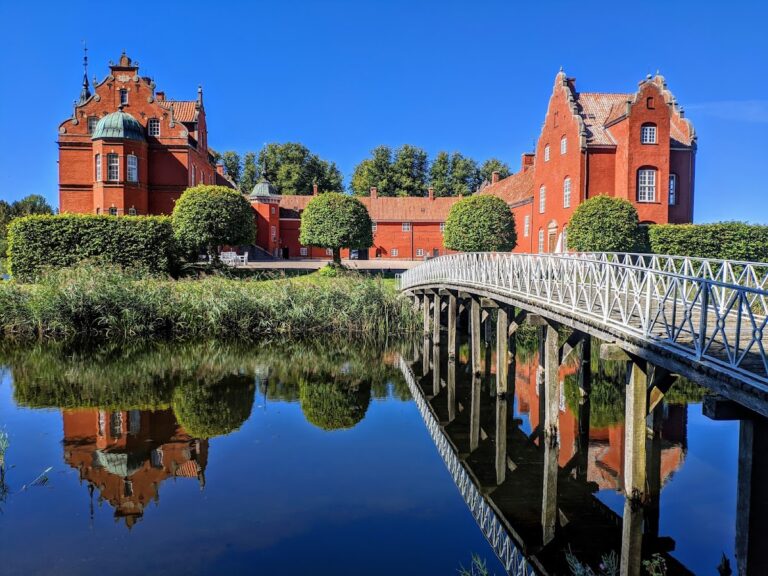
Dragsholm Castle stands on an islet in southwestern Odsherred on Zealand, surrounded by lakes and meadows. A small woodland and park surround the complex, while the Dragsholm Canal runs south of it. The site lies south of a terminal moraine, a ridge of sediment deposited at the furthest advance of a glacier, which ends at Vejrhøj and rises to 123 metres. This landscape helps explain the castle’s position on a defended island site.
Island setting and medieval fabric
The name Dragsholm means “the islet by the drag” or land bridge. Before the nineteenth-century drainage of the Lammefjord, a narrow strip of land connected Odsherred with the rest of Zealand. Vikings could haul ships across this strip to avoid the dangerous waters north of Zealand. The castle’s island setting and surrounding moat, a water-filled ditch around a fortified building, formed part of its defensive environment.
Medieval hall and northeast tower
The original palatial complex was centred on a hall, with residential and service rooms below it. Later medieval work added substantial fortifications, including the large tower at the northeast corner. Prison cells were installed in this tower. Their windows and toilets varied according to the prisoner’s crimes, conduct, and the seriousness of insults directed at the king, linking the physical arrangement of the cells to the status and treatment of their occupants.
Baroque residence
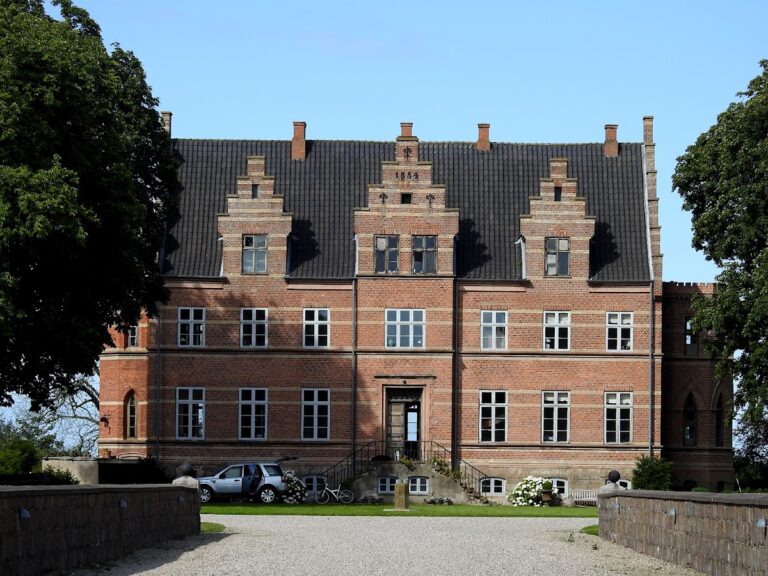
The present castle is principally the result of the rebuilding begun in 1697. Its Baroque exterior remains substantially intact, although many elements of the medieval fortress were incorporated into the later residence. The interiors have been altered and modernised repeatedly. The salons and ballrooms retain the Late Romantic style introduced during the major restoration carried out around 1919.
Grounds and associated buildings
Porter’s lodge
A porter’s lodge stands on the opposite side of the moat. A porter’s lodge was a gatehouse or lodging for an entrance keeper. Additional hotel rooms have been created within this building, making it part of the property’s later accommodation arrangements.
Carriage museum and present facilities
The grounds also contain a horse-drawn carriage museum. The castle complex accommodates hotel rooms and restaurant facilities, and its rooms and interiors have been refurbished and modernised for these uses. These later changes coexist with the retained medieval fabric and the substantially intact Baroque exterior.