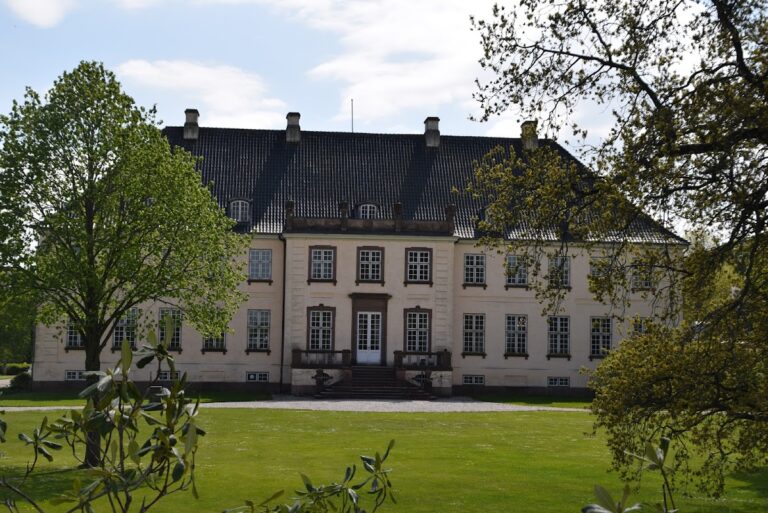
Gjeddesdal: A Manor Estate in Denmark


Site at a Glance
- Rating
- 4.2
- Popularity
- Very Low
- Country
- Denmark
- Primary era
- Modern
- External website
- Open
- Eras represented
- Modern
- Civilizations
- Danish
- Site type
- Domestic
- Remains
- Manor House
On this page5 sections
History
Gjeddesdal is a manor estate in Denmark, near Greve, created in 1672 by Holger Vind. It replaced the village of Pårup and took its name from Vind’s wife, Margrethe Gjedde. The estate became the centre of successive efforts to consolidate land, reform agriculture, and alter the relationship between its owners and tenant farmers.
Creation and Early Ownership
After Holger Vind died in 1683, Margrethe Gjedde became Gjeddesdal’s owner. Following her death in 1706, the heirs sold the estate to Niels Benzon. His son Lars inherited it in 1708 and transferred it to his brother Peder Benzon in 1714.
Peder Benzon greatly enlarged Gjeddesdal, including by closing all the farms in the village of Torslundelille. In 1730, he separated almost half of the estate’s land to create Benzonsdal. After Peder’s death in 1735, Lars Benzon bought Gjeddesdal again and sold it to their brother Jacob Benzon in 1740. Jacob retained the estate until his death in 1761.
Reform and Estate Division
The heirs sold Gjeddesdal in 1761 to Herman Lengerken von Kløcker. He briefly made it an entailed estate, a legally restricted hereditary property intended to remain intact rather than be sold, mortgaged, or divided among heirs. The arrangement was dissolved soon afterward. His widow, Caroline von Hoppe, sold the estate to Michael Wulff Gøye in 1774.
Gøye was interested in Enlightenment philosophy, an eighteenth-century movement associated with reason, reform, and concern for social and economic conditions. At Gjeddesdal, this interest included improving the lives of tenant farmers. His will gave the tenants the right to purchase their farms at prices fixed in the document and directed that part of the proceeds from a sale of Gjeddesdal establish a grant. Most of the farms were later sold to the farmers, and Tune Landbyskole, a rural school, was founded after the turn of the nineteenth century.
Gøye died in 1795, and his heirs sold Gjeddesdal to Jens Laurids Barfred in 1797. Barfred acquired additional land and formed the farm of Barfredshøj from the estate’s northern part in 1819. Financial difficulties in Danish agriculture led him to sell Barfredshøj first and Gjeddesdal in 1822.
Agricultural Improvement and Later Ownership
Heinrich Christian Valentiner acquired Gjeddesdal in 1822 after purchasing Bredeshave at Præstø the previous year. At Gjeddesdal, he improved the soil, introduced new farming methods, established a slaughterhouse, and salted meat for export to France and the Netherlands. He began keeping dairy cattle in 1828 and opened a dairy shortly before his death.
Adolph Valentiner inherited the estate in 1831. He renovated the main building and systematically drained the land. He was described as the first landowner in Denmark to undertake drainage on this scale. After his death in 1868, ownership passed first to his son Heinrich Nicolai Valentiner and then to his grandson Adolph Herman Valentiner.
Adolph Herman Valentiner sold Gjeddesdal to Martin Nymann in 1927. The Nymann family continued to own the estate through Martin Nymann, Steen Nymann, and Søren Nymann. Barfredshøj was purchased again in 1989.
Remains
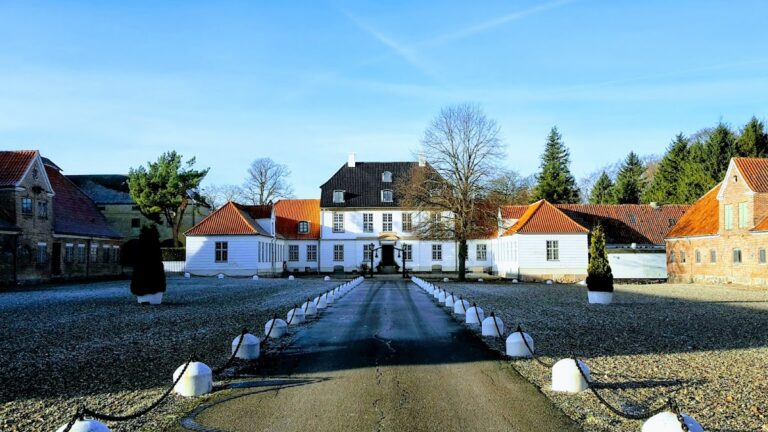
Gjeddesdal remains a manor house and estate. The former main building was destroyed by fire in 1916. A replacement main building was constructed on the same site after the fire, with construction beginning in 1916. The new building was designed by the architect Axel Poulsen.
Nearby sites