Belz Castle: A Medieval Fortress in Ukraine


Site at a Glance
- Rating
- 3.8
- Popularity
- Very Low
- Country
- Ukraine
- Primary era
- Unclassified
- Eras represented
- Unclassified
- Civilizations
- Unclassified
- Site type
- Military
- Remains
- Castle
On this page9 sections
History
Belz Castle is a medieval fortress in Ukraine, in the town of Belz, built in the mid-eleventh century. Belz first appears in a chronicle under 1030, and from 1170 to 1462 the town served as the center of an appanage principality, a dynastic state governed by a member of a ruling family, ruled by princes of the Rurikid dynasty.
The Princely Fortress
Mongol-Tatar forces partially destroyed the castle in 1241. After Belz was restored, the fortress was rebuilt several decades later. Its position within the principality made it part of the political and defensive center of the town.
The Castle Church and the Madonna
From the twelfth century, the castle church housed the Czestochowa Madonna, a revered Christian icon depicting the Virgin Mary and traditionally associated with the Polish city of Częstochowa. Tradition holds that a Byzantine princess, probably the wife of one of the princes of Belz, brought the icon from Constantinople during the twelfth century. The same tradition says that it miraculously survived the invasion of 1241.
A related legend says that defenders placed the icon on the castle wall during the Mongol-Tatar assault. An arrow struck the Virgin’s neck, after which a violent storm frightened the attackers and discord spread through their camp. The attackers then withdrew. In 1382, Władysław Opolski, a Piast prince of Opole who governed territories connected with the Hungarian Crown, removed the icon from Belz and carried it to Częstochowa in Poland, where it remains.
Later Destruction
Cossack forces under Bohdan Khmelnytsky, the military and political leader of the Khmelnytsky Uprising, destroyed the castle in 1655. Swedish forces burned the town at the beginning of the eighteenth century, adding another destructive episode to Belz’s history.
Remains
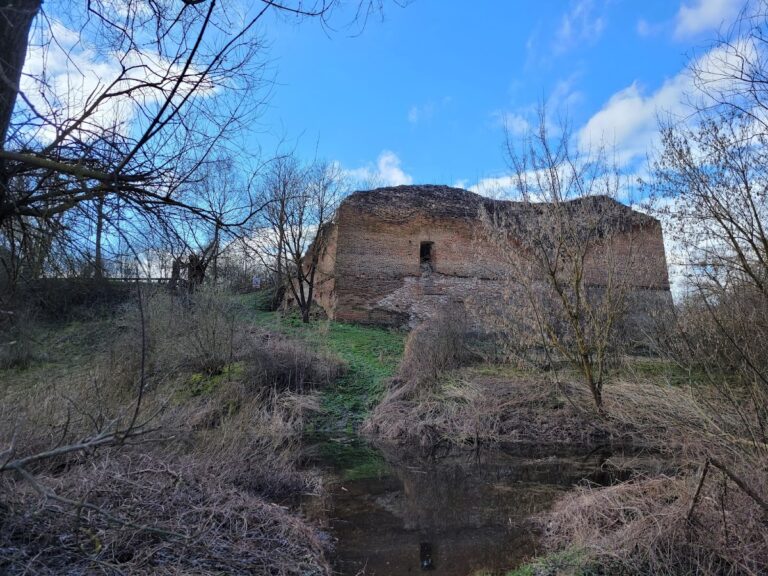
The castle had a quadrangular plan and covered approximately 4 hectares. An earthen rampart with wooden towers and a deep moat enclosed the fortified area, while the Solokiya and Rychytsia rivers bordered the town. An inner rampart separated the citadel, or fortified core, from the residential and economic quarter, and a causeway linked the town with the fortress.
Fortifications
By the end of the fifteenth century, the castle’s wooden walls were coated with clay. Wooden bastions, projecting fortifications that allowed defenders to cover walls and approaches with flanking fire, and defensive towers used the same general construction. Descriptions from 1575, 1620, and 1655 indicate that this arrangement remained unchanged through the sixteenth and seventeenth centuries. The builder is unknown, and wood was the castle’s principal construction material.
Religious and Civic Buildings
Castle Church
The castle church formed part of the fortified complex and was the building associated with the Czestochowa Madonna before the icon was taken to Częstochowa. The former castle site is now known as Zamochok, where a church dedicated to Saint Nicholas and a chapel dedicated to Saint Valentine occupy the area. Saint Nicholas was a Christian bishop traditionally associated with charity and gift-giving, while Saint Valentine was a Christian martyr traditionally associated with courtship.
Town Tower
One of Belz’s town towers survives from 1606. Historians identify it as the former location of the town archive, where important documents relating to Belz were kept.
Nearby sites