Ježevica Monastery: A Serbian Orthodox Monastery in Serbia


Site at a Glance
- Rating
- 5
- Popularity
- Very Low
- Country
- Serbia
- Primary era
- Early Modern
- Eras represented
- Early Modern, Modern
- Civilizations
- Ottoman
- Site type
- Religious
- Remains
- Monastery
On this page18 sections
History
Medieval Origins and Uncertain Foundation
Ježevica Monastery is a Serbian Orthodox monastery in Serbia, dedicated to Saint Nicholas and belonging to the Eparchy of Žiča, the administrative diocese of the Serbian Orthodox Church. It stands at the foot of Mount Jelica, about 11 kilometres southeast of Čačak. Tradition places its foundation in the fourteenth century, although no securely authenticated written record confirms the date. The present church has a seventeenth-century core and received major additions in the nineteenth century.
Two different traditions name the founder. One attributes the monastery to Ban Milutin, a nobleman and vojvoda, or military commander, of Emperor Dušan, together with his wife Ikonija. Another identifies King Stefan Milutin, the medieval Serbian ruler, as founder and connects a restoration with the reign of Emperor Dušan. Folk tradition and an interpretation of a fourteenth-century Gospel associate the church with the year 1337. The authenticity and meaning of the Gospel notation and an architectural inscription have been questioned, however. The church may have begun before the Battle of Velbazhd in 1331, possibly around 1330, but its foundation date remains uncertain.
Ottoman Rule and Religious Renewal
Ježevica suffered repeated damage, plunder, burning, and abandonment during Ottoman rule. An Ottoman destruction in 1452 was followed by rebuilding carried out by the Serbian population and monastic communities. The monastery was active again by 1474 to 1476. A priest named Ilija left a note about the destruction of nearby Stjenik Monastery, while an Ottoman register from 1476 lists the priest Radman and his family at Ježevica.
Ježevica and Stjenik operated as closely connected spiritual centers. During periods of Ottoman persecution, Ježevica’s monastic community used caves on Mount Jelica. A major restoration may have occurred during the restoration of the Peć Patriarchate in 1557, the Serbian Orthodox patriarchal institution re-established under Patriarch Makarije Sokolović. That reconstruction remains uncertain because surviving written evidence does not confirm it.
The church received its surviving painted decoration in two major campaigns. The altar area was frescoed in 1609, while the nave and narthex, the entrance or western part of the church, were painted in 1636. Ježevica may have suffered further Ottoman damage between these campaigns. Local tradition attributes the burning of the monastery lodgings and the defacement of frescoes to Gusinje Pasha, a high-ranking Ottoman official or military administrator.
Restoration and Nineteenth-Century Expansion
In 1812, during the First Serbian Uprising against Ottoman rule, one of the early schools established in Serbia was founded within the monastery precinct. Its precise building is uncertain, although it may have occupied or depended on the monastery lodgings. In 1813, the church was restored and covered with wooden shingles. The monastery and nearby settlements continued to experience hardship during uprisings and wars from the late eighteenth through the twentieth century.
Between 1846 and 1853, the church was enlarged. The western wall and entrance portal were demolished so that the earlier church could be joined to a new narthex and bell tower. This alteration destroyed the frescoes and inscription that had been on the western wall. Ježevica served as the parish church of the village until 2005, when a monastic community returned.
Archaeology, Conservation, and Protection
Modern work has clarified several stages of the monastery’s history. The frescoes were uncovered from beneath whitewash in 1937. Investigations of the iconostasis followed in 1947, and fresco fragments were found during work in 1950. Excavations in the precinct took place in 1980, while the iconostasis and selected icons were conserved in 1996. Ježevica entered Serbia’s register as a Monument of Great Importance in 1982 and remains protected as a major Serbian cultural monument.
Remains
Church Structure and Later Additions
Seventeenth-Century Church
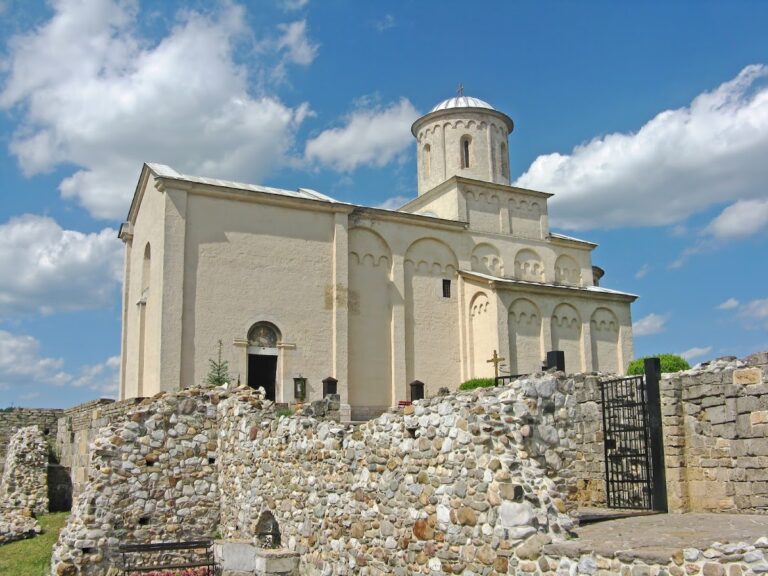
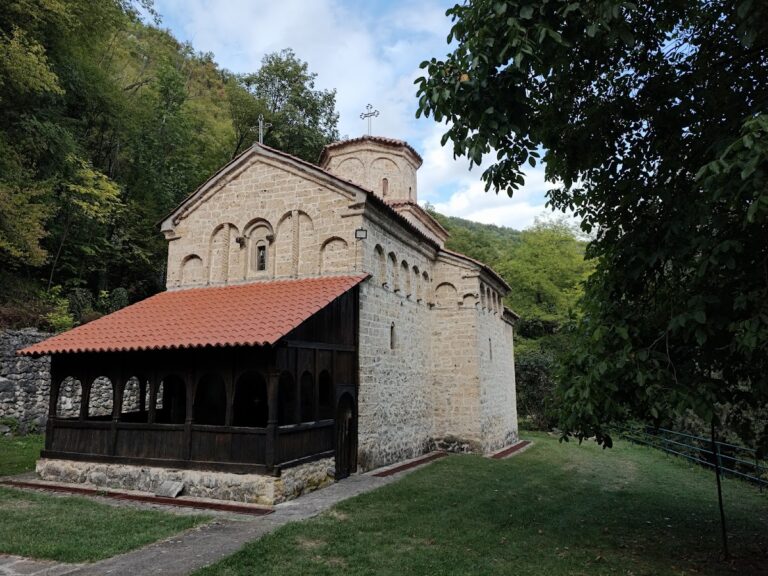
The church has a single-nave plan with a cross incorporated into its ground plan. Rectangular choir spaces end in a semicircular, vaulted apse, the rounded eastern termination of the altar area. The design is associated with the Raška architectural tradition and has been compared with churches in Old Herzegovina, the Ovčar-Kablar Gorge, Arilje, and Žiča. Before later enlargement, the church measured about 12 metres in length.
A central blind dome, meaning a dome without an opening or lantern, rests on four central pilasters through pendentives, curved surfaces that support a dome over a square or polygonal space, and intermediate vaulted arches. The seventeenth-century narthex was separated from the nave by a high wooden partition. A later northern doorway was opened in the choir area, while the western extension created the present facade.
Nineteenth-Century Narthex and Bell Tower
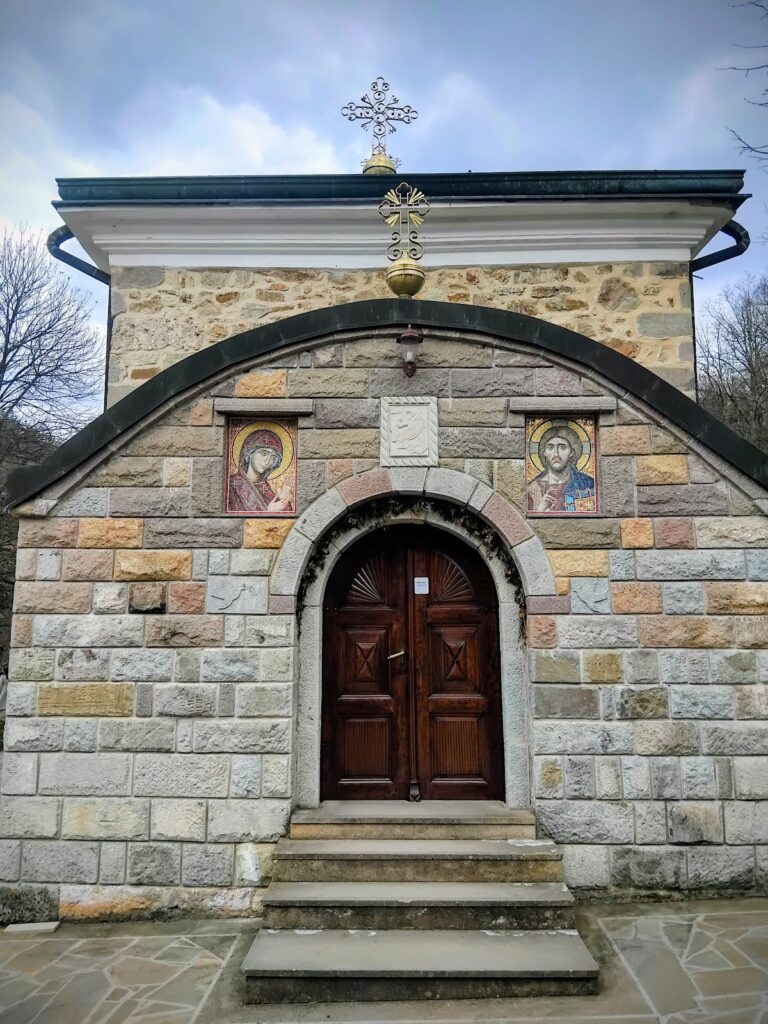
The nineteenth-century narthex and bell tower were built from finely dressed, soft yellow-orange stone resembling onyx. The Baroque tower has a flattened bulb, lantern, and cross, and is regarded as the tallest church tower in the surrounding area. Its entrance lintel was carved by the stonemason Radisav Čikiriz.
Two bells were installed in the tower. They were purchased in the Austrian Empire in 1831, weighed 200 and 300 oka respectively, and together cost 1,750 groschen. The church was originally covered with wooden shingles or stone slabs, and stone slabs are now described as its roof covering. Its exterior masonry has an irregular, weathered appearance, while the interior walls remain comparatively stable.
Frescoes and Interior Decoration
Altar Frescoes
The altar apse and the wider altar area were painted in 1609. The former inscription on the western wall named the hieromonks and abbot Avakum, Jerotej, and their brotherhood, but it was lost when that wall was demolished. The frescoes include the Liturgy of the Lamb, an Orthodox Eucharistic image of Christ as the sacrificial Lamb and the surrounding service of the Church, together with hierarchs, the Communion of the Apostles, and the Virgin Mary in the “Wider than the Heavens” type.
Other altar scenes show the Vision of Saint Peter of Alexandria, the Three Hebrew Youths in the Fiery Furnace, the Resurrection, the Annunciation, the Hospitality of Abraham or Holy Trinity, and numerous saints. The Ascension is almost entirely destroyed. Some researchers attribute the altar paintings to Georgije Mitrofanović, a prominent Serbian Orthodox painter of the seventeenth century, but this remains an informed supposition. The altar paintings are regarded as more accomplished than the later frescoes elsewhere in the church.
Nave and Narthex Frescoes
The nave and narthex were frescoed in 1636. Their subjects include scenes from the life of Saint Nicholas, the Akathist of the Virgin, the Great Feasts, the Passion of Christ, and the life of the Virgin Mary. Old Testament prophets, Jacob’s Ladder, Christ Pantocrator, and angels in a heavenly liturgy also appear among the painted scenes.
Surviving paintings in the south choir area include Saints Simeon, Sava, Arsenius, Theodore Tiron, Theodore Stratelates, Mercurius, and Nicetas. Other depictions include Saints Lazar, Stefan Dečanski, Nicholas, Gabriel, Michael, John the Forerunner, Constantine and Helena, George of Kratovo, Demetrius, and other saints and biblical figures. Many paintings are damaged or lost. One composition shows Saint Nicholas presenting Stefan Dečanski to Christ, with Stefan Dečanski and Prince Lazar wearing richly decorated royal garments. The scene closely resembles the corresponding composition at Blagoveštenje Monastery.
Iconostasis and Sacred Objects
Iconostasis and Royal Doors
The present iconostasis, the icon-bearing screen separating the altar from the nave, dates from the nineteenth century. Its carved woodwork carries icons of the enthroned Christ and the Virgin and Child, among others. These principal icons were painted by Janko Mihailović Moler, a Serbian priest and painter who later became a prota, a senior priest.
The iconostasis was structurally repaired and conserved in 1996. Sixteen apostle icons were also conserved and placed on the north wall of the northern choir area so that they would not obscure the altar fresco of the Virgin known as “Wider than the Heavens.” Seventeenth-century royal doors, the central doors of an Orthodox iconostasis, were transferred to Stjenik during its rebuilding in 1802 and are now held by the National Museum in Čačak. Their original connection with Ježevica is possible but not certain.
Relics and Liturgical Treasures
The church contains relics of martyrs in a chest set within a recess beneath the altar table. A fragment of the True Cross was formerly attached to the red cloth covering the relics. In earlier practice, clergy carried the relics and the Cross through nearby villages and households in prayers for healing, protection from epidemics and natural disasters, and a fruitful year.
The church and treasury contain icons, crosses, censers, candleholders, chalices, a communion spoon, a bread vessel, a tabernacle, a Gospel printed in Kyiv in 1848, a 1876 antimension, and other liturgical objects dating mainly from the seventeenth to nineteenth centuries. The antimension is a consecrated cloth used on the altar during Orthodox liturgy. A nineteenth-century silver-gilt chalice bears filigree decoration, while several candleholders are made of silvered or gilded brass.
Manuscripts, Archaeology, and Monastic Buildings
Ježevica Gospel
The Ježevica Gospel is a fourteenth-century parchment manuscript of 183 leaves written in two periods. Its first section contains 34 leaves dating to about 1337, while the second dates from the end of the fourteenth century. The wooden binding, covered in grey leather, measures 22.5 by 17 centimetres. Formerly kept at Ježevica, the manuscript was transferred at an unknown date to the National Museum in Čačak.
Excavated Finds and Lodgings
Excavations in 1980 recovered a bronze cross from the first half of the seventeenth century. Made in northern Greece, it has gilding and multicoloured enamel and is now in the National Museum in Čačak. The work also produced seventeenth-century bronze belt fittings, fifteenth-century bronze buttons, and fragments of fourteenth- and fifteenth-century glazed pottery. Fresco fragments found around the church point to an earlier phase of painted decoration, while further investigation of the precinct could clarify the original sculpture and monastic lodgings.
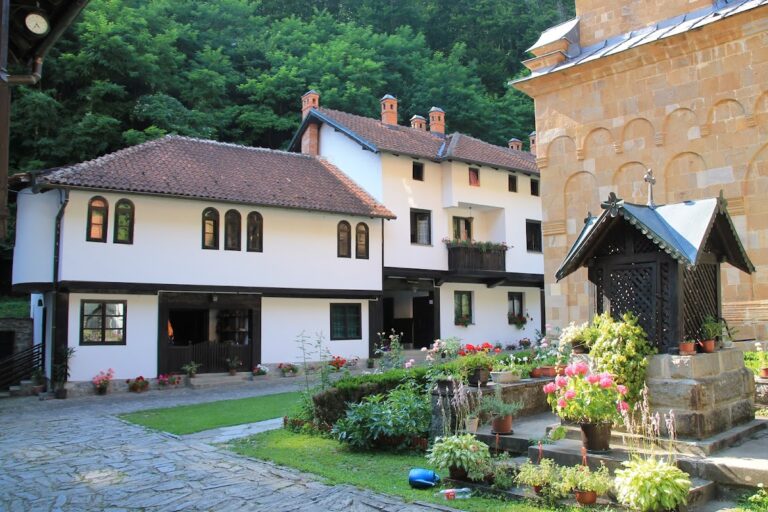
The monastery lodgings are only partly understood. Foundations of earlier konaks, or monastery residential buildings, can be seen in front of the church, and the complex includes both an old and a new konak. The precinct also retains carved architectural pieces. A marble floor, an ambo, circular decorative slabs, window elements from two-opening windows, capitals, columns, bases, and consoles were transferred from Ježevica to Stjenik during later rebuilding, while other fragments remain within the Ježevica complex.
The monastery has also preserved liturgical books printed or written mainly between the eighteenth and nineteenth centuries. The group includes Triodia, Menaia, Typika, Psalters, Octoechoi, Euchologia, a Service Book, a Horologion, and a handwritten prayer book copied in 1830 by Vuk at Sretenje Monastery.
Nearby sites