Columns of San Lorenzo: Ancient Roman Colonnade in Milan


Site at a Glance
- Rating
- 4.4
- Popularity
- Very High
- Country
- Italy
- Primary era
- Classical
- Eras represented
- Classical, Medieval
- Civilizations
- Holy Roman Empire, Roman
- Site type
- Religious
- Remains
- Temple
On this page9 sections
History
The Columns of San Lorenzo are ancient Roman remains in Milan, Italy, built within the Roman world of the second or third century and later incorporated into the Basilica of San Lorenzo complex. Known in antiquity as Mediolanum, Milan was an important Roman city, and the colonnade is regarded as one of the few surviving monuments of its imperial period.
Roman origins and relocation
The columns originally belonged to Roman buildings that stood elsewhere in the city. They probably came from a pagan temple in the area of present-day Piazza Santa Maria Beltrade, although a public bathhouse has also been proposed. During the fourth century, the columns were transported to their present position, probably after the earlier building had been dismantled, and incorporated into the architectural complex associated with the Basilica of San Lorenzo.
Medieval transformation
The arrangement visible today took shape during the medieval period, between the eleventh and twelfth centuries. Medieval builders completed parts of the entablature in brick and formed the central arch, adapting the ancient materials to the later composition. The complex continued to stand near the medieval Ticinese Gate, linking the surviving Roman elements with the development of medieval Milan.
Protection and changing surroundings
In the sixteenth century, preparations for the ceremonial entry of Philip II of Spain into Milan prompted a proposal to demolish the colonnade and widen the procession route. Ferrante Gonzaga, an Italian military commander and imperial official, rejected the proposal. The decision preserved the ancient structure during a period when the needs of ceremony and movement might otherwise have altered it permanently.
Until 1935, dense residential buildings stood between the basilica and the columns and surrounded much of the complex. Plans to preserve and restore the colonnade resulted in their demolition and the creation of the open square in front of the basilica. Tram tracks were first laid across the new square, then moved beyond the colonnade during the 1990s. Second World War bombing caused further destruction to buildings behind the church, and that area was later converted into Basilica Park, exposing the rear of the complex.
Memory of ancient Mediolanum
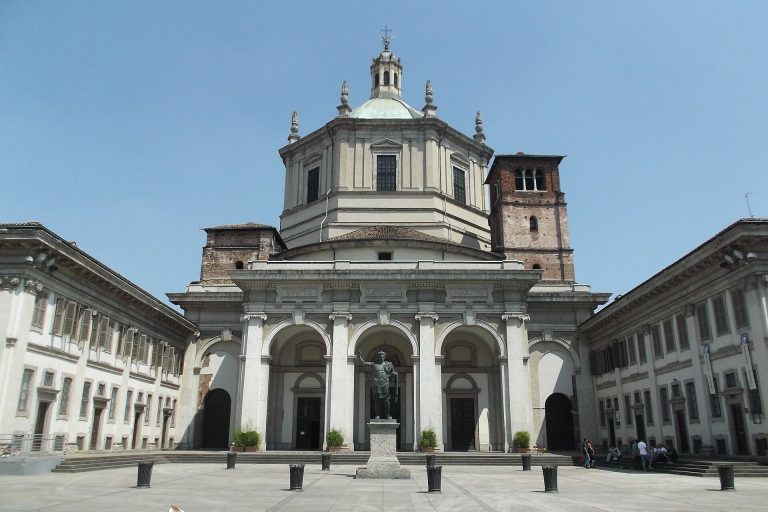
A bronze statue of Emperor Constantine was installed in 1937. It is a modern copy of a Late Antique monument preserved in Rome and refers to the Edict of Milan of AD 313, issued under Constantine and Licinius as a policy of religious toleration for Christianity within the Roman Empire. The columns retain particular emotional importance for Milan’s inhabitants and visibly connect the modern city with ancient Mediolanum. Their survival is associated with destruction caused by the Goths, Frederick I Barbarossa, the twelfth-century Holy Roman emperor, and Allied bombing during the Second World War.
Remains
The Roman colonnade
The surviving colonnade stands in a row before the Basilica of San Lorenzo, facing the open square. It consists of sixteen principal marble columns, each approximately 7.5 metres high. The marble was quarried at Musso. Corinthian capitals, an ornate classical form commonly decorated with acanthus leaves, support the entablature. The capitals are about 1.1 metres high and vary somewhat in style and size, suggesting that they were taken from two separate ancient buildings.
The lower capitals were raised with additional brick or mortar so that their levels aligned with the others. The central bay is wider than the surrounding intervals and is crowned by a brick arch. A small seventeenth column rises above the arch and supports a cross. Fragmentary marble elements remain in the entablature, while medieval brickwork completes the architrave and forms the central arch. A plaque or inscription commemorating Lucius Verus, the Roman emperor who ruled jointly with Marcus Aurelius from AD 161 to 169, is set into the colonnade and dated to AD 167.
The Basilica of San Lorenzo complex
The colonnade forms part of the wider Basilica of San Lorenzo complex. The Chapel of Saint Aquilinus within the complex contains mosaics dating from the Roman period, providing another surviving connection between the basilica and the ancient history of the site.
The Constantine statue
The 1937 bronze statue of Constantine stands on the square before the colonnade. It reproduces an ancient marble statue preserved in Rome and gives the open space a modern monument referring to the emperor’s association with the Edict of Milan.