Palazzo Stampa di Soncino: A Renaissance Noble Palace in Milan

Site at a Glance
- Rating
- 4.1
- Popularity
- Very Low
- Country
- Italy
- Primary era
- Early Modern
- Eras represented
- Medieval, Early Modern, Modern
- Civilizations
- Duchy of Milan, Spanish
- Site type
- Domestic
- Remains
- Elite Residence
On this page8 sections
History
Palazzo Stampa di Soncino is a Renaissance-style noble palace in Milan, Italy, reorganized for the Stampa family during the first half of the sixteenth century. Its origins lay in several medieval structures that the family gradually acquired in the late fifteenth century.
Medieval Origins and Stampa Patronage
Massimiliano Stampa, the first Marquess of Soncino and a prominent pro-imperial figure in Milan, commissioned Cristoforo Lombardo to reorganize the medieval complex. The project rationalized the earlier buildings and created a residence intended to strengthen the family’s prestige and express its loyalty to Charles V, the Habsburg Holy Roman Emperor whose authority extended across much of sixteenth-century Europe.
The palace stood along the Corsia di San Giorgio, a route used by Charles V’s imperial procession when he entered Milan in 1541. Its tower was almost certainly complete by 1548, when Prince Philip of Habsburg followed the same route in a triumphal entry into the city. Philip, later Philip II of Spain, was Charles V’s son.
Alterations and Inheritance
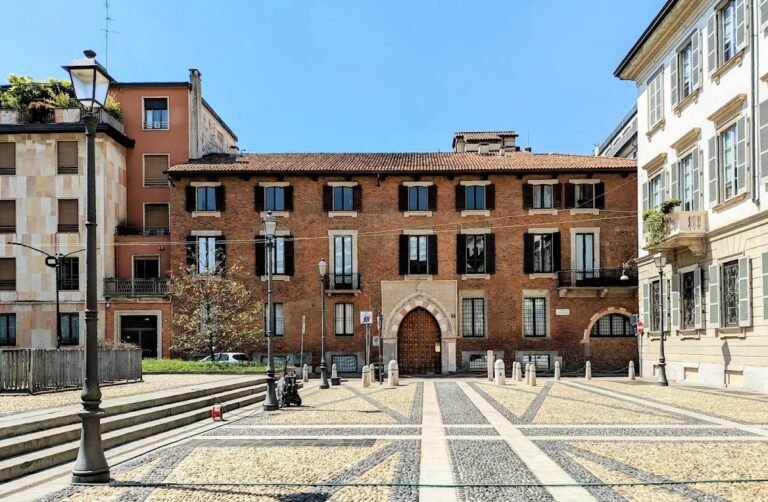
The complex continued to change over subsequent centuries. Nineteenth-century subdivisions and the opening of Via Soncino between 1878 and 1880 greatly reduced the former garden and helped produce the building’s present configuration. The nineteenth-century facade was designed by Luigi Franchi.
After Massimiliano IX Giovanni Stampa, the thirteenth Marquess of Soncino, died on 27 May 1876, the palace passed to his niece Luisa Negroni Prati Morosini, the wife of Gian Alfonso Casati. Their son Camillo obtained the marquessate in 1892 and received authorization to add “Stampa di Soncino” to his surname.
Palazzo Stampa di Soncino has been protected by the Italian heritage superintendency since 21 April 1911, under the decree issued on that date and the heritage-protection law of 1909. The building now contains residential apartments and shops, while the publishing house Skira has its principal headquarters in the building at Via Torino 61.
Representations of the Palace
The tower appeared in Serviliano Latuada’s eighteenth-century description of Milan and in engravings by Antoine du Pérac Lafréry, Marco Antonio Barateri, and Giovanni Francesco Lampugnani. Giorgio Vasari and Giovanni Stradano also included it in the 1560 fresco Siege and Capture of Milan in the Hall of Leo X at Florence’s Palazzo Vecchio.
Remains
Palazzo Stampa di Soncino occupies the entire block at Via Soncino 2, on the corner of Via Torino. The Renaissance complex is organized around an honor courtyard that was open on the western side of the principal building. Later additions and enlargements have produced a three-story structure, while the central tower rises above the courtyard and gives the palace its most distinctive vertical feature.
Medieval Fabric
Evidence of the palace’s medieval beginnings survives at the southeastern corner, at vicolo Santa Maria Valle 6. Here the building incorporates the remains of a medieval tower house, whose section rises several metres above the adjoining structures. This surviving fragment forms part of the later palace rather than standing as an isolated medieval building.
Courtyard and Tower
The square-plan tower stands centrally within the courtyard and dominates the facade on the narrow street. It is five stories high and has an upper terrace. At its summit, imagery linked to Charles V’s personal coat of arms combines the Pillars of Hercules with a scroll bearing the motto “Plus ultra,” a phrase expressing the idea of extending beyond previous limits. A globe topped by a double-headed eagle completes the composition, while marble pinecones occupy a lower position on the terrace.
The side of the tower facing Via Soncino bears the Stampa arms, showing an eagle and a crenellated keep. The tower’s heraldic decoration therefore joins the family’s own emblem to imagery associated with its Habsburg allegiance.
Garden Structure and Later Facade
A large garden formerly extended in front of the palace. Within it stood a two-story exedra, a curved architectural structure, erected during the sixteenth century. Its surviving remains can still be seen in the courtyard at Via Soncino 3.
The facade visible today dates from the nineteenth century and was designed by Luigi Franchi. It forms the later external face of a complex whose courtyard, tower, medieval corner, and garden remains preserve several stages of the palace’s development.