San Giovanni Battista: The Principal Church of San Giovanni la Punta


Site at a Glance
- Rating
- 4.5
- Popularity
- Low
- Country
- Italy
- Primary era
- Medieval
- Eras represented
- Medieval, Modern
- Civilizations
- Kingdom of Sicily
- Site type
- Religious
- Remains
- Church
On this page10 sections
History
San Giovanni Battista is the principal Catholic church of San Giovanni la Punta, Italy. Dedicated to Saint John the Baptist and Saint John the Evangelist, its completion is dated to 1380, although the date of its first construction remains uncertain. The present building is Neoclassical, a style inspired by the forms and proportions of ancient Greek and Roman architecture.
Medieval foundations and parish life
From the sixteenth century, records identify the earlier Benedictine church of San Nicolò alla Catìra as the mother church, meaning the principal church serving several settlements. Dating from the twelfth or thirteenth century, it served the communities of Catìra, La Punta, Trappeto, and San Gregorio, as well as the villages of La Punta and Trappeto. The subsidiary parish churches of San Giovanni and San Rocco stood beside it.
The Benedictines, a Western Christian monastic order whose houses also managed land and religious administration, had colonized the slopes of Mount Etna from the twelfth century at the initiative of Norman rulers. They established churches, residences, and monasteries, and initially administered the sacraments to the surrounding communities.
During the twelfth to fourteenth centuries, the villages around the church were small rural settlements inhabited by dependent colonists and agricultural laborers. Conditions for agricultural workers improved between the fourteenth and fifteenth centuries, while the growing value of Etna’s vineyards increased the influence of winegrowers and changed the area’s social and economic life.
La Punta, Trappeto, and Catìra formed part of ancient Roman massae, large ecclesiastical estates that could contain villages, farmsteads, monasteries, and churches. These territories are associated with a donation by Constantine I to the Church in 312. The names Trapeas and Castis are also connected with the area, and Trappeto probably derives from Trapeas.
Earthquake, rebuilding, and later changes
The earthquake of 11 January 1693 ruined the church and killed numerous worshippers. Its later rebuilding contributed to the imposing form that now stands in the central square of San Giovanni la Punta.
A new bell tower was constructed between 1728 and 1732. It collapsed on 29 November 1832, destroying the ornamentation of the principal doorway. Four columns from that decoration were later reused in a memorial to Blessed Gabriele Allegra, a twentieth-century Italian Franciscan friar and biblical scholar. Other fragments remain in a depot beside the church. One of the tower’s four bells came from San Nicolò alla Catìra, linking the later church with the older mother church.
Two adjoining oratories, smaller buildings used for prayer and worship, serve local confraternities. The northern oratory belongs to the Confraternity of the Most Blessed Sacrament, while the southern one belongs to the Confraternity of Saint John the Evangelist. The church remained closed for restoration from 2004 to 2006. Its bell tower is regarded as one of the largest in Sicily in overall size, together with the sanctuary at Tindari, and in the number of bells.
Remains
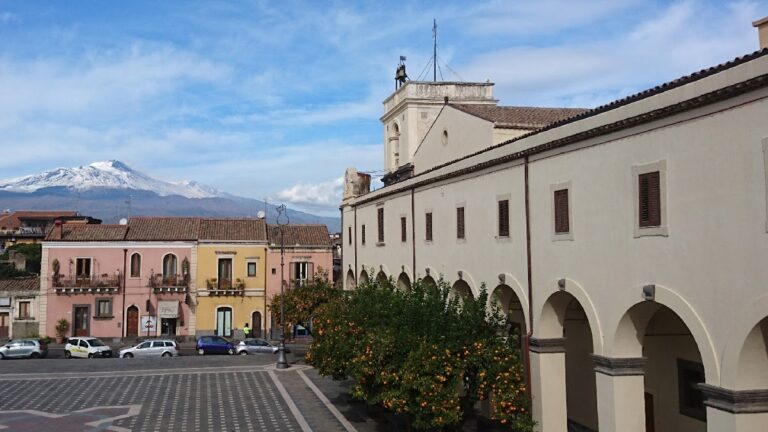
San Giovanni Battista occupies Lucia Mangano Square, the central square of San Giovanni la Punta. The church is an imposing Neoclassical structure with three naves and a broad Latin-cross plan, in which a long central space is crossed by a shorter transept. Windows illuminate the interior, while the adjoining oratories and chapels extend the building’s religious and architectural complex.
Church interior and decoration
Naves and presbytery
The three-nave interior is organized around the broad Latin-cross layout. The presbytery, the area around the main altar reserved for the clergy, contains two mural paintings by Sebastiano Conti Consoli dated 1951. The church also holds numerous paintings from the seventeenth through the nineteenth centuries, including a work by Antonio Zacco.
Chapels of Saint John and Saint Rita
The chapel of Saint John the Evangelist has extensive stucco decoration, a painting of Saint Blaise by the Campanian artist Salvatore Seme, and a valuable eighteenth-century console. Saint Blaise was an early Christian bishop and martyr. The chapel is dedicated to the town’s patron, Saint John the Apostle and Evangelist.
The chapel of Saint Rita preserves a devotional statue of Saint Rita of Cascia decorated with gold elements. At the statue’s feet stands a reliquary, a container for a saintly relic, holding part of Saint Rita’s knee. The chapel also contains important frescoes that are currently covered.
Oratories, facade, and bell tower
Oratories and entrance
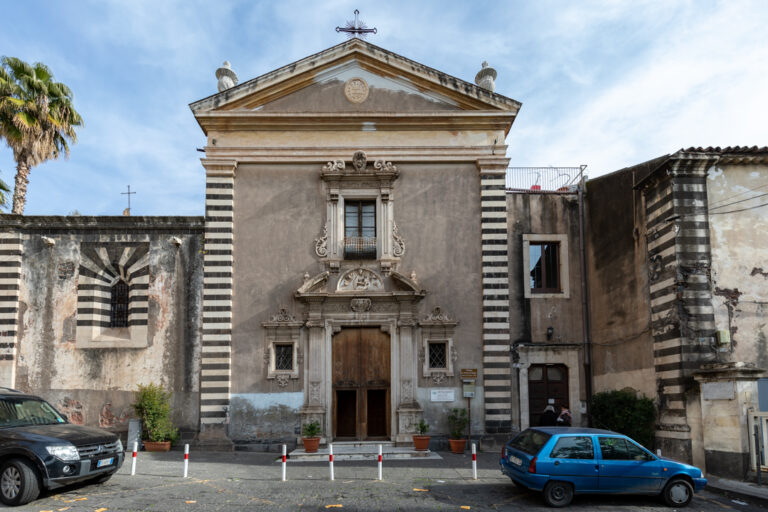
The northern oratory of the Most Blessed Sacrament has a notable facade decorated with friezes made of lava stone. The church’s bronze doors date from the last quarter of the twentieth century and were all made by the sculptor Domenico Girbino. Statues of the co-titular saints on the facade were created by Francesco Campisi in 1992.
Bell tower and doorway fragments
The bell tower had four bells, including one transferred from San Nicolò alla Catìra. Fragments of the former principal-door ornamentation are divided between the memorial to Blessed Gabriele Allegra, where four columns were reused, and the depot beside the church.
Nearby sites