Co-Cathedral of the Assumption of Mary: Nicotera’s Episcopal Church in Italy


Site at a Glance
- Rating
- 4.7
- Popularity
- Very Low
- Country
- Italy
- Primary era
- Modern
- Eras represented
- Medieval, Early Modern, Modern
- Civilizations
- Kingdom of Naples, Norman, Spanish
- Site type
- Religious
- Remains
- Cathedral
On this page5 sections
History
The Co-Cathedral of the Assumption of Mary is the principal Catholic church in Nicotera, Italy, and an active co-cathedral of the Diocese of Mileto-Nicotera-Tropea. Its long history reflects the changing fortunes of the town’s episcopal community, from its earliest recorded bishop in the sixth century through repeated destruction and rebuilding.
Early cathedral and Norman reconstruction
Tradition places Nicotera’s first cathedral and bishop’s residence on the remains of an ancient Greek temple associated with Diana, a major goddess of the ancient Roman religious tradition linked with the moon, forests, hunting, and childbirth. The earliest recorded memory of the cathedral dates to 596, when the pope appointed Proculus, Nicotera’s first bishop, to represent him in a dispute involving Boniface, bishop of Reggio, and the clergy of that city.
The cathedral was repeatedly attacked and plundered during Saracen raids. In 1065, Robert Guiscard, the Norman military leader and ruler involved in the conquest of southern Italy, ordered its reconstruction. The rebuilt church was dedicated to the Madonna of Romania, a title for the Virgin Mary.
Loss and restoration of the episcopal see
In 1304, during the wars of succession between the Angevins and Aragonese, the cathedral was reduced to the status of a collegiate church. A collegiate church is served by a college of clergy rather than functioning as a bishop’s seat. It was affiliated first with Mileto and later with Reggio.
This arrangement continued for almost ninety years. Henry Sanseverino, count of Mileto, intervened, and Pope Boniface IX restored Nicotera’s episcopal see in a papal bull dated 16 August 1392. A papal bull is a formal document issued under papal authority. The restoration returned the church to its role as the seat of a bishop and his ecclesiastical jurisdiction.
Early modern rebuilding and later disasters
Bishop Ottaviano Capece directed a major campaign between 1582 and 1618. The work enlarged and reoriented the church while giving priority to structural repairs rather than decoration. The building was reconsecrated in 1592 and dedicated to the Assumption of the Virgin Mary.
A fire in 1759 destroyed part of the church and its most valuable furnishings. An earthquake in 1783 then completely destroyed the building, which had only recently been restored after the fire. The state financed its reconstruction, preserving the original dimensions.
The church remained the cathedral of the Diocese of Nicotera until 1986. Since 1818, that diocese had been united with the Diocese of Tropea aeque principaliter, meaning that the two dioceses retained equal status rather than one becoming subordinate to the other. The present church now serves as a co-cathedral, a cathedral sharing the seat or functions of a diocese with another cathedral, within the Diocese of Mileto-Nicotera-Tropea.
Remains
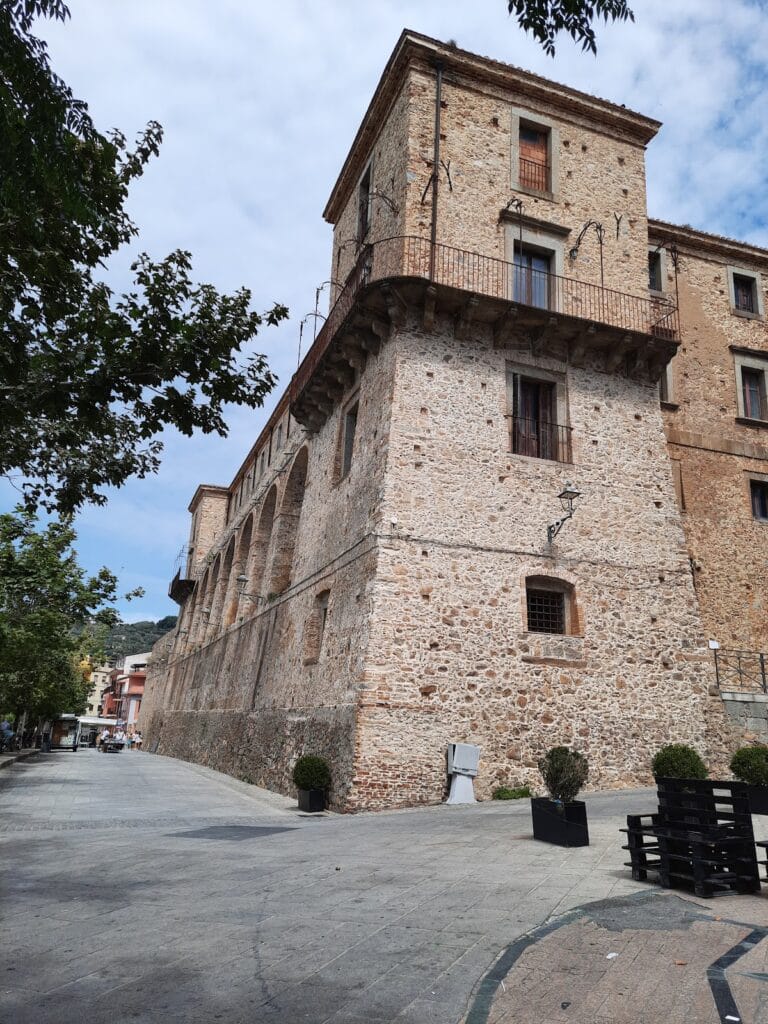
The co-cathedral stands at Largo Duomo in Nicotera. Its present form reflects both the early modern alterations and the reconstruction that followed the earthquake of 1783. The changes made between 1582 and 1618 enlarged the church and altered its orientation. After the earthquake, the interior was redesigned around three aisles in place of the former single nave. These aisles are covered by vaulted ceilings and lead to a large apse, the curved terminal space of the church. A principal altar of polychrome marble stands against the apse.
Nearby sites