Stavanger Cathedral: Norway’s Oldest Cathedral and Episcopal Seat


Site at a Glance
- Rating
- 4.3
- Popularity
- Medium
- Country
- Norway
- Primary era
- Medieval
- External website
- Open
- Eras represented
- Medieval
- Civilizations
- Norwegian
- Site type
- Religious
- Remains
- Cathedral
On this page11 sections
History
Stavanger Cathedral is Norway’s oldest cathedral, standing in central Stavanger, Norway. Construction began around 1100 in the medieval Romanesque period, and the building was completed around 1150. It became the seat of the Bishop of Stavanger and the center of the Diocese of Stavanger, and it remains one of the two churches of the Domkirken og St. Petri parish.
Foundation and medieval cathedral
Bishop Reinald, probably from Winchester in England, is traditionally credited with laying the cathedral’s first stone. Stavanger dates the city’s foundation to 1125, when it received town rights and the Diocese of Stavanger was created by division from the Diocese of Bergen. The cathedral was dedicated to Saint Swithun, a ninth-century Bishop of Winchester whose cult became associated with Winchester Cathedral.
Reinald’s career was closely tied to the early history of the cathedral. After a conflict with King Harald, he was hanged in 1135. The first cathedral was a Romanesque stone church with a wooden rectangular nave, a narrower chancel, and a tall western tower. Its medieval community later faced a major disaster when a fire devastated Stavanger in 1272 and severely damaged the cathedral.
Gothic rebuilding after the 1272 fire
Reconstruction took place under Bishop Arne, who served from 1276 to 1303. The choir was rebuilt and extended while retaining its original width, and the Romanesque building was partly transformed in the Gothic style. The work added a new portal and vestibule, reshaping the eastern and western ends of the cathedral.
The original western tower was not restored after the fire. Instead, it was replaced by a vestibule with a somewhat larger base. Excavations beneath the vestibule later revealed the foundation of a large central tower, probably built before the nave and possibly used as a watchtower. The tower had been demolished after the fire, and proposals to rebuild it in the 1920s were not carried out.
From Catholic cathedral to Lutheran church
Stavanger Cathedral was formerly Roman Catholic. During the Protestant Reformation, the sixteenth-century religious transformation that changed Norway’s established church from Roman Catholicism to Lutheranism, it became an Evangelical Lutheran church.
In 1682, King Christian V decided to transfer the episcopal seat from Stavanger to Kristiansand. The Diocese of Stavanger was re-established in 1925, on the city’s 800th anniversary, and Jacob Christian Petersen became its first bishop in almost 250 years. The cathedral is now an automatically protected Norwegian cultural-heritage site and remains an active church with seating for approximately 750 to 800 people.
A civic place in modern Norwegian history
In 1814, the cathedral served as an election church and polling place during the election of the Norwegian Constituent Assembly, which drafted Norway’s Constitution. Its parish was one of more than 300 constituencies that chose electors. Those electors later met in each county to select representatives for the assembly at Eidsvoll.
A storm in the mid-nineteenth century damaged parts of the roof. Renovation during the 1860s substantially altered the building, including the plastering of its stone walls and the removal of much of its medieval appearance. Architect Gerhard Fischer led a major restoration from 1939 to 1964 that partly reversed those changes. The latest major restoration took place in 1999.
Remains
Romanesque plan and stonework
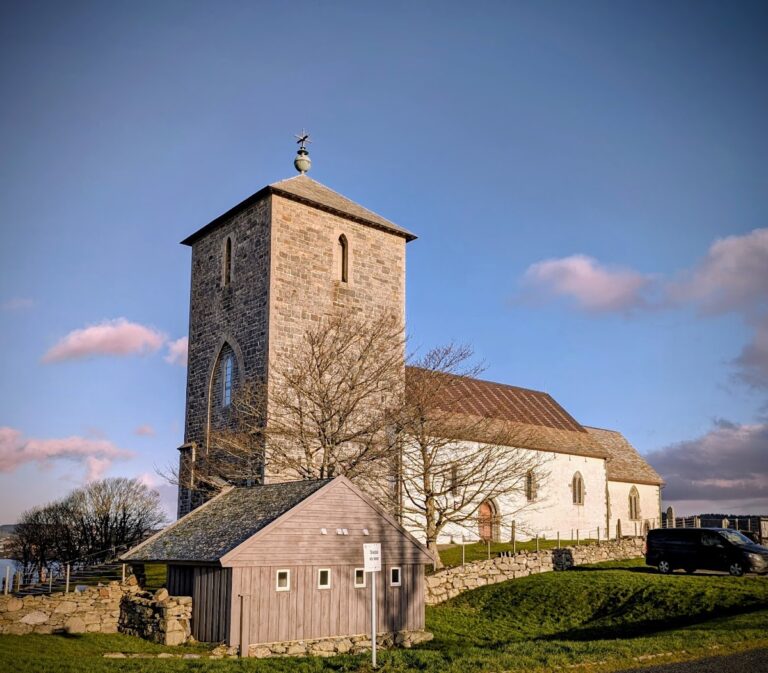
Stavanger Cathedral is a gray stone long church built between approximately 1100 and 1150. Its materials include stone, soapstone, and green slate. The building has a basilican plan, meaning that a higher central nave rises above two lower side aisles. The nave measures approximately 25.8 by 18 metres. Round Romanesque columns divide the interior, with six arches linking the columns on each side, while diaphragm arches span across the building and help organize its interior space.
The central nave contains an arcade of round pillars. Their capitals carry numerous figures depicting Ragnarök, the cataclysmic end of the world in Norse mythology. Palmettes and arcatures, or rows of small decorative arches, enrich the masonry along the cornices. The cathedral stands in central Stavanger, in the Storhaug borough, between Breiavatnet to the south, the square and Vågen to the northwest, Cathedral Square to the north, and Kongsgård to the southwest.
Gothic choir and vestibule
The choir rebuilt after the 1272 fire preserves its original width but extends the eastern end of the cathedral. Its Gothic treatment includes an eastern facade with two corner towers, lancet windows, a large central window, and sculptures placed between the towers and the main body of the church. The rebuilding also created the portal and vestibule that replaced the earlier western arrangement.
The vestibule contains several tomb monuments and epitaphs, including a monument to Bishop Botolf Asbjørnson, who served from 1355 to 1380. Additional graves and epitaphs occupy the side aisles. Excavations below the vestibule exposed the foundation of the earlier large central tower, adding physical evidence of a building phase that preceded the present nave.
Crypt and burials
Crypts lay beneath the Romanesque choir. Approximately 1,000 skeletons were found there, suggesting that an earlier church may have stood on the site. The crypt has a separate entrance from outside. Further burials were prohibited in 1805 because of the smell, and approximately 100 coffins were removed during a nineteenth-century restoration.
Furnishings, sculpture, and artistic works
Statues at the entrance to the sacristy portray King Magnus VI, King Erik II, and King Haakon V. The original biers associated with the statues of Magnus VI and Erik II were removed during the 1860s renovation. The Gothic baptismal font dates from approximately 1250 to 1300, while the bishop’s chair dates from 1925.
Andrew Lawrenceson Smith built the pulpit in 1658, replacing an earlier pulpit by Nils Olavson. A statue of Saint Swithun by Stinius Frederiksen was installed on the eastern side of the choir during the major restoration of the 1960s. Emanuel Vigeland designed the chandeliers, and Viktor Sparre created the cathedral’s stained-glass windows in 1957, including another window in the choir.
The choir preserves a Danish Bible by Anders Lauritsen Smith, a portrait of the superintendent Jørgen Erikson, and a goblet and dish made by Laurits Clausen in 1608. A liturgical vestment bearing an image probably representing Saint Swithun was found in the attic during the nineteenth-century restoration.
Organ, bells, and gallery decoration
A gallery between the nave and choir once held an organ installed in 1622. The gallery was demolished during the 1860s renovation. The present organ was built in 1991 by Reil of Heerde and incorporates older pipework from a 1941 instrument made by the Danish firm Frobenius Orgelbyggeri. It has 51 stops distributed across three manuals and pedals.
A carillon, a set of tuned bells played from a keyboard, was installed above the entrance in 1925. It was enlarged in 1997 from 27 bells to 49. Around 1660, the gallery parapet was decorated with motifs copied from Cor Iesu Amanti Sacrum, also known as Emblems from the Heart. Three of the original six motifs are displayed in Stavanger Museum.