Anagni Cathedral: A Romanesque and Gothic Diocesan Basilica in Italy


Site at a Glance
- Rating
- 4.8
- Popularity
- Very Low
- Country
- Italy
- Primary era
- Medieval
- External website
- Open
- Eras represented
- Classical, Medieval
- Civilizations
- Papal States, Roman
- Site type
- Religious
- Remains
- Cathedral
On this page22 sections
History
Anagni Cathedral, formally the Basilica Cathedral of Santa Maria Annunziata, is a Roman Catholic cathedral in Anagni, Italy, and the seat of the Diocese of Anagni-Alatri. Built by the medieval church on the site of the ancient Hernician acropolis, it was constructed in the late eleventh and early twelfth centuries in a primarily Romanesque style, then altered with Gothic features. It remains both a diocesan cathedral and a minor basilica, an honorary papal designation distinct from its role as a cathedral.
Foundation and Medieval Construction
The cathedral occupies an elevated center associated with the Hernicians, an ancient Italic people of central Italy. An earlier early-medieval cathedral had stood on the same site before Bishop Pietro da Salerno decided to build the present church. Work began around 1072 and was principally completed around 1104, with financial support from the Byzantine emperor Michael VII Doukas, who ruled from 1071 to 1078.
The building was later reshaped during the thirteenth century. In 1250, Bishop Pandolfo replaced the wooden roof trusses over the central nave and transept with Gothic arches. This intervention introduced a new architectural language into a church whose principal structure belonged to the Romanesque period.
A Papal and Ecclesiastical Center
From the eleventh through the thirteenth century, Anagni served as a secondary center of the papacy. The frequent presence of popes made the cathedral a setting for ecclesiastical ceremonies and political negotiations, including the pactum anagninum, an agreement negotiated between the papacy and the empire. The cathedral also hosted the canonizations of Bernard of Clairvaux, Clare of Assisi, Edward the Confessor, and Peter the Hermit, a preacher associated with the First Crusade and patron of Trevi nel Lazio.
The church was repeatedly used for confrontations between popes and rulers. Pope Alexander III excommunicated Frederick Barbarossa, the German king and Holy Roman emperor Frederick I, in the cathedral on 24 March 1160. Pope Gregory IX excommunicated Frederick II in 1227 for failing to begin the Sixth Crusade, and again in 1239 during his conflict with the papacy. The cathedral was also the scene of the excommunications of the antipope Ottaviano Monticelli, known as Victor IV, and of Manfred.
In 1243, the cathedral hosted the election of Pope Innocent IV. Clare of Assisi was canonized there by Pope Alexander IV in 1255, linking the church to one of the most important religious figures of the thirteenth century.
Conflict and Later Preservation
In 1303, the cathedral complex was drawn into the attack on Pope Boniface VIII known as the Outrage or Slap of Anagni. Sciarra Colonna and Guillaume de Nogaret carried out the assault on behalf of Philip IV of France. The attack took place in adjoining premises connected to the cathedral by the cloister; those premises have since disappeared.
The cathedral’s medieval fabric and associated collections have been shaped by repeated modern interventions. The presbytery balustrade was restored in 1905 and 1906, followed by restoration of the bell tower in 1938. During the 1990s, the interior was comprehensively restored and repainted, and the restored crypt was inaugurated on 1 July 1994. The surviving crypt, chapels, works of art, archaeological collections, and medieval furnishings contribute to the cathedral’s continuing historical and ecclesiastical importance.
Remains
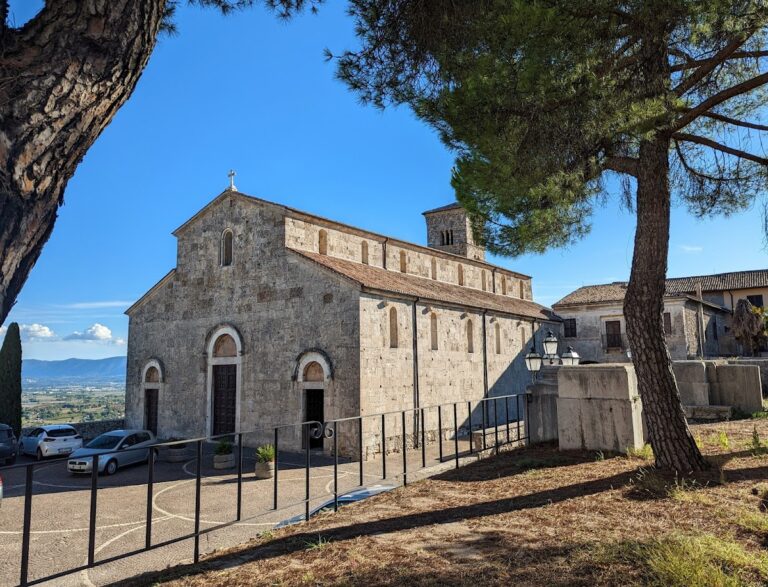
Anagni Cathedral combines a massive Romanesque structure with Gothic alterations and a complex group of associated spaces. Its exterior includes a plain wall, eastern entrances, a western triple apse, a staircase, and a separate bell tower. Inside, three naves, a richly furnished presbytery, medieval pavements, chapels, painted apses, and the extensive Crypt of Saint Magnus preserve the changing religious and artistic character of the building.
Exterior and Bell Tower
Triple Apse and Entrances
The exterior is marked by a plain, massive wall and three entrances on the eastern side. The western portion presents a triple apse and a monumental staircase toward the surrounding urban space. A vaulted staircase leads to the forecourt, where the cathedral’s triple portal stands separately from the Romanesque bell tower. The triple apse of the transept dates from 1074 and rises approximately twenty metres above the staircase. The southern side contains the Caetani Chapel, built in 1292 for burials associated with members of the Caetani family, and a loggia of Boniface VIII containing his statue. The episcopal palace stands beside the cathedral.
Romanesque Bell Tower
The Romanesque bell tower rises approximately 25 to 30 metres in the forecourt. Its five levels, or orders, contain successive single-, double-, and triple-light openings. An iron framework installed inside the tower in 1938 supports five bells.
Naves and Presbytery
Three-Nave Interior
The interior has three naves built by the magistri comacini, early medieval builders associated with advanced masonry practices in northern and central Italy. The central nave measures approximately 34 metres in length, 18 metres in width, and 16 metres in height. Massive Romanesque columns divide the naves, while Gothic arches and cross-vaulting rest on pillars and pilasters.
Presbytery and Episcopal Furnishings
The presbytery, the part of the church reserved for the clergy around the high altar, has three apses. A marble balustrade separates it from the nave. Restored in 1905 and 1906, the balustrade is decorated with mosaics. The area contains three altars, including smaller altars dedicated to the Sacrament and Saint Joseph, and a white-marble high altar with a small tabernacle.
Above the high altar stands a pyramidal, multi-level ciborium, a canopy supported by four columns. Small columns divide its stages, while the summit ends in a finial with a double cross described as the symbol of the basilica. Mosaic decorates the architrave above the columns. At the center of the choir is the episcopal throne, whose decoration bears the symbol of Bishop Landone and represents the donors, the Conti family, in the background. The associated work dates from 1263 to 1276.
The Easter candlestick was made by Pietro Vassalletto in 1263. Its mosaic spiral column rises from a marble base supported by lions, while a cherub holds the candle at the top. Related columns serve as supports for holy-water vessels at the entrance.
Cosmatesque Pavement
The mosaic pavement was executed by the Cosmati family in 1231 using the Cosmatesque technique, a medieval Italian method of forming geometric designs from cut coloured stone and marble. Porphyry, serpentine, and other multicoloured marbles create the patterns. A broad Byzantine-style interlace runs through the central nave in linked circular forms, with related designs in the presbytery and before the altars. Some sections of the presbytery were commissioned by Bishop Seneca from fragments of a marble choir and imitate the nave’s designs.
Paintings and Chapels
Doorways and Apses
A late-thirteenth-century lunette above the central doorway shows the Madonna and Child between Saint Magnus and Saint Secondina. Beside the left entrance, behind a grille, a fourteenth-century fresco depicts the Madonna enthroned between Saint Catherine of the Wheel, or Catherine of Alexandria, and Saint Anthony the Abbot.
The central apse contains figures of the Apostles, each identified by an attribute, with Saint John at the center. The original painting was destroyed and restored in 1880, and the surviving work is associated with Antonio Borgogna. Other paintings show saints venerated at Anagni, the Annunciation, and Christ Pantocrator, the image of Christ as almighty ruler, by Pietro and Giovanni Gagliardi. The left apse contains scenes of the disciples at Emmaus and adoring angels. The right apse depicts the marriage of Saint Joseph and the Virgin and the death of Saint Joseph.
Chapels
The cathedral contains a baptistery and the Lauri, Caetani, and Raoli chapels. The Raoli Chapel, also called the Chapel of Saint Charles, contains Madonna della Misericordia by Frenguelli, donated by Pope Leo XIII, together with two paintings by the Gagliardi brothers.
Crypt and Adjacent Medieval Spaces
Crypt of Saint Magnus
The Crypt of Saint Magnus was built with the upper church during the late eleventh and early twelfth centuries. Romanesque arches and an original Cosmatesque pavement dated approximately 1224 to 1231 survive alongside frescoes covering about 540 square metres. The fresco cycle was completed by the middle of the thirteenth century and is attributed to three otherwise unidentified workshops traditionally called the First Master or Master of the Translations, the Second Master or Ornament Master, and the Third Master or Master of Anagni. The last is also identified with the painter of the Gothic frescoes in the Aula Gothica of Santi Quattro Coronati in Rome.
The twenty-one vaults present the history of human salvation from creation to judgment. Their subjects include scenes from the Old and New Testaments, the Ark of the Covenant, and the Apocalypse. One unusual cycle on the creation of the world presents the proportional union of the four elements and humanity, relating the microcosm, or human world, to the macrocosm, or larger universe. It includes Hippocrates and Galen and a theory of the elements derived from Plato.
The crypt walls depict miracles attributed to Saint Magnus and the lives of saints buried at the altars. The altars contain the bodies of Saint Magnus, Saint Aurelia, Saint Noemisia, and Saint Secondina, together with relics of Saint Oliva, Saint Sebastian, Saint Caesarius, and other martyrs.
Oratory of Saint Thomas Becket
The Oratory of Saint Thomas Becket lies beside the crypt. Its vestibule formerly contained tombs of prominent local families and leads to a former Mithraeum, a sanctuary dedicated to Mithras during the Roman imperial period. A sacrificial altar survives there. The later Christian oratory was painted after Thomas Becket’s canonization by Alexander III at nearby Segni on 21 February 1173.
The frescoes narrate biblical history from the creation of humanity and the birth of Jesus to the Last Judgment and Christ’s triumph. They include the parable of the Foolish Virgins and a cycle showing the life and martyrdom of Thomas Becket, the archbishop of Canterbury murdered after opposing King Henry II of England. On the rear wall, Becket appears beside the blessing Christ.
Chapel of the Saviour
The medieval Chapel of the Saviour stands beside the Treasury. Its twelfth- and thirteenth-century frescoes remain with preserved wooden furnishings, including a twelfth-century episcopal throne described as one of the oldest in Europe.
Treasury and Archaeological Collections
Cathedral Treasury
The Treasury preserves medieval ecclesiastical objects made in varied techniques and styles. Its holdings include goldwork, enamels, ivories, reliquaries, valuable textiles, and illuminated parchment antiphonaries, liturgical books containing chants for Christian worship. Among the associated objects are a reliquary casket connected with Thomas Becket and a cope associated with Boniface VIII.
Lapidary and Cryptoporticus
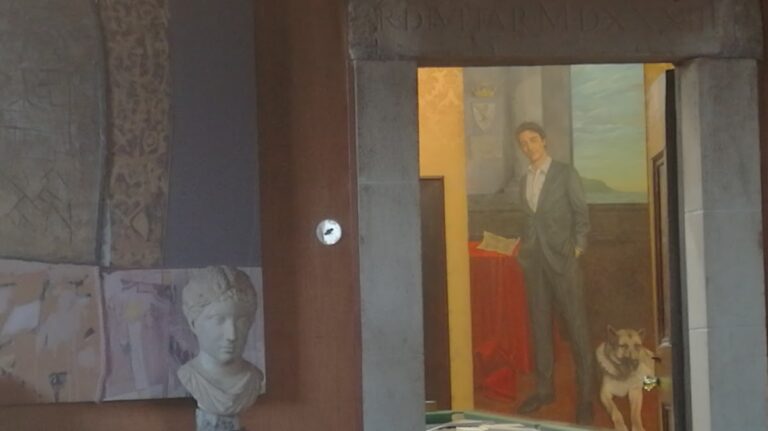
The Lapidary is reached through a side entrance in the right aisle and occupies rooms beside the cloister. It contains marble slabs, fragments of ancient mosaic and Cosmatesque pavement, Roman inscriptions, pieces of tombstones, coats of arms, and funerary stones. Important Roman funerary monuments known as cippi, small stone monuments used for funerary or commemorative purposes, stand before the balustraded approach. They were found at Anagni in the area called Terme di Piscina.
Some lapidary pieces came from Rome and the Roman catacombs rather than Anagni or its immediate territory and were donated to the cathedral. A separate archaeological collection is displayed in glass cases in the cryptoporticus, a covered or partly underground passage or gallery.