Dunkeld Cathedral: A Medieval Cathedral and Parish Church in Scotland


Site at a Glance
- Rating
- 4.5
- Popularity
- Low
- Country
- United Kingdom
- Primary era
- Medieval
- External website
- Open
- Eras represented
- Medieval, Modern
- Civilizations
- British, Kingdom of Scotland
- Site type
- Religious
- Remains
- Cathedral
On this page10 sections
History
Dunkeld Cathedral is a medieval cathedral and parish church in Dunkeld, United Kingdom, developed from an early Culdee Christian monastery traditionally dated to 730. The present building was constructed between 1260 and 1501 in a mixture of Gothic and Norman forms, and it remains an important surviving centre of Scottish religious history.
Early monastery and the cult of Saint Columba
The first community at Dunkeld may have begun as early as the sixth or early seventh century, after Saint Columba, an Irish missionary associated with the Christianization of parts of Scotland and the foundation of Iona Abbey, travelled to Alba. The monastery is traditionally dated to 730 and was associated with the Culdees, an early medieval Christian community linked with Scotland and Ireland.
In 849, Kenneth I of Scotland transferred the relics of Saint Columba from Iona to Dunkeld, probably because Viking attacks made Iona increasingly vulnerable. Dunkeld then became an administrative and ecclesiastical centre and attracted pilgrims. The relics were traditionally kept there until the Reformation, when they were reportedly taken to Ireland. During the ninth century, a larger ecclesiastical complex of red sandstone was built, and Dunkeld was declared the primatial centre of the Christian faith in Alba. By the middle of the tenth century, its influence had declined as St Andrews became Scotland’s principal church centre, although Dunkeld Abbey remained important.
Abbey, bishopric, and cathedral construction
Dunkeld continued to be connected with important figures in Scottish history. Abbot Crinan, who died in battle in 1045, was married to a daughter of Malcolm II, and their son later became King Duncan I. Donald III was probably buried at Dunkeld in 1099 before his remains were transferred to Iona.
The abbey-based administration ended when a diocesan system was established during the first half of the twelfth century. Cormac was probably appointed the first Bishop of Dunkeld in 1114. The last abbot was Ethelred, a son of Malcolm III and Saint Margaret who was also Earl of Fife.
Construction of the present cathedral began in 1260 and continued for more than two centuries, probably replacing an earlier church. The choir was completed first under Bishop William Sinclair, who held the see from 1309 to 1337. It contained the high altar and seating for the clergy. Bishop Robert Cardeny began the nave in 1406, and Bishop Thomas Lauder completed it in 1464. Lauder also began the chapter house in 1457, completing it in 1469, and initiated the west tower and south entrance porch. The tower was finished during the episcopate of Bishop Livingston, from 1475 to 1483. The cathedral was completed in 1501 and dedicated to Saint Columba.
Reformation and religious change
The Scottish Reformation, the sixteenth-century transformation that established Protestant churches and ended Roman Catholic worship at Dunkeld, brought major changes. Roman Catholic services ended in 1560, and government orders led to the removal of the statues that August. The Laird of Caldeny later stripped the nave roof for his own use despite orders to spare the building. The local population continued to worship in the choir as a parish church.
Bishop Robert Crichton initially resisted the Reformed faith and was removed from office in 1571. He changed his position and was reappointed in 1584, dying the following year. The bishopric was abolished in 1689, after which the cathedral passed to the Crown and later became associated with the Earls of Fife.
Battle, restoration, and modern care
In 1689, Dunkeld became the scene of fighting during the Battle of Dunkeld. Jacobite forces, who supported the restoration of the deposed Stuart monarchy, fought government troops supporting William III and II, the Protestant monarchs who came to the throne during the Glorious Revolution. Government forces occupied and fortified the cathedral and the nearby house of the Marquis of Atholl. Street fighting damaged or burned many buildings and caused substantial damage to the cathedral. The Jacobites were defeated, although their opposing commander, Lieutenant-Colonel William Cleland, was killed and buried in the nave. The Marquis of Atholl had the choir repaired in 1691.
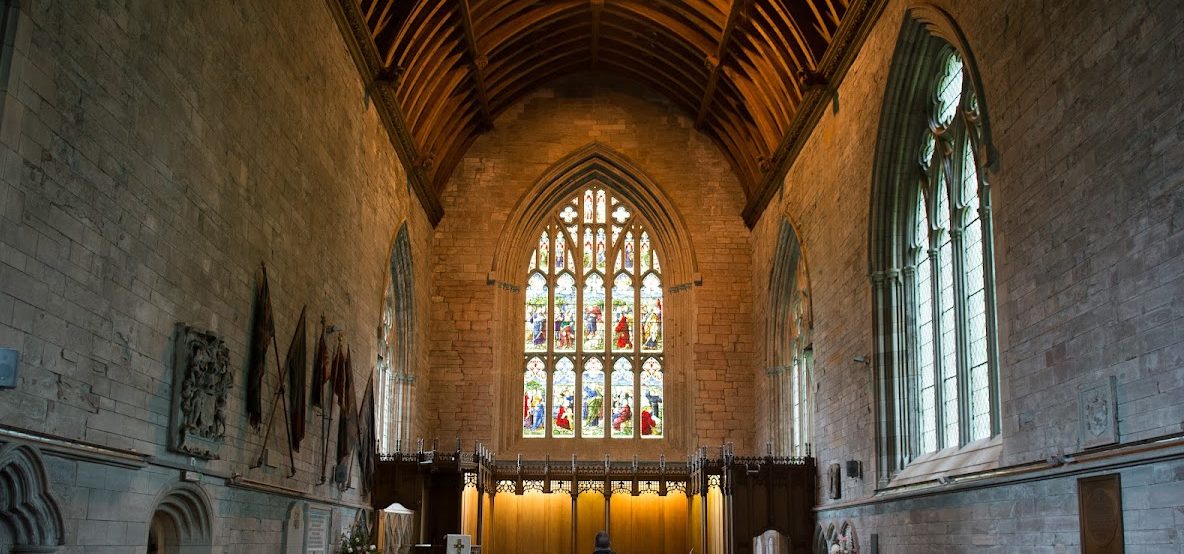
Further restoration took place in 1762, including a new tower roof. In 1814 and 1815, architect Archibald Elliott stabilized the nave ruins and renewed much of the choir’s stone decoration in an attempt to give the building a more medieval appearance. The choir interior was renovated in 1908. Wooden galleries and fittings added during the earlier restoration were removed, the communion table was moved slightly west of the former high-altar site, and a new pulpit and wooden screen designed by Lorimer were installed.
The ruined nave and tower entered state care in 1925. Historic Environment Scotland manages the nave, south porch, and west tower, while the Church of Scotland manages the choir as a parish church. The congregation uses the smaller Little Dunkeld Church during the winter months, and a small Chapter House Museum presents monastic and medieval objects alongside local-history exhibits. The building is Crown property and a scheduled monument. Although the Church of Scotland has no formal cathedrals or bishops, Dunkeld retains its historic name.
Remains
Layout and construction
Dunkeld Cathedral stands on the north bank of the River Tay and follows an east-west plan, with the choir at the eastern end and the nave to the west. It is built mainly from grey sandstone in a square-stone style. Its long construction period produced a combination of Gothic and Norman architectural elements. Stones from the earlier Culdee monastery appear as an irregular reddish streak in the eastern gable, associated with the red-sandstone walls or construction of the ninth-century complex.
The building is divided physically between a restored and reconfigured eastern choir, still used as a parish church, and a roofless western nave preserved as a ruin. The choir is as wide as the nave itself when the nave’s side aisles are excluded. The nave has aisles on both sides, a south entrance porch slightly west of its centre, and a northern entrance directly opposite it. The principal entrance is at the west end.
Western nave and tower
A four-storey tower rises at the north-west side of the nave, and its roof has been restored. Before the Reformation, the lowest storey served as an ecclesiastical court. Remains of wall paintings inside the tower depict the Judgement of Solomon and the biblical story of a woman caught in adultery. The tower also contains the medieval grave slab of the canon Alexander Douglas.
The south wall at the eastern end of the nave contains the tomb of Bishop Robert Cardeny, who began the nave’s construction. The nave, south porch, and tower form part of the section managed by Historic Environment Scotland, while the choir remains in ecclesiastical use.
Chapter house and treasury
The two-storey chapter house stands on the north side of the middle part of the choir. It functions as a sacristy and treasury, and its lower storey was later used as a mausoleum for the Earl of Atholl. A large memorial stone on its south wall bears the coats of arms of John, the second Earl and first Marquis of Atholl. A statue of John, the fourth Duke of Atholl, stands before it.
The chapter house contains a display case with chalices and bowls used in services after 1745, together with a bronze bell dating from the eighth or ninth century. A Class III Pictish stone from the eighth or ninth century also stands there. Its single carved face carries a simple cross, and it was reused as a grave slab in 1729, probably after being reduced in size.
Choir monuments and Pictish sculpture
The choir contains a headless gisant, a reclining sculpted funerary figure, probably representing Bishop William Sinclair, who oversaw the choir’s construction. Behind the wooden screen stands the tomb and armoured effigy of Alexander Stewart, Earl of Buchan, known as the Wolf of Badenoch.
Other recorded burials include John Scotus; Geoffrey de Liberatione, Bishop of Dunkeld from 1236 or 1237 to 1249; Richard de Inverkeithing, Bishop from 1250 or 1252 to 1272 and chamberlain to King Alexander II of Scotland; Michael de Monymusk, Bishop from 1370 to 1376; the first Earl of Atholl, who lived about 1440 to 1512; Robert Cockburn, Bishop from 1524 to 1526; and Charles Edward Stuart, Count Roehenstart, who lived from 1784 to 1854.
The Apostles’ Stone, a Class II Pictish stone from the eighth or ninth century, stands in the choir. It originally formed part of a larger cross. One face shows twelve human figures traditionally associated with the apostles, although the scene is actually a battle. The carving also includes Daniel in the lions’ den and the biblical story of the loaves and fishes. Together with the earlier masonry and surviving monuments, these stones connect the functioning parish church with Dunkeld’s early medieval religious past.