Ferrara Cathedral: The Mother Church of Ferrara


Site at a Glance
- Rating
- 4.5
- Popularity
- Medium
- Country
- Italy
- Primary era
- Medieval
- External website
- Open
- Eras represented
- Medieval, Early Modern, Modern
- Civilizations
- Papal States
- Site type
- Religious
- Remains
- Cathedral
On this page22 sections
History
Ferrara Cathedral is the principal Catholic church of Ferrara, Italy, dedicated to Saint George and serving as the mother church of the Archdiocese of Ferrara-Comacchio. Construction began in 1135, during the city’s expansion onto the left bank of the Po and the northward movement of its urban center. The building began in the Romanesque period, an architectural style known for massive masonry and rounded forms, and later developed through Gothic, Renaissance, and Baroque phases.
The new cathedral in the twelfth century
The cathedral’s construction followed authorization obtained in 1132 from Anacletus II, an antipope, meaning a claimant to the papacy who was not recognized as legitimate by the opposing papal authority. Guglielmo degli Adelardi and Prince Federico Giocoli contributed to the establishment of the new church. It replaced the earlier cathedral of San Giorgio fuori le mura, which stood outside the city walls on the right bank of the Po di Volano, at the site of Ferrara’s earliest settlement. That older church later became a parish church, while the new cathedral retained the dedication to Saint George.
The main altar was consecrated on 8 May 1177, forty-two years after the foundation stone was laid. This indicates that the eastern part of the medieval cathedral was nearly complete by that time. The church subsequently acquired Gothic features alongside its Romanesque structure, reflecting the long process through which the building reached its present form.
Renaissance additions and civic ceremonies
Between 1451 and 1493, a campanile, or bell tower, was built on the south side. Its design is attributed to Leon Battista Alberti, the fifteenth-century Italian architect and architectural theorist, although the tower remained incomplete. During approximately the same period, the apse was built to a design by Biagio Rossetti, a Ferrarese architect and urban planner. These works introduced Renaissance elements to a cathedral whose principal structure had originated in the Romanesque period.
The cathedral also served as a setting for major ecclesiastical and civic occasions. In 1539, Cristóbal de Morales’s Gaude et laetare ferrariensis civitas was first performed there to mark the elevation of Ippolito II d’Este to the cardinalate. The church continues to host the diocese’s principal celebrations, including ordinations, pontifical Masses, and solemn funerals.
Eighteenth-century rebuilding
A major transformation began in 1712, when Francesco Mazzarelli consolidated parts of the building for Cardinal Taddeo Luigi Dal Verme. From 1717, Cardinal Tommaso Ruffo entrusted the continuation of the work to Tommaso Mattei. The rebuilding lasted seventeen years and reduced the medieval arrangement from five naves to three. It also substantially changed the interior decoration, which was completed during the following century and gave the interior its later Baroque character.
The rebuilding affected the cathedral’s furnishings as well as its structure. Earlier works were removed from the church, and some were later preserved in the Cathedral Museum, housed in the former church of San Romano on Piazza Trento e Trieste. The museum’s collections therefore retain objects connected with both the medieval cathedral and its eighteenth-century transformation.
War damage, restoration, and status
On 28 January 1944, bombing in Ferrara destroyed buildings behind the apse and damaged part of the cathedral’s southern side near the campanile. The exterior of the apse was restored in 2006. From 4 March 2019 to 22 March 2024, the cathedral underwent restoration and structural consolidation to address chronic structural defects and damage caused by the 2012 Emilia earthquake.
Pope John XXIII raised the cathedral to the dignity of a minor basilica in 1959. A minor basilica is a church granted special honorary status by the pope. The cathedral is also included within the UNESCO World Heritage designation covering Ferrara’s historic city center, which dates from 1995. Its continuing religious life includes the spring blessing of the four painted palii, ceremonial banners awarded in Ferrara’s four historic Palio competitions. The cathedral also contains the tomb of Pope Urban III, who died at Ferrara in 1187.
Remains
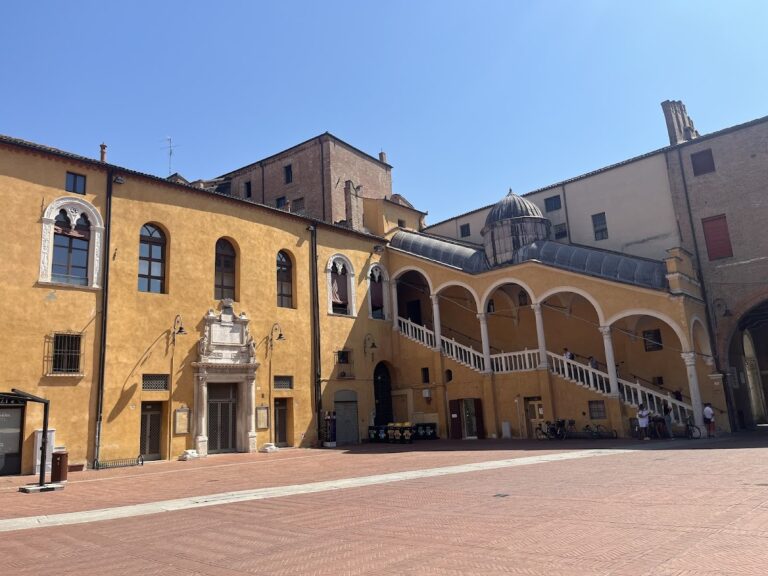
Ferrara Cathedral stands in the city center opposite the Palazzo Municipale and beside the former Piazza delle Erbe, now Piazza Trento e Trieste. A covered passage links the church with the Archbishop’s Palace. Its axis deviates 24 degrees clockwise from exact eastward orientation. The surviving building combines a marble-faced medieval exterior, a Renaissance campanile and apse, and a three-naved interior shaped by eighteenth-century rebuilding and Baroque decoration.
West facade and medieval sculpture
Romanesque and Gothic facade
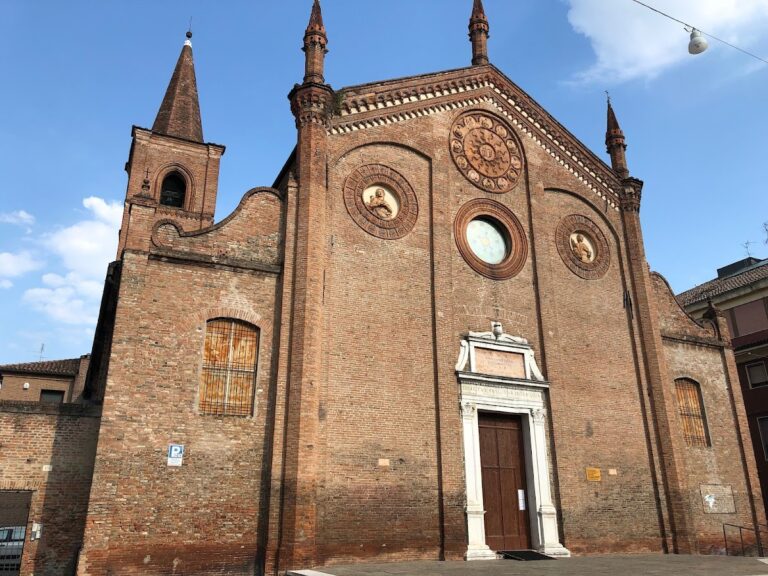
The lower part of the west facade preserves the character of the original Romanesque design, while the upper sections combine Gothic and early Renaissance elements. White marble covers the facade, which has three cuspids, galleries, arcades, rose windows, splayed windows, statues, and numerous Gothic bas-reliefs. The central porch is supported by lions and telamons, male sculpted figures used as architectural supports. Above it, a Gothic loggia has pointed arches and quatrefoil tracery. Its terracotta Madonna and Child was made by Michele da Firenze in 1427.
Portal sculpture and the Last Judgment
Above the central doorway are works attributed to Nicholaus, including a lunette showing Saint George killing the dragon and scenes from the New Testament. The door jambs carry figures of the prophets Daniel, Jeremiah, Isaiah, and Ezekiel. Nicholaus may also have designed the facade, apses, side walls, and interior structure.
The upper facade contains a Gothic Last Judgment influenced by northern French Gothic art. The composition directs the damned toward Hell and the blessed toward Paradise. A monstrous figure devours the damned, while Abraham receives the souls of the righteous. Above this scene, Christ appears within a mandorla, an almond-shaped frame used around sacred figures, accompanied by angels carrying the instruments of the Passion. Mary and Joseph kneel in intercession, the elders occupy the sides of the gable, and a frieze shows the Archangel Gabriel weighing souls, an image known as psychostasis.
Other elements of the facade include a statue of Alberto V d’Este as a pilgrim and a bronze bust of Pope Clement VIII above a plaque commemorating the papal capture of Ferrara. Some of the small galleries resemble features at the cathedrals of Parma and Modena.
South side and the former Porta dei Mesi
Galleries and former pilgrimage entrance
The south side along Piazza Trento e Trieste has two galleries with sculpted columns. Its former second great portal faced Via San Romano toward Bologna. Known as the Porta dei Mesi, or Porta dei Pellegrini, it was demolished during the eighteenth-century restoration. Pilgrims traveling to Rome used this entrance.
Month sculptures and surviving fragments
Sculptures representing the months of the year once surrounded the portal. Their author is unknown and is conventionally called the Master of the Months of Ferrara Cathedral. Surviving pieces include thirteenth-century panels and a capital showing scenes from the life of Saint John the Baptist. These fragments are now displayed in the Cathedral Museum.
Hippogriff supports that formerly flanked the Porta dei Mesi now stand in front of the cathedral, before the entrance staircase. Alongside the church, the Loggia dei Merciai contains commercial premises and has housed merchants’ shops since the medieval period.
Campanile and apse
Renaissance campanile
The Renaissance campanile is built of brick faced with limestone, including white and red Verona stone. Its northern and southern columns use gray Noriglio limestone. The bases are made of Istrian stone, the capitals of Prun stone, and some southern and western coats of arms of soft Vicenza stone. Built between 1451 and 1493, the tower assumed its present form at the end of the sixteenth century but lacks its projected cusp. Its incomplete state is associated with the sandy ground, which could not safely support the added weight of a roof.
Five bells tuned in C hang in the campanile and follow the Bolognese ringing system. The largest was cast in Bologna by Giovanni Battista Censori in 1607. Other bells were cast by Carlo Ruffini of Reggio Emilia in 1781 and by the De Poli Foundry of Vittorio Veneto in 1969. Three of the middle bells are electrified with a dual system.
Biagio Rossetti’s apse
The brick apse, designed by Biagio Rossetti, has terracotta arches and marble capitals. Its southern facade includes an early Gothic gallery of round arches overlaid by pointed Gothic arches, together with a smaller stone gallery beneath the eaves. The entrance atrium preserves the original columns, telamons, and lion supports from the medieval porch. It also contains two sarcophagi, a Romanesque holy-water stoup, and other sculptural fragments.
Interior and works of art
Baroque interior and major monuments
The present interior has three naves and a triple transept. Its decorative character is largely Baroque, following the eighteenth-century rebuilding. The central high altar was consecrated in 1728 and made by Celio Tirini, a Venetian sculptor living in Ravenna. It reuses marble from buildings in Ravenna, chiefly material from the ruins of the palace of King Theodoric.
The tomb of Pope Urban III stands to the left of the high altar, while a bust of Pope Clement XI is positioned to its right. On the counterfacade, monumental statues of Ferrara’s patrons, Saint George and Saint Maurelius, were made by Giovanni Marchiori in 1746. The cathedral also contains fifteenth-century bronze statues of the Crucifixion and Saints George and Maurelius by Niccolò Baroncelli and Domenico di Paris, Guercino’s seventeenth-century painting Martyrdom of Saint Lawrence, and a marble monument to Ruggero Bovelli made by Ulderico Fabbri to a design by Enrico Alessandri in 1955.
Chapels and apse painting
The side chapels contain Madonna Enthroned with Saints by Garofalo, Coronation of the Virgin with Saints by Francesco Francia, and Virgin in Glory with Saints Barbara and Catherine by Bastianino. Between 1577 and 1581, Bastianino painted the apse fresco of the Last Judgment above the choir. Its composition was inspired by Michelangelo’s fresco in the Sistine Chapel.
The final chapel on the left is the late nineteenth-century Neo-Gothic Baptistery Chapel. Its baptismal basin is carved from a single octagonal block of marble and has recently been attributed to Nicholaus.
Organs and musical furnishings
Medieval and eighteenth-century organs
A fifteenth-century pipe organ once stood in the cathedral at an uncertain location. In 1465, Giovanni da Mercatello built a replacement for the center of the main apse. Cosmè Tura painted its shutters in 1469. When Biagio Rossetti redesigned the apse, the organ was transferred to the convent of San Domenico.
A second organ stands in the first chapel on the right, dedicated to Santa Maria delle Grazie. Domenico Fedeli built it in 1746, and Filippo and Antonio Fedeli enlarged it in 1780. It has mechanical transmission, one 52-key keyboard, and an 18-note pedalboard permanently coupled to the manual.
Modern cathedral organ
The cathedral’s principal organ was built in 1967 by Fratelli Ruffatti of Padua. It has fully electric transmission, a mobile independent console in the apse, three 61-note keyboards, and a 32-note concave-radial pedalboard. Its sound-producing sections are distributed behind the high altar and in Baroque cases above the choir galleries on both sides of the presbytery.
Cathedral Museum collections
The Cathedral Museum occupies the former church of San Romano on Piazza Trento e Trieste. It preserves works removed from the cathedral during the eighteenth-century rebuilding, together with sacred objects and art connected with the church’s history.
Among its principal works are the organ shutters painted by Cosmè Tura in 1469 with the Annunciation and Saint George and the Dragon, Jacopo della Quercia’s Madonna of the Pomegranate of 1409, and eight mid-sixteenth-century tapestries depicting the histories of Ferrara’s two patron saints. The tapestries were produced by the Este ducal workshops under the direction of the Flemish weaver Johannes Karcher, from cartoons by Garofalo and Camillo Filippi. The museum also displays sacred objects, reliquaries, miniatures, and sculptural elements associated with the Porta dei Mesi.
Nearby sites