Santo Stefano: A Medieval Church in Ferrara


Site at a Glance
- Rating
- 4.3
- Popularity
- Very Low
- Country
- Italy
- Primary era
- Medieval
- Eras represented
- Medieval, Early Modern, Modern
- Civilizations
- Italian, Papal States
- Site type
- Religious
- Remains
- Church
On this page16 sections
History
Santo Stefano, also known as Santo Stefano Protomartire, is a medieval church in Ferrara, Italy, whose origins precede the eleventh century. The title Protomartire means “first Christian martyr” and refers to Saint Stephen, the church’s dedicatee. The church developed on the left bank of the Po beside a watercourse that was later filled in and became Piazza Saint’Etienne, within the growing medieval city. It is regarded as one of Ferrara’s oldest churches.
Early ecclesiastical history
In 960, Bishop Martino gave Santo Stefano to the canonry of San Giorgio, an ecclesiastical institution served by a community of canons. Between 1083 and 1135, the church assumed an especially important role in Ferrara’s religious life. After the relics of Saint Leo were transferred from Voghenza, some of the canons and the bishop lived at Santo Stefano until Ferrara’s new cathedral was completed.
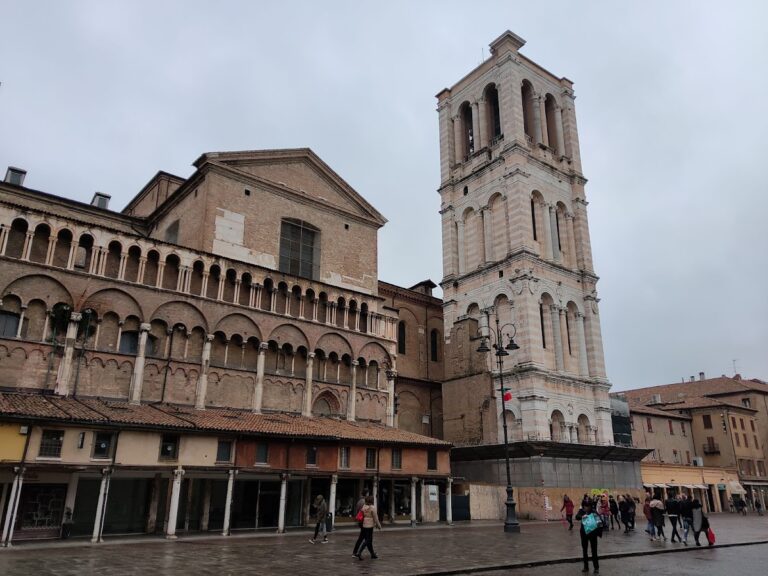
In 1300, Santo Stefano and Ferrara’s other parishes came under the direct authority of the cathedral chapter. The church’s bell tower also underwent a major change during the medieval period. An earlier tower partly collapsed in 1275, after which its belfry was rebuilt at a lower height.
Rebuilding and Oratorian administration
The earthquake that struck Ferrara in 1570 seriously damaged the church. Under the direction of the rector canon Don Antonio Angiari, Santo Stefano was restored and enlarged into a building with three naves. This rebuilding established much of the arrangement later modified by further interventions.
In 1657, responsibility for the parish passed to the Fathers of the Congregation of the Oratory of San Filippo Neri. Founded in the sixteenth century by Philip Neri, this Catholic community emphasized communal religious life, preaching, spiritual instruction, and pastoral work without monastic vows. The Oratorians commissioned or installed numerous works at Santo Stefano, including the mausoleum of General Costantino Ranieri, the altar dedicated to Saint Leo, and paintings by artists active in seventeenth-century Ferrara.
The Oratorian congregation was suppressed in 1796, but worship continued in the church. Since the official consecration records could not be found, Santo Stefano was consecrated again on 26 September 1824 by Cardinal Carlo Odescalchi. The ceremony was accompanied by the installation of the portal attributed to Biagio Rossetti and terracotta busts of Saint Stephen and the Virgin in niches on the facade.
Restoration and wartime destruction
In 1905, the exterior fronts were restored with the aim of recovering the church’s original Gothic appearance. The work included removing the plaster, rebuilding three pinnacles after the example of those at San Romano, and replacing an eighteenth-century rectangular window with a circular one modelled on San Giuliano. In the early 1930s, adjoining houses were removed from the apse area during the widening of Via Cortevecchia.
An aerial bombardment on the night of 2 September 1944 caused severe damage to Santo Stefano. The attack destroyed many works, among them Francesco Ferrari’s ceiling frescoes of 1882, frescoes by Virginio Monti, the high altar, the organ lofts, and Antonio Randa’s painting The Apparition of the Virgin to Saint Philip Neri. That painting had been commissioned after 1657 at the expense of Ferrara’s public authorities to avert further floods, reflecting the belief that Saint Philip Neri protected the city from flooding.
Restoration was completed in 1947, allowing the church to reopen for worship. Santo Stefano remains a Roman Catholic church belonging to the Archdiocese of Ferrara-Comacchio.
Remains
Santo Stefano has three naves, a presbytery, and a pentagonal apse. The building is constructed entirely of exposed brick. Its exterior fronts and bell tower retain Gothic lines despite repeated collapses, alterations, and stylistic restorations. The surviving fabric therefore brings together medieval forms, post-earthquake enlargement, later decorative campaigns, and reconstruction after the destruction of 1944.
Exterior and bell tower
Facade
The facade is organized around a gabled central body divided by a central blind arch and two lateral arches with curved “gooseneck” profiles. Two side sections, each crowned by volutes, complete the composition. A fourteenth-century terracotta cornice runs across the facade in two tiers of small arches.
At the center is a fifteenth-century rose window formed by a double wheel. Its decoration includes the rayed Christ monogram IHS and relief panels representing the Twelve Apostles. Two circular niches from the fifteenth century contain nineteenth-century terracotta busts of Saint Stephen and the Virgin.
Portal
The stone portal dates from the sixteenth century and is attributed to Biagio Rossetti, a Ferrarese architect and urban designer active around the turn of the sixteenth century. It was transferred from the demolished church of San Silvestro, which once stood in the area now occupied by the city hospital. The portal has pilasters with composite capitals, a classical entablature, a dedicatory plaque framed by volutes, and the Latin inscription DILECTUS PASCITUR INTER LILIA.
Lateral fronts and tower
The fronts of the side naves are shaped by blind arches and blocked pointed-arch windows. On the north front, the pointed arches carry terracotta decoration. The bell tower combines Romanesque forms in its lower levels with Gothic treatment in the belfry. Its upper section has a string course decorated with small terracotta arches and pointed-arch windows, while the spire, based on an octagon, was altered in the twentieth century.
Interior and devotional furnishings
Presbytery and choir
The interior reflects the enlargement after the 1570 earthquake, the late seventeenth-century work of the Oratorian fathers, and rebuilding after the 1944 bombardment. The choir contains Virginio Monti’s nineteenth-century altarpiece of the Martyrdom of Saint Stephen, set within eighteenth-century stucco decoration. Two late Baroque portals in the side walls of the presbytery are attributed to the local sculptor Pietro Turchi. The altar and the large organ lofts associated with the Strozzi organ are modern, while the curved marble balustrade dates from the eighteenth century.
Stucco and candelabra-style paintings decorate the pillars and arches of the main nave. Statues of Saint Gregory the Great and Saint Augustine by Pietro Turchi stand in niches on the counter-facade, the interior wall opposite the main facade. Near the presbytery are two paintings attributed to Giuseppe Avanzi, showing episodes from the life of Saint Philip Neri.
Right nave
The first altar in the right nave contains the relics of Saint Leo and Giacomo Parolini’s 1689 altarpiece, which depicts Saint Leo the Great, Saint Anthony of Padua, and Saint Francis of Paola. The second altar holds a seventeenth-century painting attributed to Antonio Randa, Saint Francis de Sales Approving the Rule of Saint Jeanne de Chantal, which survives in very poor condition. Avanzi’s Martyrdom of Saint Lawrence, dated 1714, occupies the third altar.
A polychrome stone mausoleum for General Costantino Ranieri stands against the end wall of the right nave. The funerary monument dates from the seventeenth century and belongs to the group of works associated with the Oratorian period.
Left nave
The first altar in the left nave contains a fifteenth-century fresco of the Madonna of Grace, backed by Ippolito Scarsella’s sixteenth-century painting of Saints John and Paul. The second altar bears a painting attributed to Ghedini, showing the Madonna placing the Christ Child in the arms of Saint Catherine of Bologna. A seventeenth-century wooden crucifix occupies the third altar. The church also contains works by Gandolfi and Paganini, as well as a work attributed to Cozza.
Chapel and uncertain relic identification
Saint Maurelius chapel
A chapel beneath the bell tower has a cross-vaulted ceiling with traces of a starry sky. Its walls preserve sinopias, reddish preparatory drawings made for fresco painting, together with a fragment of frescoes from the first half of the fourteenth century. The paintings depict the Stories of Saint Maurelius, a cycle attributed to Vitale da Bologna, a fourteenth-century painter associated with Gothic art in Bologna and northern Italy.
The Saint Maurelius frescoes were discovered and detached in 1949. They are now preserved at the civic museum in Casa Romei, while the chapel retains the related wall evidence and fragments.
Remains associated with Saint Leo
Human remains at the foot of the central altar in the right nave have an uncertain identification. Tradition associates them with Saint Leo, Bishop of Montefeltro, whose remains were transferred to Ferrara after his death. Another identification connects them with Saint Leo II, Bishop of Voghenza from 611 to 620. Confusion was increased by Giacomo Parolini’s seventeenth-century painting of Saint Leo the Great, but the remains do not belong to that pope, who is buried in Saint Peter’s Basilica in the Vatican.