Ribe Cathedral: Denmark’s First Christian Church and a Romanesque Cathedral


Site at a Glance
- Rating
- 4.6
- Popularity
- Medium
- Country
- Denmark
- Primary era
- Medieval
- External website
- Open
- Eras represented
- Medieval, Early Modern, Modern
- Civilizations
- Danish
- Site type
- Religious
- Remains
- Cathedral
On this page17 sections
History
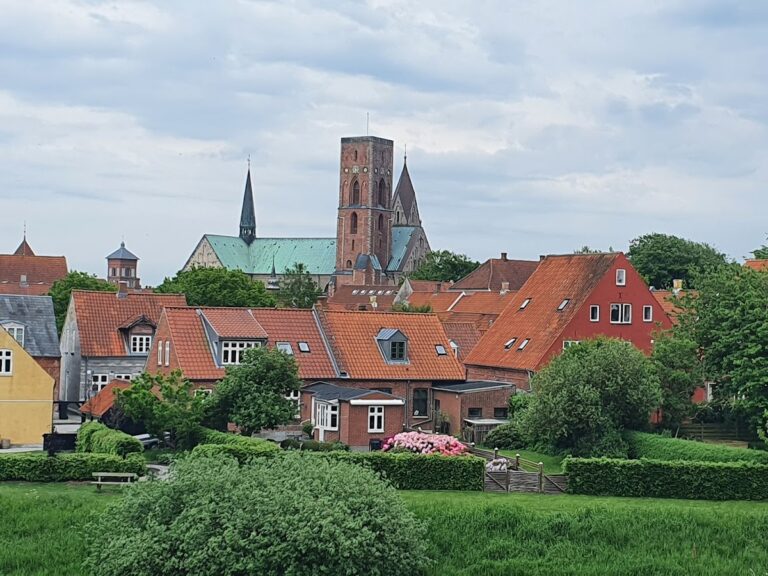
Ribe Cathedral is a cathedral in Ribe, Denmark, founded in 860 as the country’s first Christian church by Ansgar, a missionary monk from Hamburg who later became Archbishop of Hamburg. The permanent cathedral that followed was built in the Romanesque period, and the building still combines that medieval tradition with later Gothic and modern elements. Dedicated to the Virgin Mary, it is now the active cathedral church of the Church of Denmark and the seat of the Diocese of Ribe.
The first Christian mission
Ansgar established the first church with the permission of the pagan King Horik I. It stood south of the Ribe River, opposite the market, and was made of timber. Its bells caused concern because people feared that their sound would frighten away land spirits. The church was consequently closed during the early Christian mission, but it reopened after Ansgar gained the friendship of the younger King Horik II.
After Ansgar’s successor, Rimbert, died in 888, the Danish mission collapsed. The missionaries left, and the church was burned in an attempt to erase the memory of the foreign religion. Ribe later became a diocese in 948 under the authority of the Archbishop of Hamburg. Its first bishop, Leofdag, was killed that year while crossing the river near Ribe. He was never formally canonized, but local people venerated him as a saint until the Reformation, and his remains eventually came to Ribe Cathedral.
The medieval cathedral
Ribe grew from a trading market into an international commercial centre during the Viking Age, with connections across northern and western Europe. The town’s prosperity helped pay for major work at the cathedral. Bishop Thur began the first stone cathedral in 1110, and construction was completed in 1134. In 1145, Bishop Elias founded the cathedral school and chapter, the body of clergy assisting with cathedral worship and administration, and oversaw the building’s completion and consecration.
Royal burials further increased the cathedral’s standing. King Erik II of Denmark, murdered at the Urnehoved Assembly in July 1137, was buried there. King Christoffer I was also buried in the cathedral in 1259, after dying suddenly on 29 May. A rumour blamed Abbot Arnfast of Ryd Abbey for poisoning him with communion wine.
A major fire damaged Ribe and the cathedral in 1176. Instead of being wholly rebuilt, the church was repaired and enlarged, supported by the wealth of the town. During the same period, Ribe’s citizens built a second town wall. On Christmas Day 1283, shortly before morning Mass, the cathedral’s northwest tower collapsed into the church and surrounding streets, killing several people. The tower was replaced by the much larger Commoner’s Tower, completed in 1333. Its upper floors served as a city archive and watchtower, while eight cannons were later installed there during the Danish-Swedish wars. They fired on Swedish ships in 1644.
Part of the cathedral burned in 1402, after which the surrounding auxiliary buildings were restored and enlarged with brick. Prince Christoffer of Bavaria was proclaimed King of Denmark at the Viborg Assembly on 9 April 1440, and his coronation took place in Ribe Cathedral on 1 January 1443.
Reformation and early modern changes
Denmark became officially Lutheran in 1536. The cathedral was closed, its monks were expelled, and the building suffered vandalism and neglect. In 1560, the remaining Roman Catholic statues, artworks, altars, and decorations were removed, while medieval wall paintings were covered with plaster.
Hans Tausen, a leading Danish Lutheran reformer, served as Ribe’s Lutheran superintendent and bishop from 1542 until his death in 1561. His later memorials in the cathedral recall his role in the Danish Reformation. A town fire on 3 September 1580 destroyed Ribe’s centre but caused no serious damage to the cathedral. The Commoner’s Tower partially collapsed in 1594 and was rebuilt ten metres lower, without its spire. It thereafter had a flat top.
Between 1595 and 1597, the cathedral received a new pulpit carved by Jens Asmussen of Odense. A storm surge on the night of 11–12 October 1634 flooded Ribe, the surrounding farmland, and the cathedral up to the level of the pulpit. Known as the Great Drowning, the disaster killed many people and animals, and about 8,000 people may have drowned. Later that year, a new organ replaced the old one. A large clock was installed in the Commoner’s Tower in 1696.
Restoration and modern use
Hans Adolf Brorson became Bishop of Ribe in 1741. He was one of the city’s best-known Lutheran bishops and a hymn writer whose work became part of Danish church tradition. The cathedral was restored in 1843, when its floor was lowered by half a metre. A comprehensive restoration from 1883 to 1904 sought to return each section to its original style as far as possible.
Three new doors, including a bronze main entrance, were made by Anne Marie Carl-Nielsen in 1904 to commemorate the restoration. From 1939 until his death in 1952, the late-Romantic composer Rued Langgaard served as the cathedral’s organist. His unconventional music gained wider recognition only after his death.
From 1983 to 1987, the artist Carl Henning Pedersen redecorated the apse. The proposal caused substantial controversy and was presented at a public exhibition, where approximately half of 10,000 visitors supported it. The local parish council eventually approved the project, which became an important precedent for introducing modern decoration into medieval Danish churches.
Remains
Ribe Cathedral is regarded as Denmark’s best-preserved Romanesque building, although its fabric also contains later Gothic work and several artistic traditions. The first permanent cathedral used tufa imported from Germany because suitable building stone was scarce around Ribe. Its design followed northern German Romanesque models, with heavy masonry, semicircular arches, a central nave flanked by lower aisles, and a flat timber ceiling. After the fire of 1176, large red bricks were used to repair and expand the surviving structure. The nave gained double aisles on each side, and some earlier ceilings were raised and replaced with Gothic stone vaults.
Entrances and medieval sculpture
The main portal
The late-twelfth-century main portal is known as the Cat’s Head Portal. Two lions stand at the bases of the columns beside the doorway, while the relief above shows Jesus being taken down from the cross. About fifty years earlier, a triangular relief of the Last Judgment had been placed above the main entrance. It is considered one of the largest surviving Romanesque granite reliefs.
Towers and bells
The Commoner’s Tower
The Commoner’s Tower replaced the northwest tower that collapsed in 1283. Its lower levels belonged to the church, while its upper floors served municipal purposes as an archive and watchtower. Completed in 1333 at a height of 62 metres, it was originally capped by a copper Rhenish helmet, a tall rising roof associated with church architecture in the Rhineland, and a narrow spire. After the partial collapse of 1594, it was rebuilt ten metres lower with a flat roof. The tower later held eight cannons and a large clock installed in 1696.
The cathedral bells
The two towers contain six bells. The oldest dates from the fifteenth century and was cast by Hinrik Dobbran. The other bells were made by Melchior Lucas in 1599, J. N. Bieber in 1770, Jac. Fr. Beseler in 1847, P. P. Meilstrup the Elder in 1858, and P. P. Meilstrup the Younger in 1869.
Interior furnishings and memorials
Organ and altar
The organ facade comes from Johan Heide’s 1635 organ. Heide worked as an organ maker in Flensburg from 1615 to 1641 and had trained under the royal organ maker Nicolaus Maas. The instrument was expanded and modernized repeatedly. Frobenius built a new organ in 1973 and enlarged it in 1994, producing an instrument with 50 voices. The main altarpiece was painted by Ebbe Jehn Petersen, and a model of the ship Marie, made by Ribe captain B. Cl. Jensen, hangs at the crossing, the area where the nave and transept meet.
Wall paintings and epitaphs
The nineteenth-century restoration removed plaster layers from the walls, with the loss of many medieval frescoes. Surviving paintings include the Virgin and Child in the nave, Saints Andrew and Bartholomew on a pillar, and Saint George and the Dragon in the north transept. Several historical epitaphs, memorial inscriptions or monuments to the dead, remain in the cathedral. The oldest was erected by King Valdemar for his son in 1231.
The south transept contains Admiral Albert Skeel’s chapel, built partly of sandstone and decorated with fine wood carvings. The cathedral also preserves the gravestone of King Christoffer I from 1259 and a portrait gravestone for Iver Munk, the last Roman Catholic bishop of the Diocese of Ribe. Hans Tausen is buried in the church, where his epitaph hangs; his gravestone was moved beside the entrance to the Commoner’s Tower. Hans Adolf Brorson is also buried in the cathedral.
Later artistic features
Apse decoration
The apse, the curved termination of the church behind the altar, was redecorated by Carl Henning Pedersen between 1983 and 1987. Pedersen was a member of the COBRA art movement, and the work introduced modern artistic decoration into the medieval interior.
Maria Tower and baptismal font
A statue of Hans Tausen stands at the base of the Maria Tower. Inside the cathedral is a bronze baptismal font dated 1375, another surviving feature from the building’s long medieval history.
Nearby sites