Basilica di San Tommaso Apostolo: Cathedral Basilica and Shrine of Saint Thomas in Ortona


Site at a Glance
- Rating
- 4.6
- Popularity
- Low
- Country
- Italy
- Primary era
- Medieval
- External website
- Open
- Eras represented
- Medieval, Early Modern, Modern
- Civilizations
- Kingdom of Naples, Kingdom of Sicily, Norman
- Site type
- Religious
- Remains
- Cathedral
On this page15 sections
History
Basilica di San Tommaso Apostolo is a Catholic basilica in Ortona, Italy, and serves as the cathedral basilica and co-cathedral of the Archdiocese of Lanciano-Ortona. The church is dedicated to the Apostle Thomas and stands on the site of an ancient Roman temple. Its consecration is associated with the early Christian period, while its long history has been shaped by destruction, rebuilding, and its connection with the apostle’s relics.
Early church and medieval rebuilding
The first church was destroyed by the Normans in 1060. After an earthquake caused further destruction, it was rebuilt and reopened on 10 November 1127 under the dedication of Santa Maria degli Angeli. An inscription now preserved in the diocesan museum records that dedication. The building’s later medieval form included elements associated with Norman and Swabian architecture, the latter reflecting Hohenstaufen rule in southern Italy and its preference for carefully carved stone and Gothic forms.
Ortona became a diocese in 1570, and the church then became the city’s cathedral. Giandomenico Rebiba became its bishop. In December 1859, Pope Pius IX granted the church the title of minor basilica, an honorific status recognizing a church’s religious or historical importance.
The arrival and protection of Saint Thomas’s relics
On 6 September 1258, the relics of Saint Thomas and his tombstone arrived in Ortona from the Greek island of Chios. Leone, an Ortonese commander, brought them aboard one of three galleys taking part in Manfred’s military expedition under the admiral Filippo Chinardo. The transfer established the church as a place of prayer and pilgrimage connected with the apostle.
A parchment prepared at Bari in 1259 by the notary Giovanni Pavone confirms the arrival. A later account by the Ortonese physician and writer Giambattista De Lectis describes the removal of the remains and tombstone from a church on Chios. In 1475, several Ortonese nobles tried to take the relics to the Lord of Venice. Their attempt failed, and the relics were then secured behind iron bars and chains. The number of keys was increased from one to five, while custody was shared between two city councillors elected by the municipal council and canons selected by the bishop.
The church also served as the setting for an important civic event. On 17 February 1427, peace between Lanciano and Ortona was solemnly proclaimed there through the mediation of Giovanni da Capestrano, a fifteenth-century Franciscan friar and preacher.
Attacks, restoration, and the modern cathedral
Ottoman forces commanded by Piyale Pasha, a sixteenth-century admiral, attacked Ortona and set fire to the church in 1566. The relics survived, although later tradition holds that the tomb and remains were desecrated. Renovation followed the creation of the diocese in 1570. A first silver reliquary bust of Saint Thomas had already been stolen by mercenary troops in 1528. A second bust was taken and melted down by French forces after their attack and desecration of the cathedral in 1799.
The greatest destruction came during the German occupation and the fighting at Ortona in 1943 and 1944. The cathedral was almost completely destroyed, with the sacristy barely left standing. On 5 November 1943, diocesan vicar Luigi Carbone, parish priest Pietro Di Fulvio, and Don Tommaso Sanvitale arranged for the silver bust of Saint Thomas to be hidden inside the second floor of the bell tower. The masons Nicola Di Fulvio and Peppino Valentinetti carried out the concealment.
After the fighting had moved away from Ortona, Monsignor Tesauri, archbishop of Lanciano and bishop of Ortona, ordered the altar above Saint Thomas’s tomb to be demolished on 11 January 1944. The reliquary was recovered, and the relics were carried in procession to the parish priest’s house in the Castello district. Fragments of the former main doorway and Gothic portal were also gathered from the ruins. The silver bust was removed from its hiding place and displayed publicly again on 16 July 1945. The other relics were found intact beneath the altar.
The rebuilt cathedral reopened for worship and was rededicated on 5 September 1949 by Bishop Gioacchino Di Leo and Cardinal Federico Tedeschini. The rebuilding restored the church’s religious function while incorporating surviving medieval material. The first nucleus of the diocesan museum was assembled after the Second World War to protect artworks from the cathedral and other local churches that had survived the destruction of Ortona. It opened as the Cathedral Museum on 3 May 1980 and became part of the Diocesan Museum of Lanciano-Ortona after restoration and rearrangement in 2003.
Continuing devotion and examination of the relics
Saint Thomas is venerated with the Madonna del Ponte as co-patron of the Archdiocese of Lanciano-Ortona. His liturgical feast falls on 3 July. The principal local patronal celebration takes place on the first Sunday of May and is called the Perdono, a religious observance associated with a papal grant of a plenary indulgence.
The cathedral hosted the statue of the Madonna del Ponte on 3 June 2005 during the Eucharistic-Marian Year. From 1 to 15 December 2009, it housed the relics of Pope Celestine V during the Celestinian Jubilee.
A scientific examination of Saint Thomas’s relics took place from 12 September 1983 to 25 April 1986, involving specialists from the University of Chieti. The work included opening the sarcophagus and reliquary, examining the bones, determining their sex, age, and period, studying pathological conditions, reorganizing the remains, and conducting histological and histochemical tests. The examination identified a gracile adult male approximately 160 ± 10 centimetres tall and between 50 and 70 years old. The bones showed evidence of a rheumatic disease probably corresponding to ankylosing spondylitis. A fracture of the cheekbone indicated an injury from a sharp, well-honed implement rather than a heavy blow. The remains were conserved, reassembled, and returned beneath the crypt altar.
Earlier examinations followed the attacks of 1566 and 1799, and another took place on 20 January 1944 after Ortona’s liberation. Further studies in 1952 and 1958 produced a systematic technical inventory of the bones. The 1944 verification established that both the relics beneath the altar and the concealed silver bust had escaped damage. A separate study examined whether a radius preserved in the Basilica of San Nicola in Bari could belong to the same individual. Its estimated height of 163.40 centimetres was considered statistically compatible with the Ortona estimate, as was the absence of the left radius from the Ortona remains.
Remains
Layout and exterior
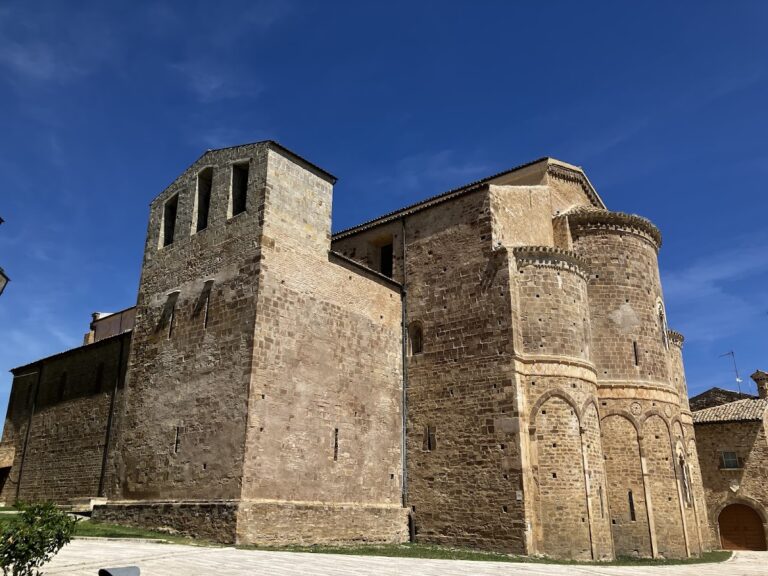
The pre-war church had a Baroque Latin-cross plan, meaning a long nave crossed by a shorter transept. The present building follows a longitudinal arrangement comparable to major Apulian basilicas developed in the early thirteenth century. Its postwar exterior combines reconstructed portions with medieval elements recovered from the ruins.
Facade and portals
The eighteenth-century facade, its half-dome, and the fourteenth-century portico with nine columns were destroyed during the Second World War. The facade was rebuilt in 1947 with surviving and recovered material. Before the destruction, it had two classical rib-shaped buttresses ending in hook-like forms, a central rectangular window, and a medieval main portal enriched with Baroque decoration. A portico with broad arches stood before it.
The secondary portal from the Swabian period survived the wartime destruction. The main portal facing the square was reconstructed from fragments recovered from the ruins. Attributed to Nicola Mancini and dated 1311, it is set on the church’s longitudinal axis and made from carefully worked stone. Its lunette, the semicircular field above the doorway, depicts the Virgin and Child with John the Baptist and John the Evangelist.
Limestone from ancient coastal quarries was used from at least the thirteenth century. The stone resisted salt and moisture carried from the sea and could be finely carved with the vegetal and geometric decoration associated with Norman-Swabian work. Pointed arches, Swabian-period capitals, and Gothic windows with trefoil tracery, a three-lobed window pattern, survive in the facade. The apse, the rounded end of the church, dates from the fourteenth century.
Bell towers and dome
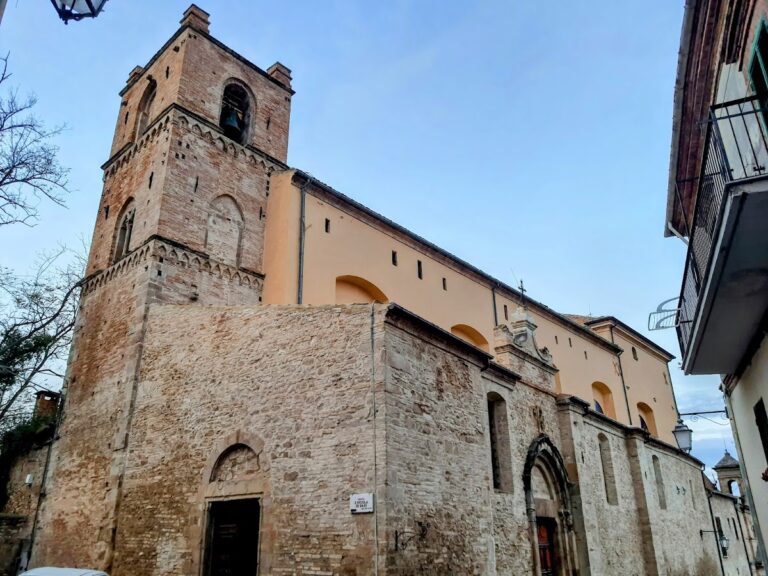
A medieval tower on the left side of the former facade was reused as a clock tower and equipped with two bells for striking the hours. A separate tower on the right was smaller and rectangular, with three arches on its principal side and two larger arches on its left side. The rebuilt bell tower contains a large B-flat-2 bell cast in 1605 by the Paolucci brothers of Chieti. It measures 168 centimetres in diameter and 200 centimetres in height.
The earlier dome was lower and wider than the present one, which rises more narrowly and vertically. Eighteenth-century paintings and photographs from the early twentieth century preserve evidence of the former interior frescoes. These decorations were reconstructed in the rebuilt church. The chapel and crypt of Saint Thomas retain the same position they occupied in the earlier building, although the former niche had additional fresco decoration.
Interior and sacred spaces
Nave, apse, and sacristy
The central nave vault dates from the eighteenth century, while the apse vault is fourteenth-century. To the left of the high altar, the old sacristy contains console heads that support the ribs of its sail vault, a curved vault rising from a polygonal or square base. The dome frescoes are by Luciano Bartoli. Antonio Piermatteo painted the figure of Saint Matthew, described as the only original figure to survive the German destruction; the remaining frescoes were reconstructed.
The fourteen Stations of the Cross were made by the Ortonese artist Stefano Durante. A hanging crucifix in the crypt was created by the sculptor Aldo D’Adamo. These works belong to the reconstructed interior and its later artistic furnishing.
Crypt and relics of Saint Thomas
Below the presbytery, the area around the main altar traditionally reserved for the clergy, the crypt contains the relics of Saint Thomas, a gilded copper urn, and the apostle’s tombstone with a Greek inscription. The urn and its effigy were made in 1612 by the Ortonese painter Tommaso Alessandrini. The remains were returned beneath the crypt altar after the scientific examination of 1983 to 1986.
Chapel of Saint Thomas
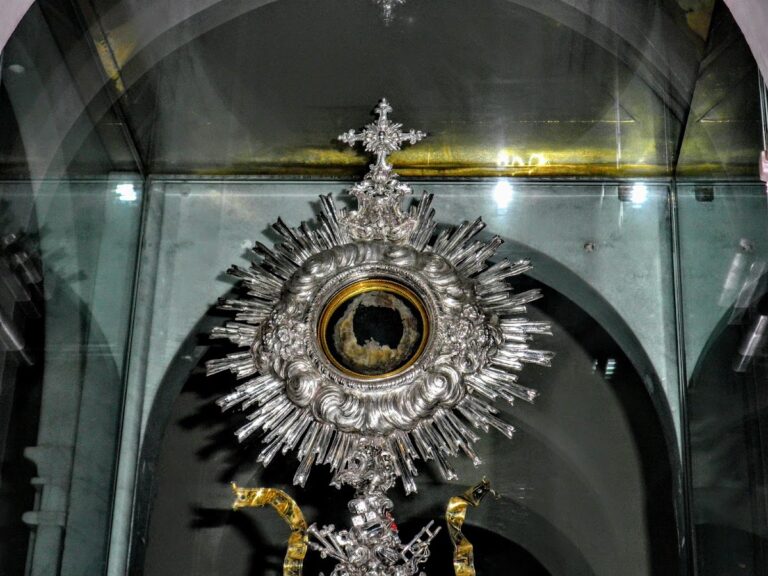
The Chapel of Saint Thomas contains nineteenth-century stucco bas-reliefs by Vincenzo Perez. Two ceramic panels by Tommaso Cascella depict the Ortonese at Chios and the arrival of the apostle’s relics in Ortona. The chapel also preserves the third silver reliquary bust of Saint Thomas, made by the Pani foundry in Naples in the nineteenth century. It contains fragments of the apostle’s skull.
Chapel of the Blessed Sacrament
The Chapel of the Blessed Sacrament contains two high-relief stucco works by Vincenzo Perez, depicting the Last Supper and Sinite Parvulos. Both were made during the first half of the nineteenth century. Two oil paintings by Franco Sciusco date from 1985.
Diocesan museum
The diocesan museum occupies three large rooms that formerly served as chapels connected to the cathedral. Its collection includes artworks from the twelfth through the nineteenth centuries. The works came from the cathedral and other religious buildings in the surrounding territory and were preserved after the wartime destruction of Ortona.