Basilica of St. Quirinus: A Late Romanesque Pilgrimage Church in Neuss


Site at a Glance
- Rating
- 4.6
- Popularity
- Low
- Country
- Germany
- Primary era
- Medieval
- External website
- Open
- Eras represented
- Classical, Medieval, Early Modern
- Civilizations
- Holy Roman Empire, Roman
- Site type
- Religious
- Remains
- Basilica
On this page21 sections
History
The Basilica of St. Quirinus is a Roman Catholic church in Neuss, Germany, built by a medieval religious community in the late Romanesque period between 1209 and 1230. Dedicated to Quirinus of Neuss, a third-century Roman martyr and the city’s patron saint, it became an important pilgrimage church on the Lower Rhine.
Roman and Early Medieval Origins
The church stands above a Roman cemetery connected with the settlement founded south of present-day Neuss by a Roman legion in 16 BC. Finds from the area suggest that Christians may have lived among the Roman population. Around 850, a monastery was probably established on or near the former cemetery, although its survival during the Norman invasion of 866 remains uncertain.
A church at the site appears in a document of 1043 recording a donation by Emperor Henry III. The same document provides the earliest known association between Quirinus and Neuss. During the second half of the twelfth century, the religious community was transformed into an aristocratic women’s collegiate foundation under the patronage of Quirinus. The foundation also owned the Quirinushof estate, known locally as Kringshof or Jungfernhof, in present-day Oberkassel.
The Quirinus Cult and the Medieval Rebuilding
An old tradition says that Abbess Gepa, sister of Pope Leo IX, brought the remains of Quirinus from Rome to Neuss in 1050. The relics drew substantial numbers of pilgrims, and the prosperity associated with the pilgrimage may have helped pay for the replacement of several earlier buildings.
Construction of the present church began on 9 October 1209 and ended in 1230. Its foundation stone names Master Wolbero as builder, together with Adolf of Altena as archbishop of Cologne, Sophia of Altena as abbess, and Otto IV as emperor. Adolf had already been deposed when the inscription was made, but it continued to use his archiepiscopal title, perhaps as a courtesy to his sister Sophia. Because the church also served as the burial place of a bishop, the rebuilding may have included the creation of a prestigious tomb.
The design drew on churches in Cologne, especially St. Maria in Capitol, Groß St. Martin, and St. Aposteln. Their Romanesque choirs and three-conch arrangements influenced the new building, which became the last major church constructed in the Rhenish three-conch tradition. Its form also illustrates the transition from Romanesque architecture toward Gothic forms.
Fire, War, and Alteration
The west tower once rose almost 100 metres and dominated the Neuss skyline until the eighteenth century. Lightning destroyed its bells in 1496. In 1741, another lightning strike caused a serious fire. The Gothic spires of the west tower and crossing tower, along with several small gallery structures, were not rebuilt. Instead, the church received Baroque alterations, including a dome topped by a statue of Quirinus and a flatter roof on the principal tower. The west tower was lowered by more than 30 metres.
During the French Revolutionary and Napoleonic period, the church was looted and converted into a storage building. The monastery buildings were demolished, and objects removed for safekeeping before the French occupation either failed to return or were destroyed.
A tower fire damaged the building again in 1914. Bombing in 1944 caused further destruction, and several people sheltering in the crypt were killed. Repeated restoration campaigns have since preserved the approximately eight-hundred-year-old church in very good condition.
Modern Religious and Civic Associations
Pope Benedict XVI elevated the church to a Basilica minor on 6 October 2009, at the request of Joachim Cardinal Meisner, archbishop of Cologne. This papally granted title recognizes a church’s particular religious and historical importance. The basilica remains associated with the Roman Catholic Archdiocese of Cologne and continues its dedication to Quirinus of Neuss.
The church is also the home parish of Josef Cardinal Frings, former archbishop of Cologne, who celebrated his first Mass there. A bronze statue of Frings was placed beside the church in August 2000. A plaque bearing the arms of Benedict XVI was installed at the organ gallery on 29 June 2010.
Remains
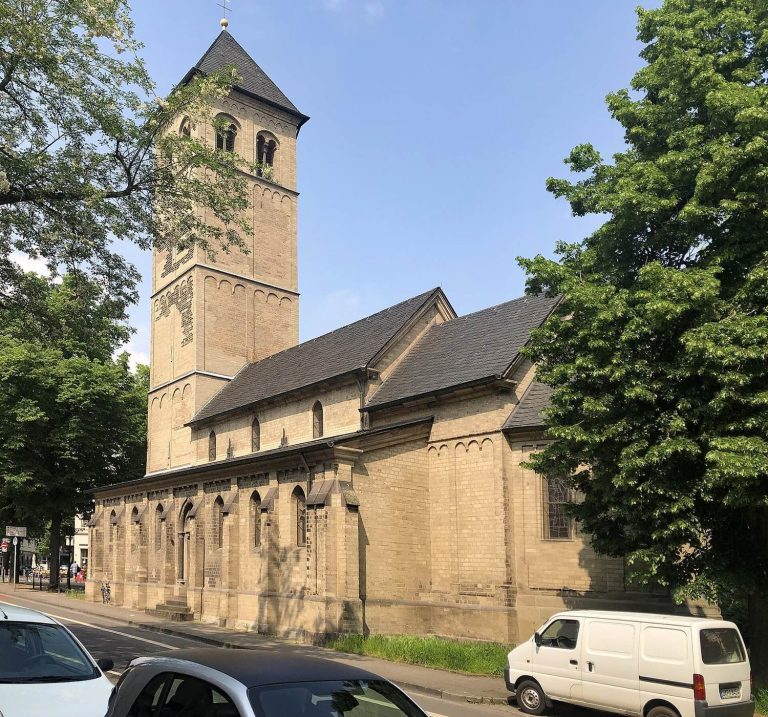
The Basilica of St. Quirinus is a three-aisled gallery basilica with two transepts and a three-conch plan. In this arrangement, the main apse and the apses at the ends of the transepts are rounded. The building is regarded as a major example of late Romanesque architecture in the Lower Rhine, while its pointed arches and other features reveal the emergence of Gothic design. Light-coloured tuff contrasts with black basalt, both quarried in the nearby Eifel and carried to Neuss by ship along the Rhine.
Choir, Towers, and Exterior
Choir and Crossing Tower
The choir contains two-storey apses articulated by applied blind arches, decorative arches that do not open into the interior, and topped by dwarf galleries. These galleries stop short of the corners, leaving the corners of the crossing tower visible. At gallery level, the tower continues the choir’s pattern through small paired arcades and rises through two additional storeys with small triangular gables.
Westwork and West Tower
The monumental western part of the church, or westwork, contains pilasters, broad blind arcades, and arched friezes. These elements have Lombard origins and are used on an unusually extensive scale here. The lower façade suggests that the original design may have envisaged two towers, while the middle section leads toward a simpler central tower. Pointed arches in the tower reflect the influence of the developing Gothic style.
The west tower originally reached almost 100 metres and was the tallest tower in the Rhineland. The 1741 fire reduced it by more than 30 metres, after which it received a flat pyramidal roof. The crossing tower was crowned instead by a Baroque dome about 45 metres high, topped with a statue of Quirinus.
Portals
The main portal was reserved for the abbess and senior clergy. Pilgrims and the wider population used the more elaborately developed south portal. Since 1995, that entrance has contained a work by the Cologne sculptor Elmar Hillebrand, donated by the Neuss Civic Marksmen’s Association. Its figures represent the regiment’s patron saints and give a sculptural impression of marksmen’s activities.
Interior and Early Remains
Nave and Gallery Basilica
The interior is unusually tall. Its three-part wall elevation consists of arcades, an open gallery above the aisles, and a clerestory, the upper nave wall pierced by windows. The clerestory includes unusual fan-shaped and keyhole-shaped windows. The galleries also provided space for pilgrims.
Crypt and Roman Remains
The crypt beneath the altar is the oldest surviving part of the church. It contains two columns dating from around 1050 and floor remains from the ninth century. Beneath the building, the remains of a Roman-period apse form part of a cella memoriae, an ancient commemorative structure associated with the remembrance of the dead. The remains can be seen through a glass panel in the present floor. A Roman sarcophagus with a Late Romanesque tomb slab is also preserved inside the church.
Lantern Tower
Above the altar rises one of Central Europe’s tallest lantern towers, a raised tower over the central space that admits light through windows. Its square lower stage has blind arcades and pendentives, curved triangular surfaces that support a dome over a square plan. The octagonal upper stage contains window openings and ends in a ribbed, umbrella-shaped dome with a central oculus.
Shrine and Sacred Furnishings
Quirinus Shrine
The apse contains the Quirinus shrine made in 1900 by Bernhard Witte, a goldsmith from Aachen. It holds the saint’s relics and rests on a slab supported by four stone prophets from the former high altar, made by Hein Minkenberg. The shrine replaced one made in 1597, now kept in the Clemens Sels Museum. An earlier medieval shrine was destroyed in 1585.
Two nineteenth-century candle stands beside the shrine commemorate the successful defence of Neuss during the siege by Charles the Bold, the fifteenth-century duke of Burgundy. Behind the shrine stand a tintinnabulum, a ceremonial bell, and a conopeum, a processional canopy. These are traditional insignia of a Basilica minor. The shield on the bell bears nine round forms, including a beehive-shaped bell. The nine spheres were a fourteenth-century symbol of Quirinus of Neuss.
Altars and Sculptures
A sixteenth-century statue of Quirinus stands at the southern side altar. It portrays him as a knight with shield and lance and belongs to the workshop circle of the Cologne sculptor Tilmann van der Burch. A forked crucifix dated 1360, known as a plague cross, is attached to a northern nave pillar. It depicts Christ suffering with sores.
The late Gothic Beautiful Madonna, dated approximately 1400 to 1430, is an important example of the Rhineland’s Soft Style, an international Gothic manner marked by graceful figures, flowing drapery, and gently curved forms. Other works include an early sixteenth-century Anna Selbdritt, showing Saint Anne with the Virgin Mary and the infant Jesus, a Pietà from around 1430, a Baroque statue of Matthias, and a sixteenth-century figure of Peter on the southern nave pillars.
A large wooden cross made in 1592 hangs at the centre of the nave at the height of the organ gallery. Its representation of Christ is notably dynamic. The apses contain large wall paintings created in 1863 and 1864 by Franz Ittenbach, a Düsseldorf painter associated with the Nazarene movement’s religiously serious revival of earlier European art.
Later Furnishings
The Joseph altar in the northern aisle was erected in 1871 for the silver pontifical jubilee. It includes a sculptural image of Pope Pius IX kneeling in prayer, reflecting an early connection between the church and Rome. A larger-than-life statue of St. Christopher by Hein Minkenberg, dated 1936 to 1937, stands beside the portal at the pillar of the northern west tower. Elmar Hillebrand created the tabernacle, ambo, rood screen, and Stations of the Cross.
The fifteenth-century choir stalls are located in the northern and southern apses and were partly destroyed during the Second World War. Beneath the dome stands a modern people’s altar made from Portuguese Aurora marble. Hillebrand created it in 1970, and Cardinal Frings consecrated it on 12 January 1971. Shallow reliefs beneath tall arcades on its four sides depict the Nativity, Christ’s crucifixion, the Resurrection, and the Second Coming.
Organ and Bells
Organ
The large organ was built in 1907 by Ernst Seifert of Cologne-Mannsfeld and Kevelaer. It originally had 78 stops on three manuals and pedal, with pneumatic membrane chests, and stood on the two side galleries. After the 1914 tower fire, it was electrified and given a new console on the north gallery. It was removed for protection in 1942, repaired in 1947 with a brighter tonal arrangement and another new console, and expanded with a fourth manual in 1955.
Cleaning in 1993 and 1994 included placing the swell division in a new solid-fir case and repainting the organ case. The instrument now has 85 speaking stops on four manuals and pedal with pneumatic actions, making it one of the largest organs in the Archdiocese of Cologne. Romanus Seifert & Sohn comprehensively restored and cleaned it in 2015, installing a new standard-compliant console and an electronic setter system. The system stores thousands of registration combinations, permits remote tuning by one person, and allows performances to be recorded and replayed. Nonfunctional façade pipes added in the 1930s were removed so that the sound could enter the nave more freely.
Bells
The tower contains seven bells and has room for an eighth. The bells are among the largest peals in the Archdiocese of Cologne. During later renovations, many sound openings were closed to reduce sound emissions, allowing the sound to mix within the bell chamber before directing it outward. Two large bells cast in 1922 survive from an original six-bell peal, which was expanded to seven bells after the Second World War. The Quirinus bell remained out of service because of damage from May 2012 until December 2016. The peal’s musical motif is Te Deum laudamus.