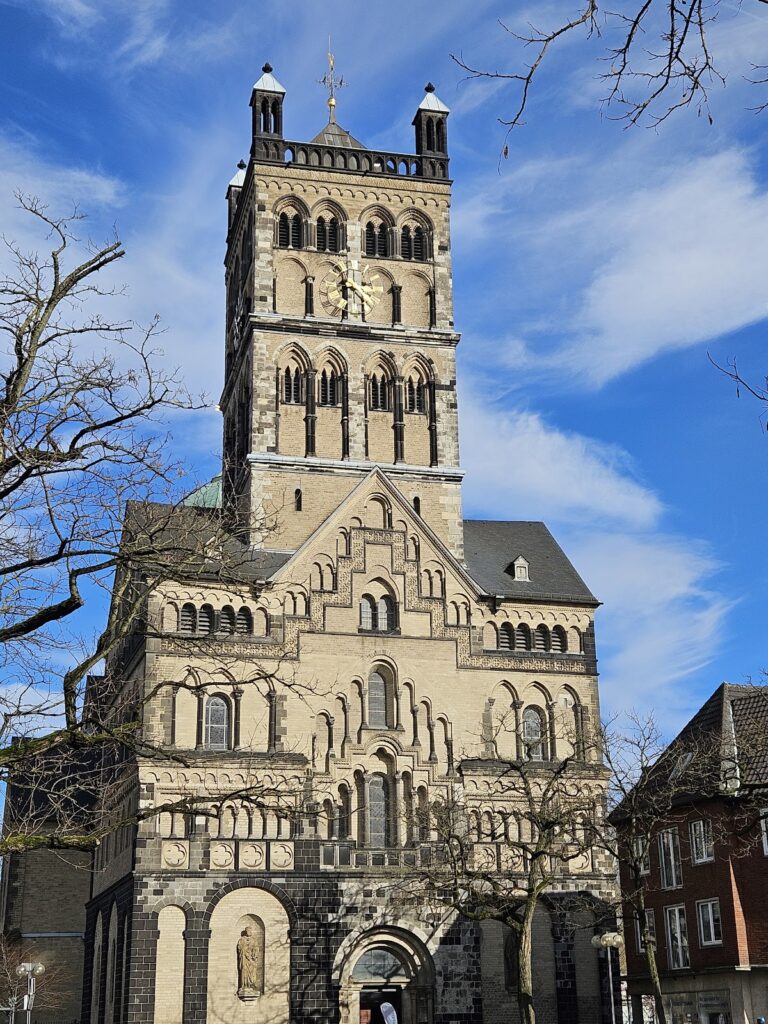
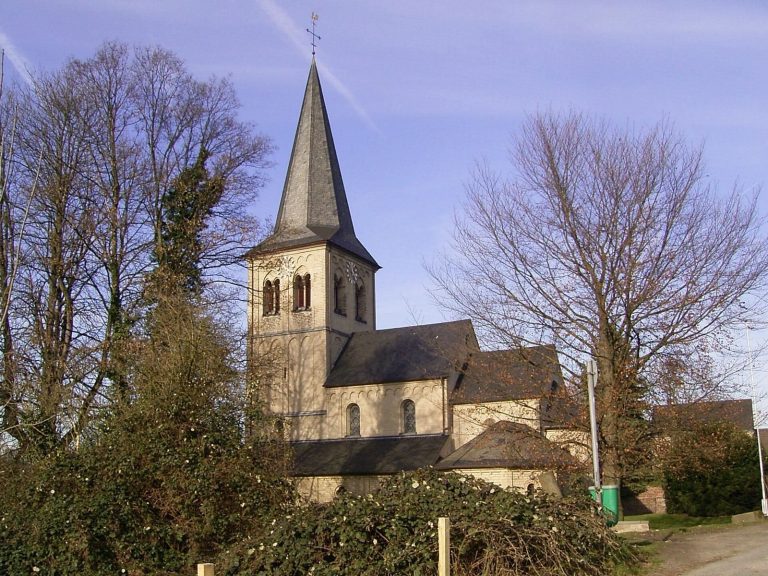
Alt St. Martin: Düsseldorf’s Oldest Surviving Church
Site at a Glance
- Rating
- 4.4
- Popularity
- Very Low
- Country
- Germany
- Primary era
- Medieval
- External website
- Open
- Eras represented
- Medieval, Early Modern, Modern
- Civilizations
- Carolingian, Duchy of Berg, Holy Roman Empire
- Site type
- Religious
- Remains
- Church
On this page8 sections
History
Alt St. Martin is the oldest surviving church and building in Düsseldorf, Germany. Its origins reach back to the Carolingian period, the era of the Frankish Carolingian dynasty in the eighth and ninth centuries, when Bilk was still a village. Archaeological evidence dates the first church to around 700. Until 1206, it probably also served as the parish church for neighboring Düsseldorf.
From the Carolingian chapel to the Romanesque church
The original church was destroyed by fire sometime between 788 and 919, during incursions by Saxons, Normans, or Magyars. Around 1000, a three-aisled basilica was built on the same site, incorporating surviving parts of the earlier building. A basilica is a longitudinal church with a central nave flanked by side aisles. The building developed further between 1150 and 1200, when its tower was constructed, and around 1200, when an apse, a rounded eastern termination, a small rectangular choir, and vaulting were added.
Loss and recovery of its religious role
By the early nineteenth century, the church had become so structurally unsound that abandonment was considered. From 1812, the nearby Loreto Chapel served as Bilk’s parish church, and Alt St. Martin lost its parish function. For more than a century, the former church was used as a barn and textile workshop. An attempted sale failed, while the district government refused permission for demolition because the tower served as a widely visible surveying point.
Recognition of the building’s historical value grew in the mid-nineteenth century. A committee of Bilk citizens raised money for initial preservation work, followed by a comprehensive restoration by the architects Rincklake and Pickel between 1879 and 1881. A hurricane destroyed the tower spire in 1924. The spire and the left side aisle were damaged again during the Second World War, with repairs completed by 1951. A further major renovation took place from 1962 to 1974 and included modern artworks in the interior.
Religious use and protection
After the Second World War, Alt St. Martin returned to religious use. Catholic services of the St. Bonifatius parish and Protestant services of the Luther Church congregation are regularly held there. The church is associated with both Roman Catholic and Protestant traditions. On the Catholic side, it belongs to the Archdiocese of Cologne, the Roman Catholic jurisdiction headed by an archbishop. Alt St. Martin is also protected as a monument in North Rhine-Westphalia.
Remains
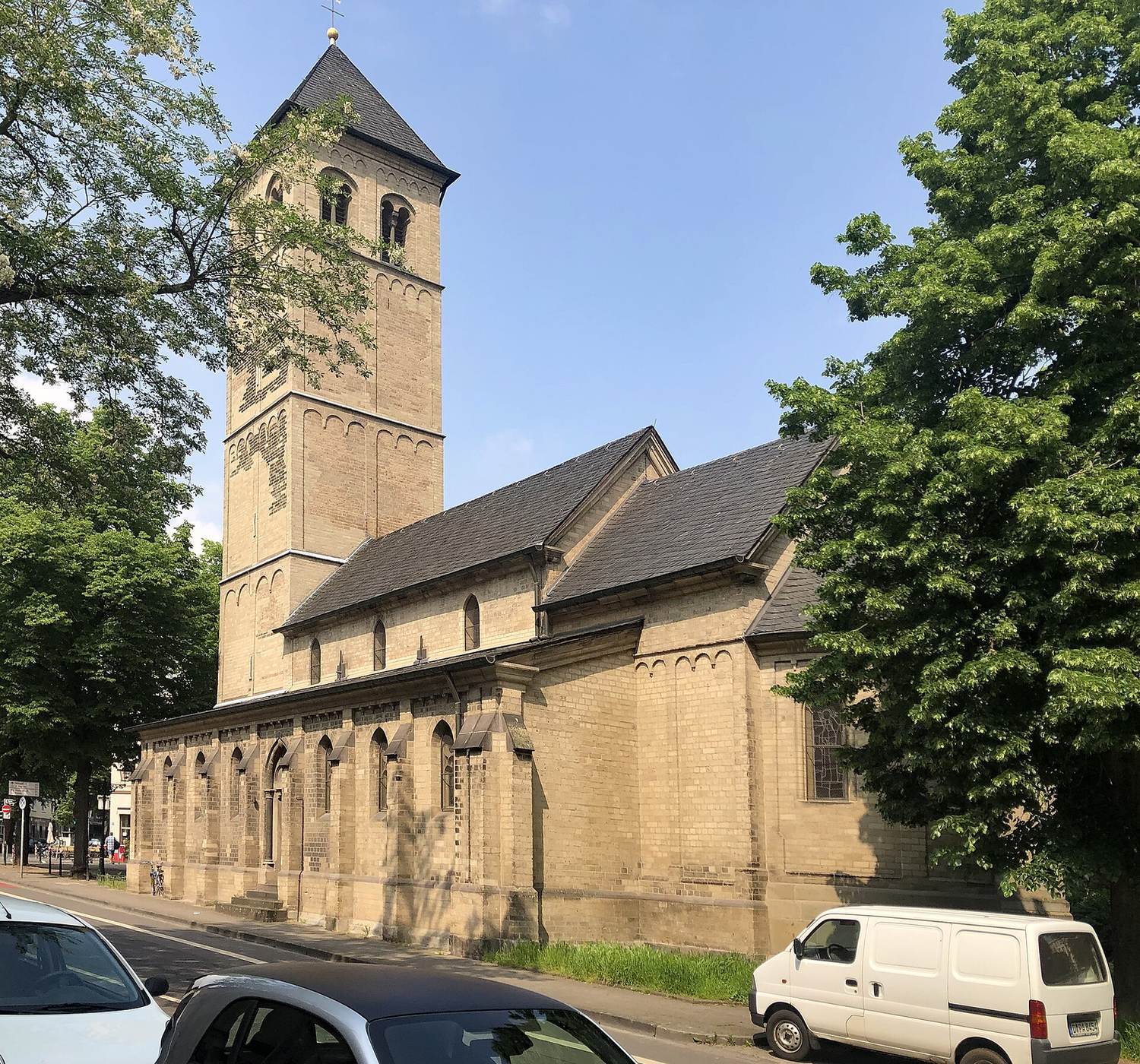
Alt St. Martin is a simple early Romanesque, three-aisled pillar basilica whose surviving fabric brings together elements from several building phases. The early church stood on the site of a rectangular Carolingian chapel. The present structure includes the later tower, eastern apse and choir, vaulted areas, and side aisles that reflect medieval and early modern rebuilding.
Early foundations and main structure
The earliest chapel was built from Ratinger slate, greywacke rubble, and brown-coal quartzite. These stones were stacked with red clay rather than set in mortar. Around 1000, the three-aisled basilica reused remains of this predecessor. Its early Romanesque character is expressed through substantial masonry and a longitudinal basilical plan. The slender tower has five storeys and was built between 1150 and 1200. The side aisles date from the fifteenth century and were rebuilt in brick during the seventeenth century. In 1894, the German art historian and monument conservator Paul Clemen described the tower as the most imposing tower in the Bergisches Land.
Apse, choir, and surviving paintings
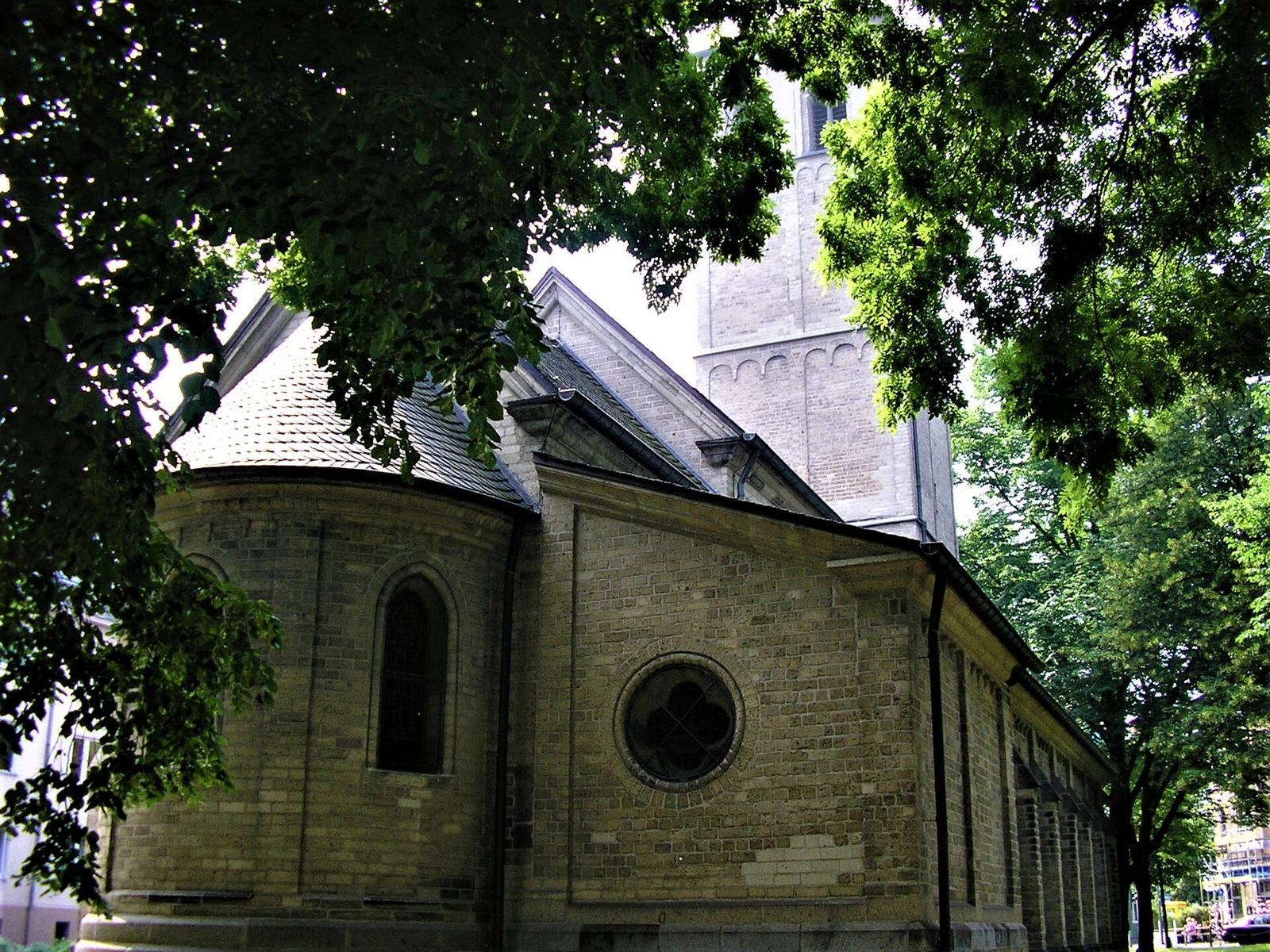
The eastern end contains a semicircular apse and a small rectangular choir, enlarged around 1200 when vaulting was added. Thirteenth-century frescoes survive in the apse, while two further frescoes that originally belonged to the choir are now mounted on the end walls. Together, these paintings form part of the limited surviving interior furnishing.
Modern interior and furnishings
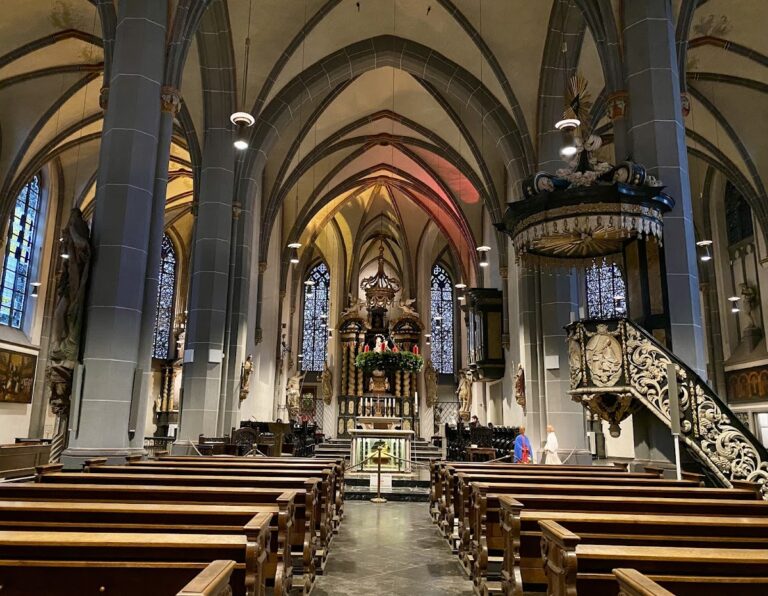
The bronze entrance doors were designed by Bert Gerresheim, while Heinz Gernot created the altar and tabernacle. Hermann Gottfried made the church windows in 1964. Above the entrance, a semicircular leaded-glass window made in 2006 by the Bilk glass artist Uwe Hertel displays the coat of arms of Tours. Tours, a city in France, is the burial place of Saint Martin of Tours, a fourth-century Christian bishop and major saint of Western Christianity. The window was commissioned by the Bilk St. Martin’s Company, an organization within the St. Sebastianus Shooting Society of Düsseldorf-Bilk.
Alt St. Martin now has one ringing bell. Its organ, built in 1970 by Gebrüder Krell of Duderstadt, is a mechanical tracker-action instrument. Mechanical linkages connect its keys, valves, and stops. The instrument has nine stops arranged across two hand-operated keyboards and a pedal keyboard.