St Patrick’s Cathedral: Ireland’s National Cathedral in Dublin


Site at a Glance
- Rating
- 4.5
- Popularity
- Very High
- Country
- Ireland
- Primary era
- Medieval
- External website
- Open
- Eras represented
- Medieval, Early Modern, Modern
- Civilizations
- English, Norman
- Site type
- Religious
- Remains
- Cathedral
On this page14 sections
History
St Patrick’s Cathedral is a medieval Gothic cathedral in Dublin, Ireland, built beside a holy well associated with Saint Patrick, the fifth-century Christian missionary traditionally linked with the conversion of Ireland. Founded in 1191 outside the medieval city boundaries, it developed into Ireland’s national cathedral and remains the principal national church of the Church of Ireland, the Anglican church in Ireland.
Foundation and medieval development
The church stood on an island between two branches of the River Poddle. John Comyn, the first Anglo-Norman Archbishop of Dublin, dedicated it to God, the Blessed Virgin Mary, and Saint Patrick on 17 March 1191. The following year, Comyn elevated one of Dublin’s four Celtic parish churches to collegiate status. A collegiate church was served by a chapter of clergy responsible for worship and administration, rather than necessarily being the seat of a bishop. Comyn’s charter established a chapter of 13 canons, including a chancellor, precentor, and treasurer, and Pope Celestine III confirmed the arrangement within a year.
The church was probably raised to cathedral status after 1192, although the precise date is uncertain. In 1212, Henry de Loundres was elected Archbishop of Dublin by the chapters of St Patrick’s and Christ Church, an election recognized by Pope Innocent III. Henry issued further charters between 1218 and 1220, and a charter of 1220 established the office of dean, the senior cleric responsible for directing the cathedral’s clergy and services.
The present cathedral took shape between 1191 and 1270. In 1225, King Henry III permitted donations to be collected throughout Ireland for four years to support reconstruction in the Early English Gothic style, an early form of Gothic architecture used in England and the British Isles. Work continued at least until the cathedral was rededicated in 1254. The Lady Chapel was added around 1270, probably by Archbishop Fulk de Saunford.
Shared cathedral status and medieval institutions
St Patrick’s and Christ Church both functioned as cathedrals in the Diocese of Dublin. Their relationship was regulated in 1300 by the Pacis Compositio, an agreement arranged by Archbishop Fering. Christ Church received formal precedence, the archbishop’s consecration normally took place there, and the archiepiscopal insignia were to be kept there. Archbishops were to be buried alternately in the two cathedrals unless they directed otherwise, while the institutions were to act as one and share their liberties equally.
A medieval university was founded at St Patrick’s in 1311. William de Rodyard, then dean, became its first chancellor, and the canons served as members. The institution never flourished and was suppressed during the Reformation, the sixteenth-century break with papal authority and creation of Protestant church structures under the English crown.
From the middle of the fourteenth century for more than 500 years, the north transept also served as the parish church of St Nicholas Without. The name referred to the part of the parish outside Dublin’s city proper. A fire led to the rebuilding of Minot’s Tower and the west nave between 1362 and 1370 under Thomas Minot, Archbishop of Dublin from 1363 to 1375.
Reformation and religious change
The English Reformation became effective at St Patrick’s around 1537, and the cathedral became an Anglican Church of Ireland institution. Soldiers acting under Thomas Cromwell, a leading administrator of the English Reformation under Henry VIII, defaced some images. Neglect then contributed to the collapse of the nave in 1544.
Under Edward VI, the cathedral was formally suppressed and reduced to parish-church status. Part of the building became a courthouse, the vicar’s hall was converted into a grammar school, and the deanery, the office or residence associated with the dean, was assigned to the archbishop. The cathedral’s silver, jewels, ornaments, and other valuables were transferred to Christ Church. In 1549, the walls were ordered to be repainted with passages from scripture.
A charter issued under Philip and Mary in 1555 restored the cathedral’s privileges and began its restoration. After the Catholic chapter was expelled in 1559, Catholic communities continued for at least part of the 1560s and 1570s to nominate canons and principal dignitaries to St Patrick’s. One of Dublin’s earliest public clocks was installed in the cathedral steeple in 1560.
Repair, conflict, and changing use
By the early seventeenth century, the Lady Chapel was in ruins, the eastern end of the choir had been closed by a temporary partition, and galleries had been added for large congregations. Repeated flooding, associated with the River Poddle, also damaged the cathedral. In 1620 it was described as being in poor repair. During Oliver Cromwell’s conquest of Ireland and the Commonwealth period, horses were stabled in the nave. Repairs began after the restoration of the monarchy in 1660.
The roof, which threatened to collapse, was dismantled in 1668 and replaced by 1671. Buttresses were added, the west window was replaced with a Perpendicular window, and the choir was reorganized during the 1680s. From 1666 to 1816, the restored Lady Chapel was used by French-speaking Huguenots, French Protestants who had migrated to escape religious persecution. It became known as L’Eglise Francaise de St Patrick, and the arrangement was periodically renewed until the Huguenots were assimilated into Dublin’s population.
During the Williamite War in Ireland, the conflict arising from the struggle between James II and William III for the Irish and British crowns, James II and his Catholic supporters briefly repossessed the cathedral between 1688 and 1690. After James’s defeat and departure from Dublin, Anglican control returned.
Dean Jonathan Swift and the later cathedral
Jonathan Swift, the writer and satirist, served as dean from 1713 to 1745. He took an active interest in the cathedral’s building, worship, music, and welfare work. He supported an almshouse for poor women and Saint Patrick’s Hospital, and he was buried in the cathedral beside Esther Johnson, known as Stella.
St Patrick’s served as the chapel of the Most Illustrious Order of Saint Patrick from 1783 to 1871. The Order of Saint Patrick was an Irish chivalric order founded by the Crown in 1783, and its members were known as the Knights of Saint Patrick. Investiture ceremonies were held in the cathedral until the disestablishment of the Church of Ireland in 1871. They then moved to St Patrick’s Hall in Dublin Castle, although the knights’ heraldic banners remain above the choir stalls.
Divine service was suspended in 1792 after the south wall shifted approximately 60 centimetres out of perpendicular and parts of the roof became unsafe. Flooding linked to the River Poddle remained a persistent problem, especially during the eighteenth century. A major restoration under Dean Pakenham between 1843 and 1864 was restricted by financial difficulties, but the Lady Chapel was restored, its floor was lowered toward its original level, and other urgent repairs were carried out.
Victorian reconstruction and national role
Benjamin Guinness financed a major reconstruction between 1860 and 1865 because the cathedral was considered close to collapse. The work secured its survival, but it also removed medieval chantries and other fabric. Few records of the reconstruction survive, so the proportions of the present building that are genuinely medieval and those that are Victorian pastiche remain uncertain.
A Celtic cross found buried near the cathedral in the mid-nineteenth century was preserved and was thought possibly to mark the site of the former holy well. The choir school, founded in 1432, supplied singers for the first performance of Handel’s Messiah in 1742. It continues to operate, and a girls’ choir was established in 2000.
After the disestablishment of the Church of Ireland in 1871, Christ Church became the cathedral of Dublin and Glendalough, while St Patrick’s became the national cathedral for the whole of Ireland. It is not the seat of a bishop and is headed by its dean, an office dating from 1220. St Patrick’s remains the national cathedral of the Church of Ireland and hosts national ceremonies, including Ireland’s annual Remembrance Day ceremony. The funerals of Presidents Douglas Hyde and Erskine Childers took place there in 1949 and 1974; Childers’s funeral was a state occasion attended by foreign dignitaries.
More than 500 people are buried beneath the cathedral and in its adjoining graveyard. Among them are Jonathan Swift, Esther Johnson, several archbishops of Dublin, the judge Sir Jerome Alexander, the military commander Frederick Schomberg, the historian James Henthorn Todd, and the playwright Lennox Robinson. St Patrick’s has national-monument status in Ireland, and continuing conservation seeks to prevent the recurring disrepair that repeatedly threatened the building in earlier centuries.
Remains
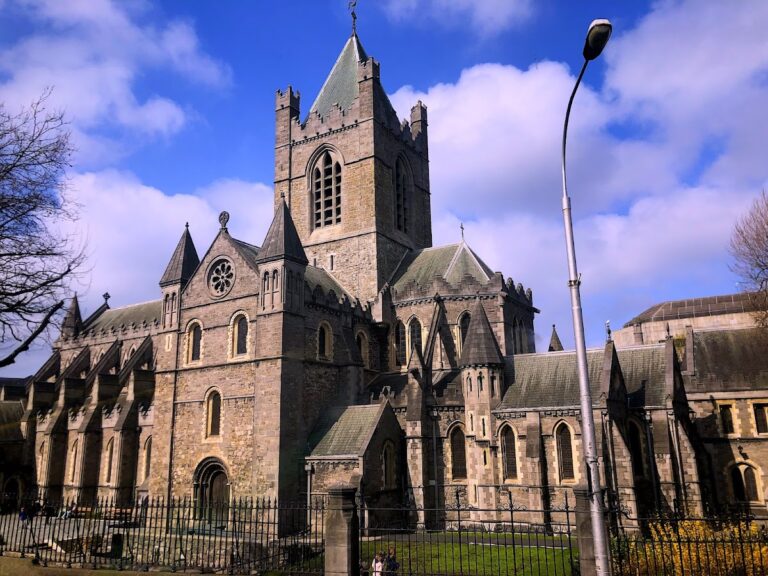
St Patrick’s Cathedral is a limestone Gothic building in the form of a Latin cross, with a nave, three aisles, transepts, a choir, and a single tower approximately 43 metres high. It measures about 87 metres internally and 91 metres externally, and is approximately 49 metres across the transepts. Slender piers support the stone vaulting. The interior fittings are relatively restrained, and the high water table means that the cathedral has no crypt or basement. The site has also historically been vulnerable to flooding.
Chapels and early fabric
Lady Chapel
The Lady Chapel stands behind the high altar and was added around 1270. Its north side is dedicated to Saint Peter and its south side to Saint Stephen. Four slender columns of dark grey stone support the vault, while a white-stone altar receives light through five narrow windows. Nineteenth-century restoration returned the chapel to use after earlier deterioration. Its use by Huguenots from 1666 to 1816 gave it the continuing historical name French Chapel. Memorial plaques to Huguenots, including Elie Bouhereau, remain on the walls, and a chair is traditionally associated with William III’s attendance at a service after the Battle of the Boyne.
Baptistery
The baptistery is the oldest surviving part of the cathedral’s earliest work. It has a white-stone vault, dark-blue geometric wall decoration, three windows, and a simple rectangular font. These elements preserve a distinct part of the building’s early religious and architectural history.
Windows and memorials
The original stained-glass windows have not survived. The oldest existing examples date from the middle of the nineteenth century. At the west end, the Saint Patrick window contains 39 scenes, beginning with his abduction in Wales and ending with his death in Ireland. William Wailes and Company made it in northern England, and it was installed during the nineteenth-century Guinness restoration before being completely restored in 2004.
William Wailes and Company also made the principal windows of the south transept and those around the Lady Chapel. Other windows commemorate Edward Cecil Guinness, the First World War, the Crimean War, the Second Boer War, and Irishmen killed in the Boer War. A south-choir window commemorates Annie Lee Plunkett, the charitable daughter of Benjamin Lee Guinness and wife of Archbishop Plunkett.
A black marble and alabaster monument made in 1631 depicts the second wife of the first Earl of Cork. A bust of Jonathan Swift stands in the south aisle, while a statue of Sir Benjamin Guinness by J. H. Foley is positioned outside the south door. At the west end of the nave, an old door contains a hole cut through it. Tradition connects the opening with the 1492 conflict between the Kildare and Ormonde factions, when Kildare is said to have offered his opponent a handshake through the door after Ormonde had taken refuge in the chapter house and a truce had been reached.
Tower, spire, organ, and bells
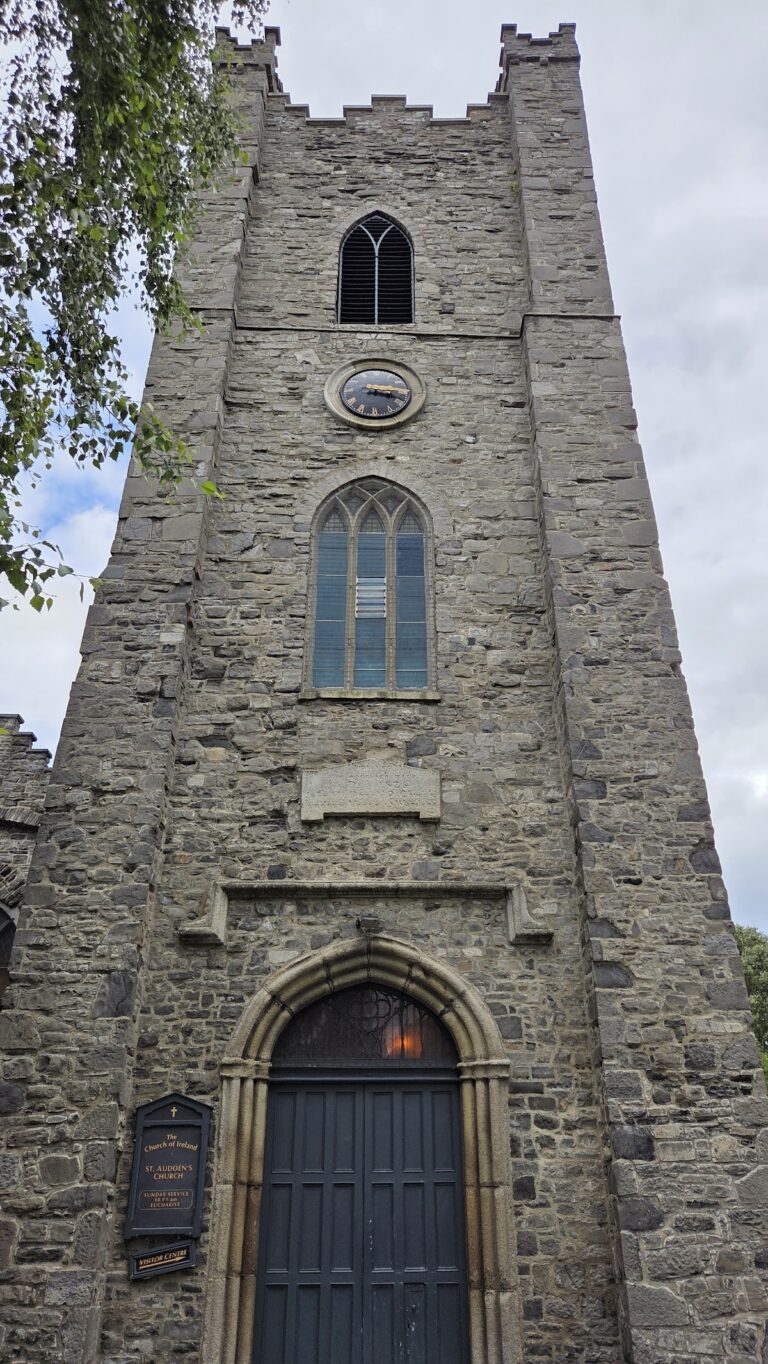
The tower known as Minot’s Tower belongs to the rebuilding of the tower and west nave after the fire of 1362. The spire was added in the eighteenth century by George Semple, an Irish architect associated with the cathedral, and remains part of Dublin’s historic skyline.
The cathedral organ has more than 4,000 pipes, including portions from a Renatus Harris instrument of 1695. Henry Willis and Son rebuilt it in the 1890s in consultation with Sir George Martin, and J. W. Walker and Sons restored it in 1963.
The bells include a 12-bell diatonic peal tuned to C, three semitone bells, and a tenor weighing approximately 2.307 tonnes. Thomas Purdue made an eight-bell ring in 1670. Later peals were presented by Benjamin Lee Guinness and Edward Guinness, with bells cast by John Taylor and Company. Two trebles added in 1909 created Ireland’s first ring of twelve bells, and the first peal rung on them in 1911 was the first tower-bell peal rung outside England. A sharp-second bell was added in 2007. An Ellacombe apparatus in the ringing room is no longer functional.
Cathedral precinct
The precinct historically included the archbishop’s complex. Its jurisdiction was divided between a liberty controlled by the dean and a larger liberty controlled by the archbishop. This arrangement reflected the cathedral’s long-standing institutional position within Dublin, alongside its religious, educational, charitable, and ceremonial functions.
Nearby sites