Roman Sanctuary of the Paphian Aphrodite (Sanctuary II): A Roman Religious Center in Cyprus


Site at a Glance
- Rating
- 4.6
- Popularity
- Very Low
- Country
- Cyprus
- Primary era
- Classical
- Eras represented
- Bronze Age, Classical
- Civilizations
- Roman
- Site type
- Religious
- Remains
- Sanctuary
On this page12 sections
History
Origins of Palaipaphos
The Roman Sanctuary of the Paphian Aphrodite (Sanctuary II) is a Roman religious complex in Cyprus, near modern Kouklia. Constructed at the end of the first or the beginning of the second century AD, it belonged to ancient Palaipaphos, a major center of the worship of Aphrodite. The sanctuary preserved an older eastern Mediterranean religious tradition in which the goddess was represented by a sacred stone rather than a human-shaped statue.
The religious tradition at Palaipaphos reached back to the Chalcolithic period, the Copper Age phase between the Neolithic and Bronze Age, around 3900–2500 BC. A settlement existed there during the Late Bronze Age, before the arrival of the Achaeans. The newcomers adopted the local fertility goddess, whose worship later became associated with Aphrodite, the Greek goddess of love, sexuality, and fertility.
Later traditions named the mythical Cypriot king Cinyras as the sanctuary’s founder and first priest. Another tradition credited Agapenor, king of Tegea in Arcadia, with founding both the city and its sanctuary. The early settlement and the continuity of the cult provide a historical basis for the idea that the sanctuary developed from a much older place of worship.
From regional center to Roman institution
From the beginning of the Geometric period, the early Greek Iron Age conventionally dated from about the tenth to the eighth century BC, through the end of the Classical period, Palaipaphos was the largest urban and religious center in western Cyprus. In the late fourth century BC, its last king, Nicocles, moved his seat to Nea Paphos. Palaipaphos nevertheless retained its religious importance because Aphrodite continued to be worshipped there.
Under Roman rule, the sanctuary became the center of the Koinon of the Cypriots, a collective institution representing Cypriot communities. The Koinon managed religious affairs, participated in worship of the Roman emperor, and controlled the minting of bronze coins on the island. The sanctuary therefore served not only as a place of pilgrimage but also as an institution with island-wide religious and administrative responsibilities.
The cult remained focused on a conical baetyl, a sacred stone regarded as the material manifestation or symbol of a deity. This non-anthropomorphic form of worship continued for centuries. Tacitus described the object at Palaipaphos as a black stone associated with Aphrodite’s altar, while Roman coins and Hellenistic clay seal impressions represented the sanctuary’s fertility symbol.
Destruction, closure, and archaeological investigation
An earthquake in AD 76 or 77 damaged the earlier buildings at Palaipaphos. Sanctuary II was probably erected afterward, at the end of the first or the beginning of the second century AD. Its construction created a Roman complex while retaining the open-court character and older religious traditions of the Paphian sanctuary.
Religious and cultural activity ended during the fourth century AD as Christianity spread through Cyprus. The sanctuary was closed during the late Roman suppression of pagan worship, traditionally placed in AD 391, when Theodosius I, the emperor whose policies promoted Christianity and suppressed traditional pagan cults, outlawed pagan religions.
Treasure hunters worked in the Palaipaphos area from at least the sixteenth century until the end of the nineteenth century. Systematic archaeological research began in 1950–1955 with the British Archaeological Mission under J. H. Iliffe and T. B. Mitford. From 1966, the German Archaeological Institute continued excavations in cooperation first with the University of Konstanz and later with the University of Zurich, under Franz Georg Maier and M.-L. von Wartburg. The Department of Antiquities also investigated many tombs in the surrounding area.
Palaipaphos and Nea Paphos were inscribed together on the UNESCO World Heritage List in 1980. The sanctuary’s historical importance rests on the long continuity of its religious tradition and its position as a major center of the ancient cult of Aphrodite.
Remains
Sanctuary complex and layout
The earlier sacred enclosure
The sanctuary complex contains two principal building groups. Sanctuary I, the earlier shrine to the south, dates approximately to the end of the Late Bronze Age. It consisted of an open-air temenos, a formally bounded sacred precinct, enclosed by megalithic walls. A covered hall, or stoa, stood within the enclosure and sheltered the conical baetyl associated with the Great Goddess.
The Roman court and halls
Sanctuary II lies north of Sanctuary I and forms a relatively uniform Roman complex measuring approximately 79 by 67 metres. Its axis differs slightly from that of the earlier shrine, although elements of Sanctuary I continued into the Roman period. The Roman complex retained an open inner court surrounded by covered stoas on its southern, eastern, and northern sides.
The building levels rise gradually from the floor of the Late Bronze Age precinct toward the floor of the North Hall. This stepped arrangement followed the slope of the site and gave the complex a commanding architectural presence for those approaching from the sea or along the road from Nea Paphos. Sanctuary II was not a conventional Classical or Graeco-Roman temple. Instead, it followed a Near Eastern tradition of a broad open enclosure bordered by halls and other structures, with altars, statues, offerings, and religious monuments distributed throughout the complex.
Sacred structures and architectural evidence
The innermost shrine
The innermost shrine probably sheltered the conical fertility symbol shown on Hellenistic clay seal impressions and Roman coins. Its exact location remains uncertain. It may have stood within the Roman court, or the sacred focus may have remained inside the older temenos of Sanctuary I. The structure may have consisted of pillars carrying awnings, forming a tall canopy rather than a solid building with permanent walls. This proposed form helps explain the surviving architectural evidence.
The sacred stone
The sacred baetyl continued to be retained in Sanctuary II. Its aniconic form, meaning that it represented the deity without a human image, distinguished the Paphian cult from worship centered on an anthropomorphic statue. The black stone described by Tacitus was associated with the altar of Aphrodite and remained the central material expression of the sanctuary’s fertility tradition.
Architectural fragments and coins
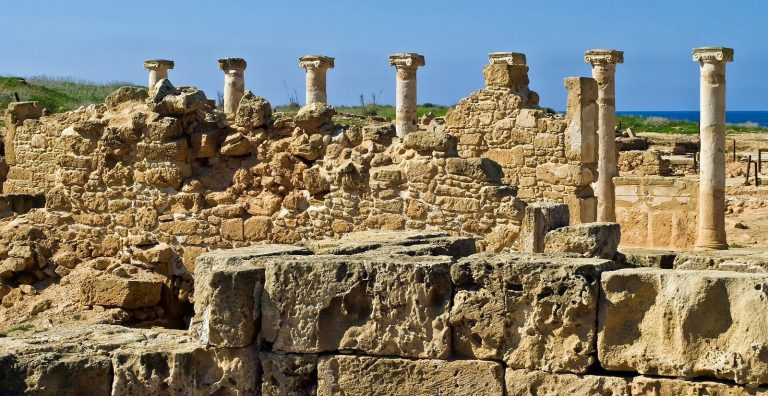
Roman and Roman-Doric capitals were found scattered across the site. Their forms combine eastern and western architectural traditions, and the fragments are now gathered on a pediment beside the road from the Manor House. The sanctuary’s large foundation walls still define the extensive ruins. Roman coins issued under Vespasian, emperor from AD 69 to 79, and Septimius Severus also depict the complex, providing evidence for its appearance and architectural character.