Agios Neophytos Monastery: An Orthodox Monastic Center in Cyprus


Site at a Glance
- Rating
- 4.7
- Popularity
- Medium
- Country
- Cyprus
- Primary era
- Medieval
- External website
- Open
- Eras represented
- Medieval, Early Modern
- Civilizations
- Byzantine, Crusader, Kingdom of Cyprus, Ottoman, Venetian
- Site type
- Religious
- Remains
- Monastery
On this page12 sections
History
Agios Neophytos Monastery is an Orthodox monastery in Cyprus near Tala, founded by the Cypriot monk Neophytos in 1159. Formally known as the Holy, Royal and Stavropegic Monastery of Saint Neophytos the Recluse, it developed from a solitary cave retreat into a monastic community and remains a functioning institution of the Church of Cyprus.
Neophytos and the Engleistra
Neophytos pursued an ascetic life, meaning one centered on strict religious discipline and withdrawal from worldly concerns. After being imprisoned for this purpose, he escaped into the hills of Cyprus. On 24 June 1159, he entered a natural cave that he had chosen for solitary practice. He spent several months making sure that the place was quiet and deserted before beginning his work.
Neophytos enlarged the cave by hand, creating a cell, a small chapel, and a tomb. This work was completed in 1160. He then closed every entrance except the one on the southern side, divided the cave into two parts, and installed a marble altar near the entrance. He dedicated the hermitage to the True Cross, the cross traditionally identified in Christian devotion as the one on which Jesus was crucified.
From hermitage to monastery
In early 1166, Paphos Bishop Basil Kinnamos urged Neophytos to accept priestly ordination and take pupils. Neophytos resisted for four years, but eventually agreed. From 1170, his hermitage became the center of a small ascetic community and later developed into a monastery. More cells were cut into the rock, and Neophytos probably composed the community’s first rule around 1187.
The community remained relatively small because Neophytos opposed materialism and disturbance. His second ritual ordinance gives the number of monks as approximately fifteen or eighteen. In 1197, he withdrew from the growing community to a new cell high above the original hermitage. He called this retreat New Zion, lived there, and cut a tomb for himself, ordering that it remain unopened until the Last Judgment.
Neophytos died in 1224 at the age of 90, after spending more than 60 years in a cell. He was buried inside the Engleistra according to detailed instructions he had left. His successor Isaias is mentioned in Neophytos’s writings, but little is known about his period as abbot. The abbots of the thirteenth, fourteenth, and fifteenth centuries are not documented, and later leaders appear not to have preserved Neophytos’s strict isolationist way of life.
Expansion, crisis, and renewed importance
The monastery expanded intermittently during the following centuries, when new paintings and decorations were added to its buildings. A major renovation took place in 1503 under another monk named Neophytos. He paid for the restoration of earlier artworks and the addition of new icons.
The community alternated between growth and decline and had become stagnant by about the seventeenth century. In 1570 it was plundered by the Turks, after which it endured difficult conditions. Its revival began around the middle of the eighteenth century. In 1631, Prior Leontios acted to prevent the monastery’s dissolution, and Cyril Loukaris, Patriarch of Constantinople, declared it senior to all other monasteries in Cyprus. This precedence was an ecclesiastical distinction connected with the authority of a prominent Orthodox patriarch.
The relics of Saint Neophytos were discovered in 1756 and transferred to the monastery’s main church. The buildings have continued to be repaired and enlarged over the centuries to protect them from deterioration. The monastery remains inhabited by monks, who support the preservation and publication of manuscripts written there. It is dedicated to Saint Neophytos, whose feast is celebrated on 28 September, and functions as both a stavropegic monastery and a museum. A stavropegic monastery is placed directly under a senior ecclesiastical authority rather than under the ordinary jurisdiction of the local bishop.
Remains
The original rock-cut hermitage
The original Engleistra, meaning a place of seclusion or hermitage, is carved into a steep rock face. It forms the oldest physical core of the monastery and is arranged around three principal elements. A large trapezoidal entrance hall, or narthex, gives access to the complex. The refectory lies to the north, while Neophytos’s cell occupies the southern side. A wall divided the cave, and the southern entrance was retained after the other openings were closed.
Church of the True Cross
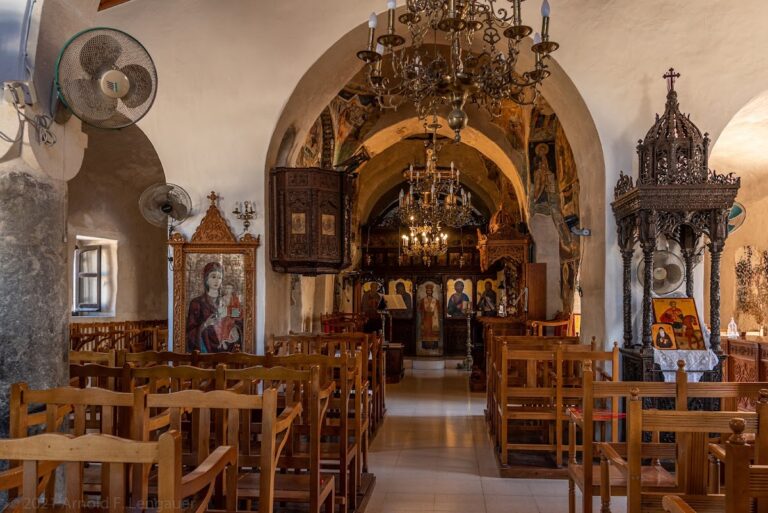
The Church of the True Cross occupies part of the cave and contains wall paintings from several phases of the monastery’s history. Its main body and sanctuary area, known as the bema, are painted with religious scenes. On the eastern wall, a cross-shaped niche once held a wooden cross containing a fragment of the True Cross obtained by Neophytos. The chapel’s paintings preserve the changing decorative history of the Engleistra rather than representing a single period of work.
Neophytos’s cell and tomb
Neophytos’s cell was cut directly into the rock as part of the original hermitage. A tomb was prepared within it for the monk, who was later buried in the Engleistra according to his own instructions. Near the cave entrance, a holy altar made from a marble slab survives as a reminder of the religious purpose of the retreat.
Engleistra wall paintings
Most of the paintings made in the original Engleistra during Neophytos’s lifetime are attributed to Theodore Apsuedes and dated to 1183. Neophytos’s writings support this attribution, as does an inscription preserved in his cell. The more distant areas painted during the twelfth century were probably completed later, most likely after 1197, and stylistic differences indicate that artists from different backgrounds worked on them.
The paintings follow traditional Byzantine church decoration, including scenes of the Crucifixion and the Annunciation. One ceiling image shows Neophytos with the archangels Michael and Gabriel. Another depicts the monk attending a divine service within the mandorla of Christ, an almond-shaped field of light surrounding a sacred figure. Non-invasive examination has identified at least five painting phases in the Engleistra. Many pigments contain high levels of lead, suggesting that some painters had experience with wooden icons rather than wall painting. Lapis lazuli, gold, and silver were also used, showing the range of materials incorporated into the decoration.
The later monastic complex
The katholikon
Outside the Engleistra stands the monastery’s principal church, or katholikon. It is a large basilica inspired by Venetian architecture and appears to have been built in the early sixteenth century. Dedicated to the Virgin Mary, the church was decorated with wall paintings, of which only a small number survive. Its construction and decoration belong to the later development of the monastery beyond Neophytos’s original cave retreat.
The monastery museum
The museum occupies the eastern building of the complex. Its five rooms contain icons dating from the twelfth to the nineteenth centuries, Gospels, manuscripts that include works by Neophytos, printed books, and ancient pottery. The displays also present the history of the monastic community. Together with the paintings in the Engleistra, these objects connect the monastery’s surviving buildings with its long religious, artistic, and literary tradition.
Nearby sites