Vigolzone Castle: A Medieval Fortress and Residence in Italy


Site at a Glance
- Rating
- 4.2
- Popularity
- Very Low
- Country
- Italy
- Primary era
- Medieval
- Eras represented
- Medieval, Modern
- Civilizations
- Holy Roman Empire
- Site type
- Military
- Remains
- Castle
On this page15 sections
History
Vigolzone Castle is a medieval castle in Vigolzone, Italy, rebuilt in 1330 after an earlier fortification had been destroyed. Combining defensive and residential purposes, it occupied a strategic position in the settlement and remained associated with the Anguissola family for centuries.
Early Fortification and Destruction
The first recorded castle at Vigolzone dates to 1095, when Lantelmo Confalonieri received it as an investiture from Aldo, bishop of Piacenza. Confalonieri was the bishop’s vassal and captain of the Piacentines who left for the First Crusade, the western European expedition to the Holy Land that began in 1096.
In 1242, troops commanded by Enzio, the Hohenstaufen ruler and imperial military commander who held the title king of Sardinia, captured the castle. Two years later, Enzio ordered Cremonese troops in his service to destroy the complex completely. The earlier fortification was consequently almost entirely demolished.
The Anguissola Rebuilding
Bernardo Anguissola rebuilt the castle in 1330. He had served as a cavalry general under Galeazzo I Visconti, the Milanese ruler of the Visconti dynasty. The Anguissola family’s possession was confirmed in 1414 for Pietro Anguissola, Bernardo’s grandson.
During the fifteenth century, Giovanni Carlo Anguissola, another grandson of Bernardo, established a grammar school in the castle. He was both a man of letters and a condottiero, a professional military commander in late medieval and Renaissance Italy. The building also remained involved in warfare and was besieged repeatedly, including by troops of Ludovico il Moro in 1483. Ludovico was a member of the Sforza dynasty and ruler of Milan during the late fifteenth century.
Warfare in the Sixteenth Century
In 1511, ownership of the castle was divided among several Anguissola family members. An inventory made that year listed weapons held at the stronghold, including colubrines, which were long and relatively light forms of early gunpowder artillery, and turnio ballistae, projectile weapons derived from the ancient bolt-throwing engine.
Troops serving Odet de Foix probably captured the castle in 1517, and atrocities were committed against the local population. On 23 October 1521, French forces commanded by Girolamo Trivulzio, vice-governor of Piacenza, fought Piacentine troops aligned with the Scotti family near the castle. The latter forces were led by the counts Jacopo dal Verme and Giacomo Anguissola. They suffered about 300 casualties, and several men were taken prisoner, including Galeazzo Anguissola, who was sentenced to death in Milan soon afterward.
In 1522, Trivulzio besieged the castle after forcing Count Gian Giacomo Anguissola, who had fled Piacenza, to take refuge inside it. Trivulzio eventually had to leave the area because of the intervention of Gian Giacomo Pisarone.
County, Literary Associations, and Later Ownership
In 1651, Ranuccio II Farnese, duke of Parma and Piacenza, elevated the fief of Vigolzone to a county. Giovanni Battista Anguissola became its head. The Anguissola family retained the castle until this branch became extinct in 1936.
The poet Giosuè Carducci stayed at the castle in 1888 and expressed his admiration for it in verses dedicated to Elvira Boselli of Piacenza. After the extinction of the Anguissola branch, the marquises Monticelli Obizzi of Crema acquired the property and commissioned restoration work from the Piacenza architect Girbafranti. The marquises Landi of Chiavenna later purchased the castle and converted it into their residence. Alteration and restoration have left the castle in good condition, and it remains owned by the Landi family.
Remains
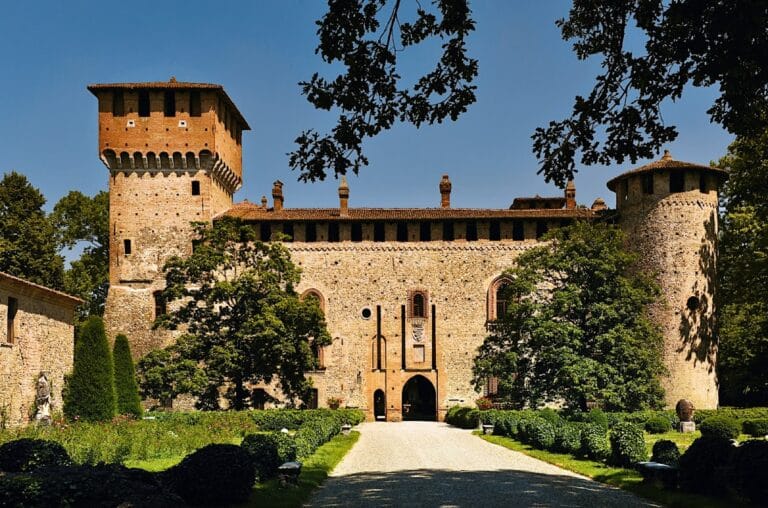
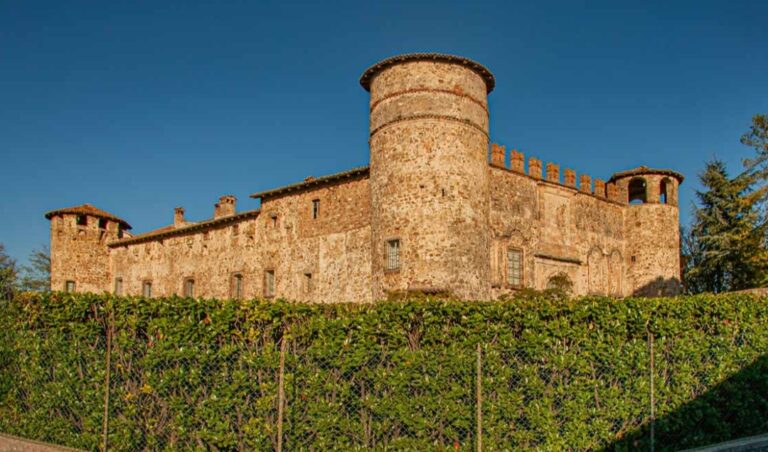
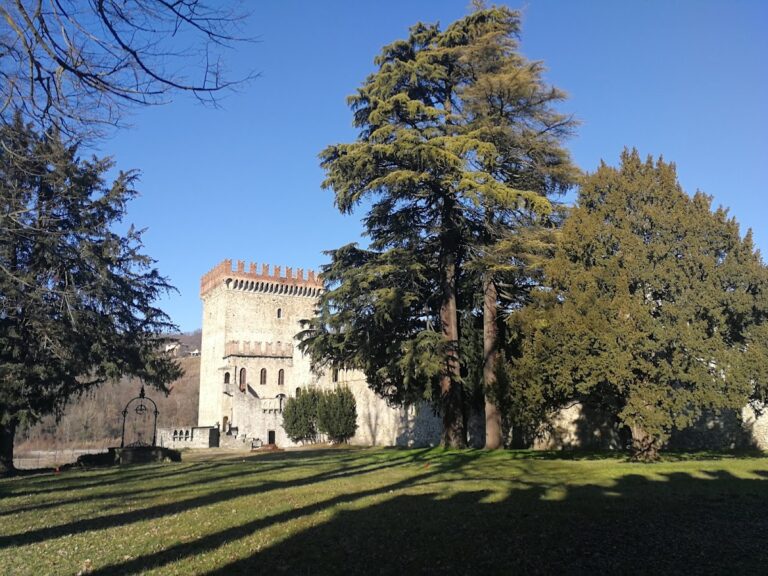
Vigolzone Castle stands west of Vigolzone’s built-up center, in the southern Po Plain near the first foothills of the Ligurian Apennines. The surviving complex has a rectangular plan built of stone and brick around an internal courtyard. Two square towers occupy opposite corners, an arrangement also found at Castello di Bicchignano. The present appearance combines medieval defensive elements with substantial internal changes and Romantic-style additions made during work at the beginning of the twentieth century.
Fortifications and Towers
The Northern Donjon
The large northern tower served as the donjon, or principal fortified tower and strongest defensive and residential element of a castle. Rising 40 metres, it retains swallowtail crenellations, battlements whose merlons form forked, V-shaped profiles. The tower originally stood above and protected the drawbridge, which was later removed.
Earlier Defensive Remains
Traces of the pre-1330 castle survive in parts of a tower with a round base and in underground remains of walls and towers that enclosed the earlier fortified settlement. These elements preserve evidence of the complex that preceded Bernardo Anguissola’s rebuilding.
Southern Front
The castle’s internal appearance was heavily altered during works at the beginning of the twentieth century. Among the Romantic-style additions are roof-covered crenellations along the southern front, which modify the presentation of the earlier defensive form.
Interior Rooms
Feudal Court Hall
The ground floor contains the hall where the feudal court held its hearings. Its function reflects the castle’s role as more than a military installation, since the complex also served as a place of administration and residence.
Weapons Hall
On the first floor, in the left wing, the weapons hall has a wooden ceiling decorated with panels bearing the coats of arms of patrician families connected by marriage to the Vigolzone Anguissola family. A fireplace may once have stood in the room. Slender columns associated with it are decorated with the symbols of the Anguissola, Visconti, and Fontana families.
Former Theater
Another hall on the same floor formerly contained a theater. The room measured 400 square metres, but the theater was destroyed by fire in 1860.
Rebuilding Inscription
A stone inscription is embedded in one of the interior rooms. It originally stood outside the donjon near the moat before being moved indoors to protect it from weather damage. The text records the rebuilding of the castle in 1330, names Bernardo Anguissola, and ends with a formula welcoming those who enter. Its wording recalls an inscription at Castello di Montechiaro in the neighboring Trebbia Valley.
Nearby sites