National Museum of Bardo: Tunisia’s Archaeological and Historical Museum




Site at a Glance
- Rating
- 4.6
- Popularity
- Medium
- Country
- Tunisia
- Primary era
- Classical
- External website
- Open
- Eras represented
- Stone Age, Iron Age, Classical, Medieval, Early Modern, Modern
- Civilizations
- Abbasid, Aghlabid, Ancient Greek, Carthaginian, Fatimid, Ottoman, Roman
- Site type
- Museum
On this page14 sections
History
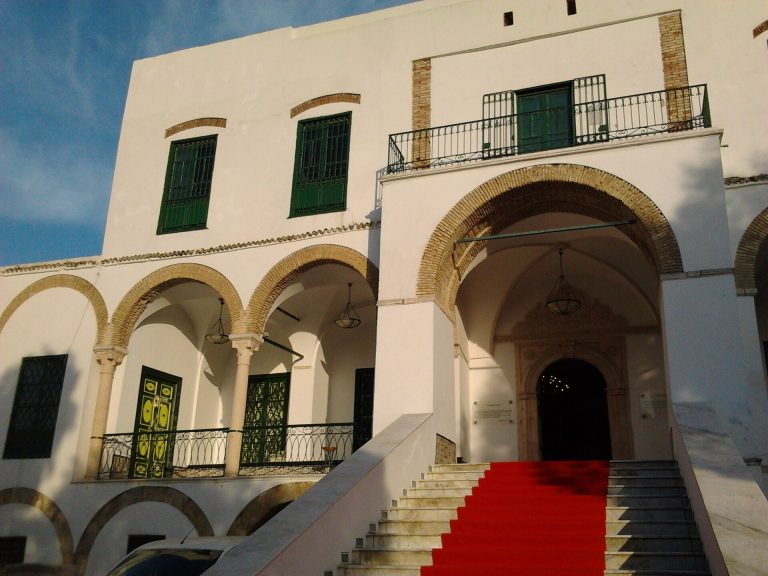
The National Museum of Bardo in Tunisia is a historical and archaeological museum in Le Bardo, a suburb of Tunis, occupying part of a palace complex developed by Tunisian rulers from the fifteenth century onward. Established by decree in 1882 and officially inaugurated in 1888, it presents Tunisia’s history from prehistoric times through the Libyco-Punic, Hellenistic, Roman, early Christian, Islamic, Ottoman, and later periods.
The Bardo palace complex
The palace complex was built on a broad plain about four kilometres from the medina of Tunis. Its name derives from the Spanish word prado, meaning meadow or garden. The complex is traditionally associated with the princely residences of Islamic Andalusia and was developed with the assistance of Andalusian artists. Hammouda Pasha Bey restored and embellished the buildings, making the Bardo the permanent residence of the Mouradite dynasty.
From the eighteenth century, successive Husainid beys enlarged the palace. A bey was the hereditary ruler of Tunisia before the French protectorate, so buildings associated with the court are described as beylical. The additions included a mosque, ceremonial rooms, a justice hall, an audience hall, and fortifications. The southern wall was later replaced by an esplanade. The complex functioned as a residential city, with approximately 800 people living within it.
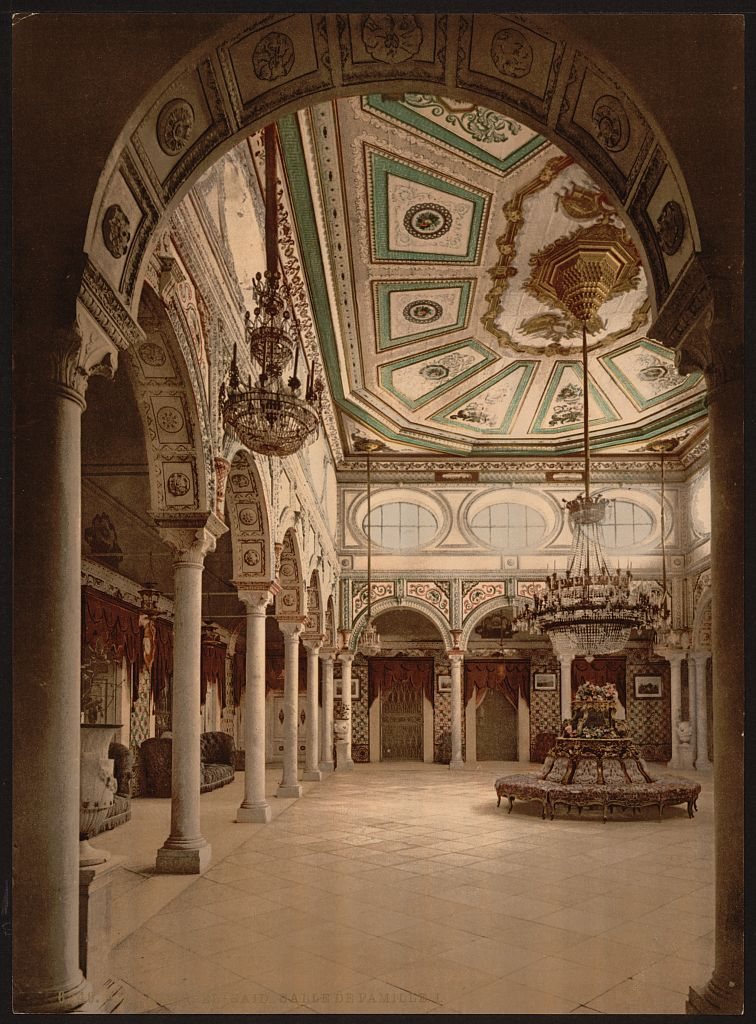
The Bardo Military School occupied part of the complex from about 1840 for approximately twenty-five years. A mint operated there from 1847 to 1891, after which the mint and military school became a barracks for the beylical guard. Nearby, the Ksar Said palace was the setting for the signing of the Treaty of Bardo on 12 May 1881, the agreement that established the French protectorate of Tunisia.
Foundation and opening
The idea of a national museum arose in the 1860s through Muhammad Khaznadar, the son of the Tunisian prime minister. Khaznadar gathered stone monuments, stelae, and statues near his palace at La Manouba. After his father’s political disgrace, the collection was dispersed, and some pieces reached the Louvre in 1881. Kheireddine Pasha also worked to protect Tunisian heritage from looting, helping establish the conditions in which a permanent archaeological collection could form.
The museum was established by decree on 7 November 1882, becoming the first institution of its kind in North Africa. In November of the same year, the former harem of Sadok Bey was transferred to the protectorate authorities. A decree of 25 March 1885 assigned the building to the museum, and René du Coudray de La Blanchère removed unsafe elements and repaired the remaining structure. The first archaeological collections entered the building in March 1885.
The official inauguration took place on 7 May 1888 in the presence of Ali III Bey and Justin Massicault, the French resident-general. The institution was then called the Alaoui Museum, after the reigning bey, Ali III ibn al-Husayn. The name National Museum of Bardo became official after Tunisian independence, specifically in spring 1958, although it had been used earlier.
Expansion of the collections
The museum’s holdings grew through military collecting, railway construction, and organized archaeological excavations. Work at Carthage, Hadrumetum, Dougga, Utica, Thuburbo Majus, El Jem, Bulla Regia, Oudna, Mahdia, and other sites supplied mosaics, sculptures, inscriptions, jewellery, ceramics, coins, and metalwork.
Paul Gauckler contributed 70 mosaics to the museum. Between 1897 and the end of the first decade of the twentieth century, the number of mosaics rose from 70 to 332, while sculpted elements increased from 920 to 1,173. Excavations carried out between 1910 and 1920 enlarged the holdings further through the discovery of the Mahdia shipwreck, the cuirass from Ksour Essef, and material displayed in the newly established Thuburbo Majus room.
The museum’s departments came to cover prehistoric and protohistoric material, Libyco-Punic antiquities, Greek and Roman works, early Christian art, Islamic art, ethnographic material, and the finds from the Mahdia wreck. Its Roman mosaic collection, formed through excavations across Tunisia, is one of the largest in the world. These floor mosaics illuminate aspects of agriculture, domestic decoration, elite society, religious belief, entertainment, and daily life in Roman Africa.
Modern changes and interruptions
The institution’s direction changed as Tunisia moved through the colonial and post-independence periods. Bertrand Pradère directed the museum from 1886 until 1928, followed by Émile Bréchot until 1948 and Pierre Quoniam until 1954. Abdelaziz Driss became the first Tunisian curator in 1956. Mohamed Yacoub followed in 1964, and Mongi Ennaïfer in 1973. Aïcha Ben Abed became the first woman to serve as curator in 1986.
In 1967 the museum ceased to be a public institution with civil legal personality and financial autonomy. A fire damaged one wing in 1984, and that area was closed to the public. Material from the Mahdia shipwreck remained inaccessible until 2000.
A major refurbishment and extension project was launched under the Ministry of Culture after a 1997 loan from the International Bank for Reconstruction and Development. The work was intended to rehabilitate the historic buildings, reorganize the collections and storage areas, modernize displays and signage, and strengthen the museum’s educational and cultural functions. Construction began on 2 March 2009. The project was delayed by the Tunisian Revolution, but the new wing opened on 19 May 2012, followed by the official inauguration of all the new rooms on 25 July 2012.
The extension added approximately 8,000 square metres and increased the exhibition space. Collections were reorganized chronologically, and previously restricted areas, including the Kelibia Baptistery, became accessible within the museum’s displays. The museum closed after the suspension of the Assembly of the Representatives of the People on 25 July 2021, because the assembly occupied the same enclosure. This was its first closure since the opening in 1888. It reopened in September 2023 after further rearrangement works enlarged several spaces and allowed additional works to be displayed.
On 18 March 2015, an Islamist terrorist group attacked the museum and held tourists hostage inside the building. Twenty-two people were killed, including 21 foreign tourists. The Islamic State of Iraq and the Levant claimed responsibility.
Remains
The museum occupies the Grand Palace and the Petit Palace within a complex of approximately 20,000 square metres, including about 9,000 square metres of exhibition space. The buildings retain their original architectural character despite their adaptation for museum use. Their rooms are arranged over three principal levels, with differentiated spaces for archaeological collections, Islamic art, popular traditions, and the Mahdia shipwreck.
Palace entrances and lower level
The entrance lies on the eastern facade beneath a gallery of seven frontal bays and one lateral bay. The arches rest on pink-marble columns, and the carriage gate is clad in copper with nails and bronze knockers. It opens onto a reception corridor. Three aligned rooms on the right contain prehistoric, Punic archaeological, and Punic funerary material, while a vaulted room on the left is devoted to early Christian archaeology.
The lower floor occupies former stables and store rooms and is comparatively undecorated. Its vaulted vestibule has columns and polychrome tiles, as well as a carved wooden door leading to the first floor. Three stairways connect the levels. One beside the early Christian room leads to the Carthage room, another from the reception corridor leads toward the Petit Palace, and a third begins in the Punic archaeology room.
Prehistoric, Punic, and early Christian displays
The prehistoric and protohistoric department covers material from approximately two million years ago to the period immediately before the arrival of the Phoenicians. It includes pebble tools, bifaces, Mousterian and Aterian tools, Iberomaurusian and Capsian material, Neolithic pottery and bone tools, and reconstructed funerary monuments. The Hermaion of El Guettar, discovered by Michel Gruet at the Mousterian site of El Guettar, is approximately 40,000 years old. Its excavator interpreted the stone arrangement as an offering to a nearby spring, and it is often cited in discussions of early religious behaviour.
The Libyco-Punic galleries contain objects from Carthage, Hadrumetum, Utica, and other sites. Libyco-Punic culture reflects interaction between indigenous Libyan traditions and Punic culture, the western Phoenician culture centred on Carthage. Stelae and cippi, smaller upright monuments used for commemorative, funerary, or votive purposes, are important for the study of Carthaginian society and Semitic inscriptions.
The Priest-and-Child Stele, found in the tophet of Carthage in 1921, presents imagery connected with the continuing debate over the Punic molk ritual. A tophet was a sacred and funerary precinct containing urns, stelae, and related ritual evidence. The precise relationship between molk offerings and child sacrifice remains disputed.
The early Christian room leads through a passage lined with terracotta tiles to a gallery containing statues mainly from Bulla Regia. Smaller rooms contain mosaics, a marble tomb, and the Kelibia Baptistery. A nearby corridor displays Roman sarcophagi and stelae in niches, while the Thuburbo Majus room presents material from that archaeological site.
Grand Palace rooms
The first floor of the Grand Palace contains most of the Roman works. The Carthage room occupies the former palace patio. It is rectangular and surrounded by a portico with six round arches on each long side and three on each short side. White-marble columns with composite capitals support the arches. A carved cornice with gilded motifs runs above them, while a second series of arches divides the gallery. Marble-framed niches line the walls, and the floor is paved mainly with white marble tiles.
The room contains sculptures from Carthage, Utica, Oudna, and Dougga, including a 2.40-metre marble Apollo from the theatre of Carthage, a colossal Capitoline Jupiter from the odeon of Carthage, and a statue of the deified Hadrian from the same building. Other works include a heavily restored terracotta statue of a Roman military officer from Oued Zarga, bronze figures of Bacchus and Hercules, a statue of Demeter from a concealed deposit in the Antonine Baths at Carthage, a statue of Isis, Hercules wearing the skin of the Nemean lion, and a Venus Pudica from the Carthage odeon.
The altar of the Gens Augusta, found on Byrsa hill, dates from the first century BC to the first century AD. Its four sides show the preparation of a taurobolium, the flight of Aeneas with Anchises and Ascanius, Rome beside weapons and an altar, and Apollo seated on a tripod. The museum also holds the statue of Innula from Haidra, probably made in Rome. Her epitaph names her and her husband, Titus Arranius Commodus.
The Roman portrait room contains marble portraits of emperors from sites across Tunisia. They include Augustus from El Jem, Vitellius from Althiburos, Vespasian from Bulla Regia, Trajan from Thuburbo Majus, Marcus Aurelius from Carthage, Lucius Aurelius Verus from Dougga, Septimius Severus from Chaoud El Battan, Caracalla from Thuburbo Majus, and Gordian from Carthage. The provenance of the Hadrian portrait is unknown.
The Bulla Regia gallery includes an Apollo Citharoedus from the temple of Apollo, with traces of red paint. It was found with statues of Aesculapius and Ceres. Other works from Bulla Regia include statues of Minia Procula, a priestess of the imperial cult, an incomplete Minerva-Victory, Saturn, a small Herculanean woman, Marcus Aurelius, Lucius Aurelius Verus, and two imperial wives represented as Ceres.
The museum also contains a marble togatus, a Roman citizen represented in a toga, from Dougga. Made in the second quarter of the third century, it shows an older man beside a chest containing scrolls. In the Sousse room, a colossal marble head of Jupiter measures 1.35 metres and weighs 1.2 tonnes. A giant sandalled foot belongs to the same seven-metre-high statue from the capitolium of Thuburbo Majus, dating to the third century.
Decorated palace rooms and Roman mosaics
The Sousse room was formerly the palace reception room. Its floor holds a large mosaic pavement from Sousse, while its ceiling is a sixteen-sided dome of cut and painted wood on a gold ground. Geometric decoration occupies the upper section, floral decoration the lower section, and painted friezes separate them. An inverted stalactite-like apex supports a chandelier. The dome was made by the Tunisian woodworkers Hamda Ben Othman and Mohamed El Gharbi.
The Virgil room has a Greek-cross plan, a high vaulted ceiling, semicircular windows, and lower walls covered with polychrome faience panels. White stucco on the upper walls and ceiling forms interlacing patterns, meanders, knots, hearts, palmettes, and foliage. The room once displayed the Virgil Mosaic opposite its entrance. This emblema, a separately composed picture inserted into a larger mosaic pavement, measures 1.22 metres on each side and shows Virgil with the Muses Clio and Melpomene. He holds a scroll bearing words from the Aeneid. Found at ancient Hadrumetum, modern Sousse, the mosaic has been dated between the first and third centuries, with the third century as the latest archaeologically acceptable attribution.
The Althiburos room was formerly the music room. Its two galleries, one for princesses and one for musicians, contain decorated wooden panels on gold grounds and painted medieval landscapes. Slender white-marble columns, inlaid with red marble, support the galleries. The ceiling consists of three painted wooden panels with geometric and floral designs. The Oudna room, once the dining room, has a carved and coloured wooden ceiling extending across the entire space.
The Roman mosaics include rural, agricultural, hunting, mythological, maritime, circus, amphitheatre, banquet, and hospitality scenes. The Laberii villa mosaics from Oudna show farming, hunting, rural life, and Dionysian subjects. The El Alia pavement, from an oecus, a principal reception or dining room in a Roman house, presents rivers, flooded plains, farms, enclosures, huts, sanctuaries, fishing, and other rural activity. It dates to approximately AD 110–120 and was partly restored in the third century.
The Estate of Lord Julius from Carthage is arranged in three registers. It shows a villa, farming, seasonal activities, hunting, the estate owner and his wife, servants, and a letter naming Lord Julius. The central villa has a fortified appearance, with a windowless ground floor and square corner towers. Domes behind it probably represent private baths. Mosaics from Tabarka show a master’s house, stables, a woman spinning while tending sheep, vines, fruit trees, and farm buildings. Other rural works include the matron at her toilette from Sidi Ghrib and a hunting scene from Carthage.
Scenes of public entertainment include a sixth-century chariot race from Gafsa, a late-second- or early-third-century race in the circus of Carthage, fourth-century victorious charioteers from Dougga and Thuburbo Majus, animal spectacles, gladiatorial scenes, and preparations for a hunt in an amphitheatre. Hunting works include the Crane Hunt, the Boar Hunt, the Hare Hunt or Vandal Horseman Mosaic, the Panther Skin, and a fishing and xenia scene from Chebba. A xenia was a depiction of food, produce, or hospitality gifts in domestic decoration.
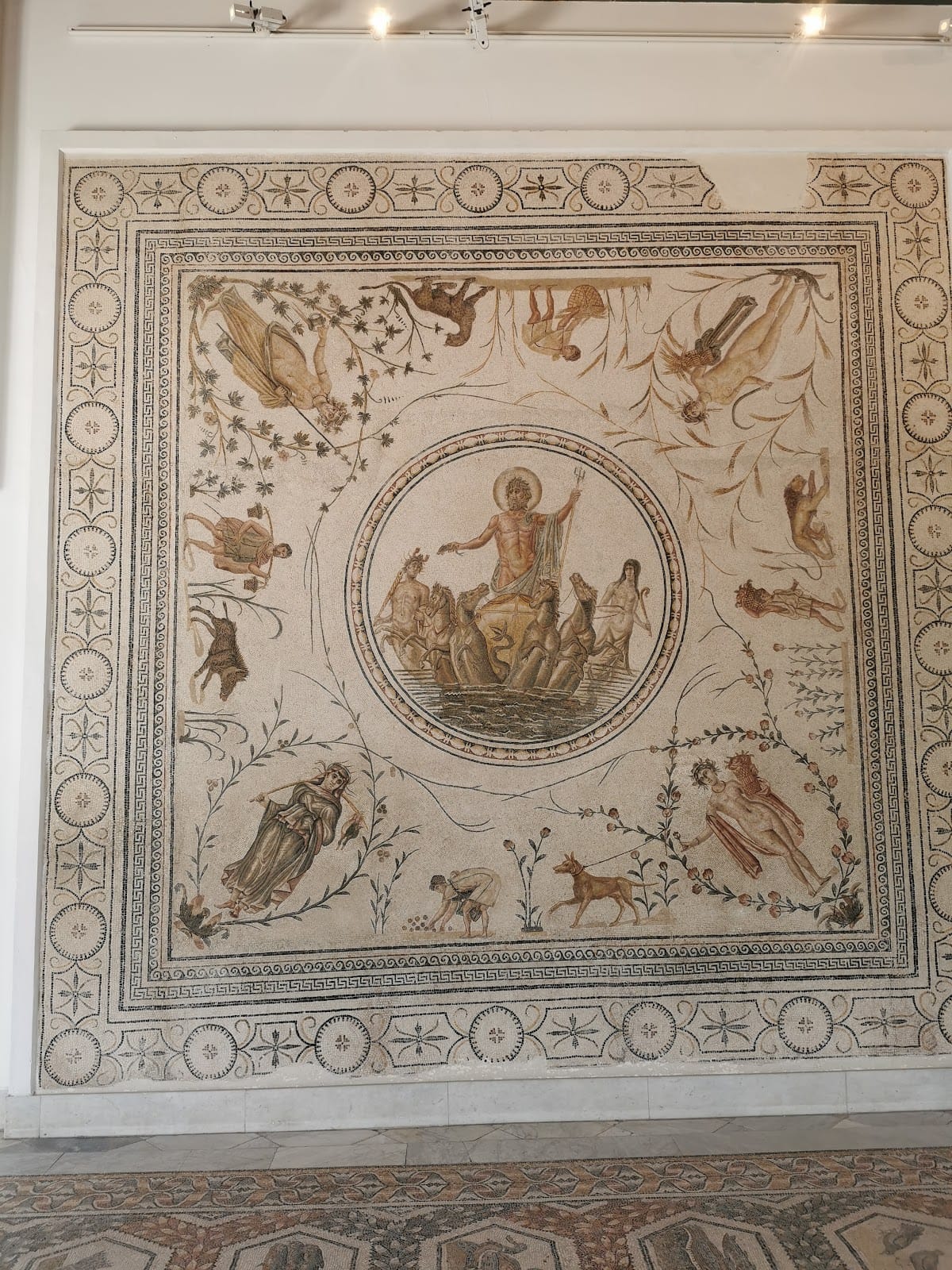
Mythological works include the Poet with Theatre Masks from Thuburbo Majus, the Triumph of Neptune from Sousse, the Triumph of Neptune and the Four Seasons from Chebba, the Crowning of Venus from Carthage, Venus and the Centauresses from Elles, the Triumph of Bacchus and Bacchus with a Gecko from El Jem, and scenes of Diana from Thuburbo Majus and Utica.
The Triumph of Neptune from Chebba is a mid-second-century pavement from an atrium. Neptune, surrounded by a halo and mounted on a chariot drawn by four hippocamps, occupies its central medallion, while female figures representing the seasons fill the corners. The larger Triumph of Neptune from Sousse comes from the House of Sorothus and dates to the late second or third century. Fifty-six medallions containing sirens, Nereids, and ichthyocentaurs surround the central scene.
Early Christian remains
The Christian collection includes funerary mosaics from Tabarka, Lamta, Sfax, and other sites. Many show the deceased between candles or in the posture of an orant, a person shown praying with raised arms. Together, these works illustrate local Christian communities and the development of Christian funerary art.
The Ecclesia Mater mosaic from Tabarka represents a church with an arched entrance, columns, a five-step stairway, a vaulted apse, a triangular pediment with three windows, a central nave, an altar with three candles, and a tiled double-pitched roof. Its inscription names Ecclesia Mater and Valentia. The mosaic has been placed in the fourth or fifth century and is associated with the transition from Christianity practised in private settings to the monumental basilica tradition after the Edict of Constantine in 312.
The Chapel Pavement from Oued Remel dates to the fifth century and depicts a construction site. A supervisor directs a craftsman cutting a column, two workers prepare mortar, and another column is transported on a two-horse cart. The Double Tomb of Victoria from Tabarka is a fifth-century mosaic laid over a lead sarcophagus containing two skeletons. A bearded scribe occupies the upper section, while Victoria appears below as an orant in religious dress, accompanied by birds and a candle.
Other Christian works include the fifth-century Caisson Tomb of Dardanius from Tabarka, the Mausoleum Pavement of Daniel in the lions’ den, the Good Shepherd relief from Carthage, and the sixth-century Medallions of the Seven Saints pavement from Carthage. Christian terracotta tiles from the sixth or seventh century, measuring approximately 25 by 28 centimetres, carry biblical, hagiographical, and pagan subjects.
The Gigthis Baptistery, found at El Kantara on Djerba, dates to the sixth century and consists of a cross-shaped basin set into the floor. The Kelibia Baptistery comes from the church of the priest Felix and dates to the second half of the sixth century. Its quadrilobed basin has a step in each arm and stands on a square mosaic pavement decorated with four vine-filled vessels. The threshold bears the words Pax fides caritas, meaning peace, faith, and charity.
Inscriptions on the basin name Bishop Cyprian, the priest Adelphius, Aquinius, Juliana, and their children Villa and Deogratias, who dedicated the mosaic for the water of eternal life. The decoration includes a dove carrying an olive branch, a vessel of milk and honey, a chest, a canopy containing a cross, dolphins supporting a Christogram, an image of Christ, fish, candles, trees, and flowers. The sixth-century Facing Lions mosaic from Carthage shows two stylized lions beside a parasol pine, with hares and doves above. Its tree-of-life imagery and treatment reflect Byzantine influence.
Petit Palace and Islamic collections
The Petit Palace is reached from the Carthage room through the art and popular-traditions area or by a staircase from the lower floor. Its vaulted vestibule has marble benches and an arched niche. The patio is bordered on two sides by porticoes with alternating black and white arch stones, supported by white-marble columns with composite capitals. A marble fountain stands at the centre, and small rooms open laterally through doors and windows framed with marble jambs.
Opposite the patio is a central room shaped like an inverted T, with a richly decorated ceiling of sculpted and coloured plaster. The vestibule, staircase, patio, and central room have polychrome ceramic wall panels. The medieval Islamic section contains archaeological material from Raqqada and Sabra, including parchment Qurans from the ninth to eleventh centuries.
The Blue Quran of Kairouan consists of parchment leaves written in gold Kufic script on a blue ground. Gold bands decorated with floral and arabesque designs separate the surahs. The manuscript originated in Ifriqiya, the medieval Islamic region centred on present-day Tunisia and extending into parts of eastern Algeria and western Libya, although an Iranian origin has also been proposed.
The Islamic collection also includes leaves from the Quran of Fatma Al Hadhna, medical manuscripts, Egyptian embroidered textiles, carved wood from the Great Mosque of Kairouan, Fatimid textiles with calligraphic and religious inscriptions, musical instruments, Fatimid marble reliefs, coins, astrolabes, sundials, and compasses. The popular-traditions section contains hammered copper and silver objects, ceramics, glass, weapons, jewellery, clothing, and urban and rural ornaments from different parts of Tunisia. Its ceramics include examples from the Abbasid, Aghlabid, and Fatimid periods.
Ethnographic rooms display Tunisian and North African costumes and jewellery, repoussé silver, Sejnane ceramics, and wall ceramics from Andalusia, Morocco, Turkey, and the Near East. A nineteenth-century panel from Qallaline shows two confronting lions. Other displays include sixteenth-century engravings of Charles V’s capture of Tunis, late-nineteenth-century Tunisian furniture, and a room devoted to Jewish religious practice in Tunisia containing Torah exemplars.
Mahdia shipwreck collections
The Mahdia rooms contain objects recovered during three underwater excavation campaigns carried out between 1907 and 1954. The shipwreck’s cargo consisted mainly of Greek bronze and marble works from Athens, probably intended for Sicily or Italy. It included furniture, architectural elements, sculptures, stelae, and reliefs. The display includes a model of the vessel, an anchor, amphorae, and reconstructed architectural and furnishing elements.
The vessel was probably sunk in a storm and was not a galley. Its anchors correspond to a type used in the middle of the first century BC. The bronzes were made by the lost-wax process, in which a wax model is covered with moulding material, the wax is melted out, and molten metal fills the resulting cavity. Small statuettes were cast in one piece, while larger works were made in several pieces. Some received a black, enamel-like surface through the use of particular alloys.
The bronzes survived in excellent condition beneath marine concretions. The marble was perforated by lithodomes, marine organisms that affected stone in oxygenated areas. Conservation was undertaken with the Rheinisches Landesmuseum Bonn from December 1987. The works were shown in Bonn from 8 September 1994 to 29 January 1995 and then returned permanently to Tunisia.
Among the bronzes is the 1.40-metre Agon, a winged nude youth associated with victory in contests, together with the signed Hermes of Boethus, dancing dwarfs, a Satyr ready to spring, Eros Citharoedus, Hermes the Orator, and busts of Dionysus and Ariadne. Bronze couches, tripods, and braziers indicate the range of furnishings carried by the wreck. The dancing dwarfs were ornamental rather than religious, despite the association of dwarf dances with the cults of Dionysus and Cybele.
The marble collection includes the Bust of Aphrodite, dated to the second or early first century BC, as well as columns, capitals, architectural fragments, Greek stelae, and reliefs. Votive stelae showing Asclepius and Hygieia receiving offerings helped identify the Piraeus as the ship’s embarkation point.
A reconstructed marble garden follows the type of the horti marmorei, or marble garden. It contains restored vessels, sculptures, and candelabra from the wreck, together with mosaic panels from Carthage, Utica, and El Jem. Four of the twelve recovered vessels were restored and placed in the garden. Sculptures around the basin represent children playing with water and date to the first half of the second century BC; they may represent Dionysian beings. Other material from the wreck includes fragments of weapons intended for metal recycling and a reconstructed crossbow.
Extension and museum services
The modern extension, designed by SCPA Codou-Hindley and Amira Nouira, added exhibition rooms, educational facilities, reception and service spaces, and relocated administrative and technical areas. Its entrance hall displays the Triumph of Neptune mosaic from Sousse vertically. New signage organizes the collections in chronological sequence. The Libyco-Punic department includes the Ba’al Hammon room, a ceramics room, a corridor of Neo-Punic stelae, and a first-floor room devoted to Punic jewellery.
The museum has 34 rooms and seven departments, together with conservation, cataloguing, and research services. Workshops address mosaics, textiles, painted wood, and general maintenance. A photographic laboratory, an architectural office, and collection-surveillance and cleaning services support the displays. The library contains approximately 5,000 books and periodicals, while the photographic archive holds about 10,000 glass negatives and approximately 44,500 photographs overall.
Since 17 June 2014, a multilingual digital guide has provided material in English, French, and Arabic. The smartphone application offers audio commentary, photographic slideshows, and historical and geographical information about the works.